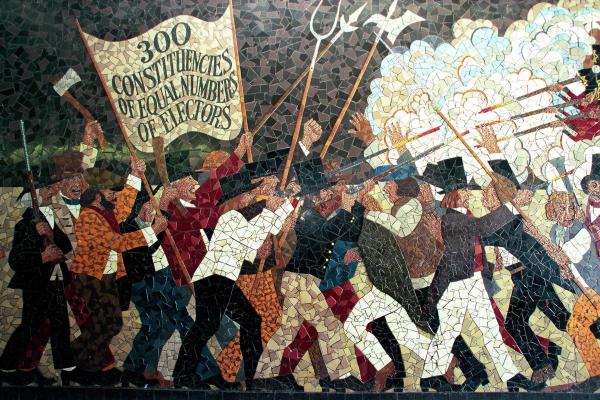
Mural in Newport, Wales, commemorating a 10,000 Chartist march in 1839
1838: Chartism: Taking its name from the People’s Charter, this working-class movement for political reform emerges in the industrial north of England, the Midlands and the Black Country. Using petitions, demonstrations, and sometimes rioting, Chartism is the first mass political movement in British history. It emphasizes the power of “the people” against the elite and political corruption. It dies out in 1857, when most of its demands (including universal suffrage for men and secret ballots to protect voters) have been met.
1845-52: Anti-Irish sentiment: The Great Famine kills 1m people in Ireland and prompts 600,000 to move to Britain, leading to significant Irish communities in cities like Liverpool and London. At the same time, anti-Irish sentiment worsens in England, often couched in racialized terms and portraying Irish migrants as inferior, and Anti-Catholic and anti-Irish organizations gain traction.
1901: Queen Victoria dies: When the Queen dies in 1901, the British Empire is the largest one the world had ever seen, covering 11m square miles and including a population of 372m subjects. This formidable expansion not only appears to confirm British people’s genius as a nation of engineers, settlers, soldiers, entrepreneurs, and missionaries, but also to demonstrate the superiority of the white Christian Westerner over other peoples. Indeed, justifications for imperialism are often predicated on pseudo-scientific theories about hierarchies between races such as those in Robert Knox’s best-selling book The Races of Men (1850), Arthur de Gobineau’s Essay of the Inequality of the Human Races (1853) and later books by social Darwinists. These ideas legitimize brutal colonial policies (e.g., Cecil Rhodes’s action in South Africa) and lay the groundwork for the racist and fascist ideologies of the 20th century.
1901: The British Brothers’ League: This xenophobic and antisemitic group formed by Captain William Stanley Shaw denounces the waves of immigration that have seen a rapid increase in the numbers of poor Eastern Europeans since 1880. The BBL marks the earliest expression of organized far-right activity in the UK and claims up to 45,000 members. The Aliens Act of 1905 results in part from its action.
1905: Aliens Act: Economic anxieties and fears of foreign influence lead to demands for restrictions on immigration. In particular, the 100,000 or so Eastern European Jews who fled pogroms in Russia and found refuge in Britain, notably in the East End of London, since the 1880s, have stirred antisemitic sentiment both in the working class and the upper echelons of British society. This contributes to the passage of the first major piece of immigration control legislation, the Aliens Act, which gives the Home Secretary responsibility for immigration and nationality matters, and prevents “undesirable aliens from entering the country.
1919: Race Riots: From January to August, race riots break in the UK’s major seaports, including Liverpool and Cardiff, when white workers target black and immigrant sailors and dockworkers who they accuse of stealing their jobs and depressing wages. 5 people are killed.
1919: The Aliens Restriction Act: The new law obliges foreign nationals to register with the police, enables their deportation, restricts where they can live and bars them from certain jobs, notably in the civil service. The act also makes it illegal for foreigners to promote industrial action.
1923: The British Fascisti: Created by Rotha Lintorn-Orman, an anti-communist activist, the British Fascisti are modelled on Benito Mussolini’s National Fascist Party, which marched to power in Italy the year before. A paramilitary group that organizes marches and trainings, and produces its own newspaper, the BF never have more than 5,000 members and dissolve in 1934, but they launch the careers of several prominent far right figures like Arnold Leese and William Brooke Joyce.
1929: The Imperial Fascist League: Founded by Arnold Leese, the Imperial Fascist League espouses antisemitism and the dominance of the “Aryan race,” includes a black-shirted paramilitary arm called the Fascists Legion, and its flag is a Union Jack with a swastika in the middle. The IFL suffers from the competition of the British Union of Fascists after 1932 and dissolves upon the outbreak of World War II.
1930: The English Mistery: Formed by the London barrister William John Sanderson, the English Mistery is an ultra-royalist reactionary fringe group that opposes social welfare and democracy and argues for the revival of the hereditary aristocracy. It dissolves in 1936.
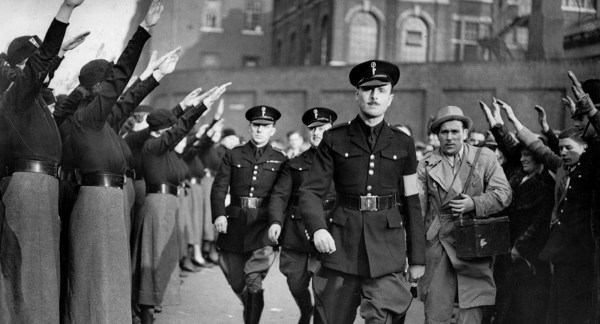
Oswald Mosley and BUF Blackshirts in 1936
1932: The British Union of Fascists: Founded by Oswald Mosley, a wealthy aristocrat and former Labour and Conservative MP, and inspired from Italian fascism, the British Union of Fascists instantly becomes the largest far-right movement in the UK. With the economic destruction of the Great Depression causing misery, Mosley uses populist rhetoric against the political establishment and scapegoats immigrants and Jews for economic woes. He advocates for a one-party, authoritarian system which would dissolve class antagonisms and lead to the triumph of the “new fascist man”. Membership reaches 40,000 and raises a paramilitary militia calling itself the Blackshirts. Nevertheless, the BUF fails to win a single parliamentary seat, owing as much to the first-past-the-post electoral system, which hinders the chances of smaller parties of getting MPs elected, as to British middle-class voters’ allergy to extremism. Indeed, the party becomes synonymous with violence in the public mind after a particularly violent response by BUF members to anti-fascist counter-protesters at a rally at Olympia, London, in 1934. Then on 4 October 1936, tens of thousands of locals turn out in London’s East End to block a BUF march targeting Jews; the event becomes known as the Battle of Cable Street and redoubles Mosley’s reputation as an inciter of hate. In 1936, he secretly marries Diana Mitford, of the famous Mitford family, in Germany, in the presence of Adolf Hitler and Joseph Goebbels. The same year, BUF support is further eroded by the Public Order Ac, a piece of legislation passed by Parliament to control extremist movements, which bans political uniforms and paramilitarism and requires police consent for political marches. In the run-up to WWII, the BUF advocates for a policy of neutrality toward Axis countries, which is disqualified by Germany and its allies’ aggression in September 1939. In May 1940, fearing a fifth column from within, the Churchill government interns without trial Britain’s leading fascists, including Mosley and his wife. They remain under custody until November 1943 and are then placed under house arrest until the end of the war. To most Britons, fascism has become synonymous with treason and anti-patriotism; following Churchill’s lead, Conservative leaders themselves avoid any association with the radical right in the decades that follow.
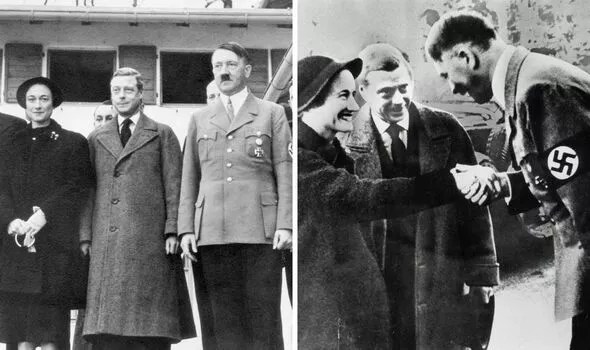
Wallis Simpson, with the Duke of York, shaking hands with Adolf Hitler on 22 October 1937
1936: Abdication of Edward VIII: On December 11, King Edward VIII abdicates less than a year after his coronation, because his decision to marry Wallis Simpson, an American divorcee, contravenes the rules of the Church of England. The year after, Edward, now Duke of Windsor, and Wallis, whom he has married, stir controversy by visiting Nazi Germany, meeting Adolf Hitler at his Berghof retreat in Bavaria, and giving Nazi salutes. Both the Duke and the Duchess are appeasers and share fascist and antisemitic opinions. During WWII, Edward’s fascist sympathies rouse such concerns among Allied intelligence services that the Churchill government forces him to move to the Bahamas to minimize the damage he might do in Europe.
1946: Lord Haw-Haw: A former member of the British Union of Fascists, and founder of the short-lived National Socialist League, William Brooke Joyce flees to Germany in August 1939 to avoid internment. Once there, he contributes to the Nazis’ propaganda broadcasts in English, notably the “Germany Calling” program, delivering his lines in an affected upper-class English accent that owes him to be derisively dubbed Lord Haw-Haw across Britain. In May 1945, he is captured by British forces, convicted of high treason, and hanged in January 1946, making him the last person executed for treason in the country’s history.
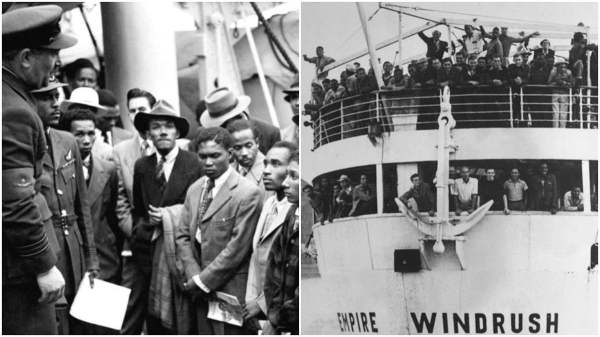
West-Indian passengers on the HM Empire Windrush arriving at the Port of Tilbury, east of London, on June 22, 1948
1948: Empire Windrush: On June 22, the arrival in London of hundreds of West Indian passengers on the HMT Empire Windrush symbolizes the broad wave of migrants from former colonies coming to the UK to rebuild the post-war economy. The same year, the British Nationality Act allows the subjects in the Empire and the Commonwealth to live and work in the UK without a visa. In the two decades that follow, migration from former colonies in South Asia (India and Pakistan, then Bangladesh) and East Africa (Kenya, Uganda) also increases as labor demands grew. As a backlash, far-right rhetoric shifts towards opposing immigration, particularly from the West Indies and South Asia.
1948: The Union Movement: Created by Oswald Mosley, the Union Movement is a racist far-right political party that opposes immigration and promotes European nationalism. Hoping to capitalize on British voters’ hostility to the soaring number of immigrants, the party nevertheless never takes off. The year after race riots in Notting Hill, in London, Mosley runs for the local seat in the 1959 general election, but receives only 8.1% of the vote. Mosley runs again in a different constituency the 1966 election, but gains just 4.6% of the vote, causing him to depart the political scene and the Union Movement to dissolve in 1973.
1954: The League of Empire Loyalists: Created by A.K. Chesterton, an anti-communist, an antisemite and a former leading figure in the British Union of Fascists, the League of Empire Loyalists is a pressure group aiming at stopping the dissolution of the British Empire and opposing immigration. Close to the Conservative party at first, it evolves towards the far right and joins the National Front in 1967.
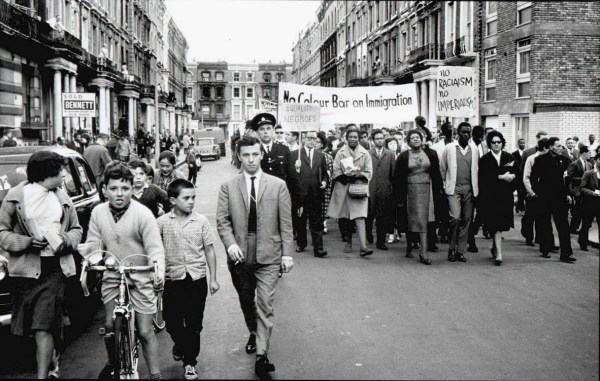
Notting Hill residents march against racism, London, 1965
1958: Notting Hill Race Riots: In late August, a mob of white people attack the house of West Indians in the area of Notting Hill, in London, which has a large Caribbean population. Brawling, vandalism and rioting ensue for almost two weeks. In response to the racist violence, the first Caribbean Carnival is organized in Notting Hill in January 1959, which becomes a popular annual street festival in 1966.
1960: The British National Party: The first iteration of the BNP is founded, following the amalgamation of several far-right, fascist organizations like the National Labour Party and the White Defence League. The party has very little success until its second iteration in 1982.
1962: Commonwealth Immigrants Act: In a context of increasing hostility to immigration in public opinion, Parliament passes stringent restrictions on the entry of Commonwealth citizens into the UK. Only people with work permits, notably for high-skilled jobs, are permitted entry. The new rules do not apply to Britain’s historic dominions (Australia, Canada, New Zealand, and South Africa) or Ireland.
1962: The National Socialist Movement’s Trafalgar Square rally: On the very day the Commonwealth Immigrants Act comes into effect, the National Socialist Movement, a neo-Nazi organization founded by Colin Jordan, gathers 3,000 people, including Oswald Mosley and John Tyndall, on Trafalgar Square. Themed “Free Britain from Jewish control,” the rally ends in a race riot.
1965: Race Relations Acts: In 1964, the Labour Party led by Harold Wilson wins the general election, whose campaign is marred by controversy about immigration and race, notably in the contested constituency of Smethwick (in the West Midlands), which the Tory candidate Peter Griffiths wins using xenophobic slogans like “If you want a nigger for a neighbour vote Labour.” One year later, the Labour majority passes the Race Relations Act, the first in a series of laws (1968, 1976, 2000, 2010) aiming at combating discrimination on the “grounds of colour, race, or ethnic or national origins” in public places, then in housing, employment, and services.
1967: The National Front: The constellation of far-right groups in Britain unite and form the National Front, a political party promoting white nationalism and opposing non-white immigration. At first, the movement is led by Chesterton, whose League of Empire Loyalists is the largest radical far-right group at the time, but it is quickly taken over by the fascist ideologue John Tyndall. As Britain goes through economic decline, the NF capitalizes on the scapegoating of immigrants and becomes known for its confrontational street marches and clashes with anti-fascist groups. It also contests elections, but with limited success. In the 1979 general election, the NF wins only 0.6% of the vote, while the Conservative Party led by Margaret Thatcher triumphs thanks to its nationalist stance and tough positions on immigration. In the 1980s, the NF all but disappears from the political landscape.
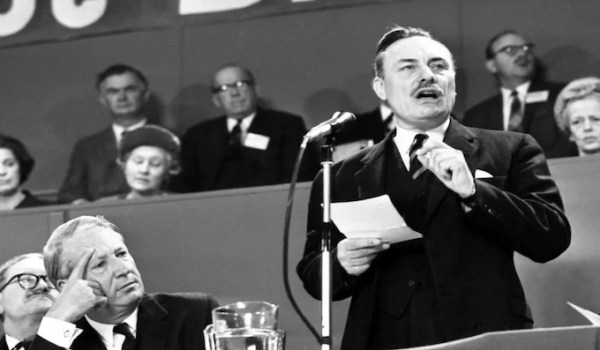
Enoch Powell, delivering his “Rivers of Blood” speech in Birmingham on April 20, 1968
1968: Enoch Powell’s Rivers of Blood speech: On April 20, Enoch Powell, a Conservative MP and former Minister, gives a televised speech before an audience of Tory activists in Birmingham. The speech is an assault on immigration from the Commonwealth, in which he quotes the fears of one constituent that “in 15 or 20 years’ time, the black man will have the whip hand over the white man,” and predicts civil war if mass immigration continues: “Like the Roman,” he warns, alluding to Virgil, “I seem to see ‘the River Tiber foaming with much blood’.” The speech causes outrage, and Powell is sacked from the Tories’ front bench by the party leader, Edward Heath. Opinion polls, however, show that a vast majority of British people agree with him. An eloquent speaker, a relentless denouncer of immigration, of the European Economic Community, and of the aloofness of the establishment, Powell becomes the most influential hard-right populist and one of the most popular politicians in the country in the next two decades. In 1974, he leaves the Conservative Party and joins the Ulster Unionist Party.
1969: The Troubles: The Troubles in Northern Ireland set a climate of violence in the province and the whole of the UK for close to four decades. Loyalist paramilitaries such as the Ulster Volunteer Force, the Ulster Defence Association, the Loyalist Volunteer Force and the Orange Volunteer Force are aligned with far-right politics, Christian fundamentalism and white supremacism, and are involved in numerous sectarian attacks and killings on Catholics but also racist attacks against non-whites and non-Christians.
1974: Keith Joseph’s ‘Our human stock is threatened’ speech: Keith Joseph, one of the leading voices on the right wing of the Conservative Party, makes a highly controversial speech in Edgbaston on 19 October 1974, in which he lambasts the “culture of poverty” holding Britain back and incites poor people to stop having children: “A high and rising proportion of children are being born to mothers least fitted to bring children into the world,” he says. “Some are of low intelligence, most of low educational attainment. (…) They are producing problem children. (…) The balance of our human stock is threatened.” The speech stirs outrage. Joseph is accused of rehashing social Darwinism and fascist eugenics and his rise within the Conservative party stops dead, leaving room for his friend Margaret Thatcher to challenge the centrist Edward Heath for the leadership of the party the following year.
1978: Viv Anderson becomes the first black footballer to play for England: In the 1970s, Black footballers, mostly born to Caribbean immigrants who settled in Britain from 1948, become an increasingly frequent presence in football. With racial tension high in many parts of Britain and the National Front peaking in popularity, many of these players are subjected to racial abuse, monkey chants and bananas pelted at them in stadiums. The most notable player to suffer this abuse is Viv Anderson, the Nottingham Forest fullback, who becomes England’s first black international player in 1978 and one of the faces of the country’s multicultural evolution. Football hooliganism – the “English disease,” as it comes to be dubbed – and incidents of racial abuse and violence in and around stadiums worsen in the 1980s. Most of the time, the so-called hooligan “firms” involved are composed of right-wing extremists.
1979: The Rise of Thatcherism: In the general election, Margaret Thatcher leads the Conservative party to a triumphant victory over Labour, using populist rhetoric to portray herself as a defender of “ordinary Britons” against the political establishment, trade unions and socialism. Preempting the far-right’s traditional ideas, she also appeals to nationalist values and advocates for tougher positions on immigration: as early as 1981, her government reforms the British Nationality Act of 1948, restricting access to citizenship and immigration from former colonies considerably.
1981: Race Riots in Black Inner Cities: In April and July, young Black men riot and clash with the police in Brixton (London), Toxteth (Liverpool) Handsworth (Birmingham), Chapeltown (Leeds) and Moss Side (Manchester). The tensions are caused by the perceived racist discrimination against ethnic minorities, police brutality, and deprivation in neighbourhoods where minorities are overrepresented.
1981: The Southall Skinhead Riot: In July, hundreds of skinheads attending an Oi! gig at a pub in Southall, a predominantly Asian suburb of London, begin to attack the neighboring Asian stores, and locals respond by burning the pub while the skinheads flee with help from the police. The event draws attention to the skinhead subculture which, though born in the late 60s under the influence of Jamaican music, is now associated to far-right politics and white power musi, and develops alongside far-right parties.
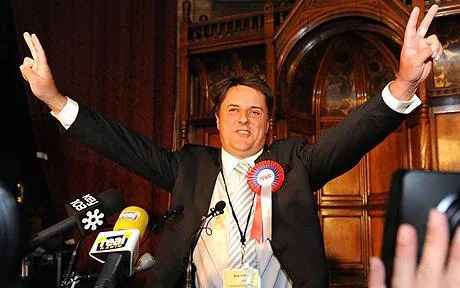
British National Party leader Nick Griffin celebrates his election as MEP in 2009
1982: The British National Party: Founded by John Tyndall and other dissidents from the National Front, the BNP is a new nationalist far-right party that at first struggles to have any electoral success until Nick Griffin becomes its leader in 1999. The party then increasingly follows a profitable strategy to use less radical rhetoric and appear more palatable to middle-class voters. The party wins no less than 44 local council seats in 2006 and two seats in the European Parliament in 2009, receiving almost 1m votes. The same year, Griffin is a guest at the BBC’s flagship news program, Question Time, giving his party a massive boost. This, however, is the high-water mark for the BNP: in the next decade, legal troubles, internal division regarding Griffin’s leadership as well as the rise of UKIP lead to the party’s collapse.
1990: The Cricket Test: In an interview with The Los Angeles Times in April, the Tory MP Norman Tebbit raises the question of where the loyalties of Britons of Asian descent lie, underlining that a majority do not support the English cricket team: this idea becomes known as the “cricket test” or “Tebbit test”.
1992: Combat 18: This neo-Nazi organization is formed by the BNP as a stewarding group to protect its events from anti-fascists. It attracts national attention for threats of violence against immigrants, members of ethnic minorities and leftists, and grows into an international structure whose members are suspected of being involved in several murders and terrorist actions. It is banned in numerous countries, including Canada and Germany.
1993: Murder of Stephen Lawrence: In April, Stephen Lawrence, an 18-year-old Black man, is stabbed to death in a racist attack in Eltham, southeast London. The police mishandling of the case leads to the MacPherson report (1999), which identifies institutional racism in the police force and calls for reforms.
1993: UKIP: The United Kingdom Independence Party is founded as a libertarian anti-EU pressure group by opponents of the Maastricht treaty. In 2006, Nigel Farage becomes leader of the party and it becomes a significant populist force. Farage presents himself as the champion of ordinary Britons against a distant, unaccountable elite in London and Brussels, and ambitions to turn UKIP into the main right-wing party in the UK, instead of the Conservative party. UKIP’s vote share reaches 13% in the 2012 local elections and it wins a triumphant 27% in the 2014 European election; later that same year, the party also gains its first two MPs when two Conservative defectors (Douglas Carswell and Mark Reckless) win by-elections. In 2015, UKIP wins 12.6% of the votes in the general election and its membership reaches 40,000. However, having achieved its primary goal with Brexit in June 2016, the party then collapses. Farage relinquishes leadership of the party, which becomes ridden with divisions and wins a paltry 1.8% in the 2017 general election, before losing all but 1 of its 145 local seats just a few weeks later. Having long wavered between being a patriotic party for the working people or a pro-business libertarian one, the party moves into far-right territory under the leadership of Gerard Batten between 2018 and 2019, resorting to Islamophobic rhetoric, seeking closer relations with extremists like Tommy Robinson and Paul Joseph Watson. The strategy is ineffective. Many longstanding members, including Farage leave, and UKIP is supplanted by Reform UK. Its shares of the votes in the 2019 and 2024 general elections are merely 0.1% and 0.01% respectively.
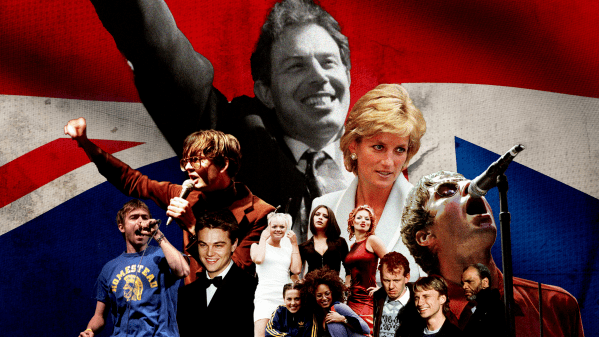
Tony Blair and Cool Britannia
1997: Cool Britannia: After 18 years in opposition, the Labour party – rebranded New Labour – wins the general election in a landslide, and its charismatic young leader, Tony Blair, becomes Prime Minister. The new government adapts Labour’s socialist agenda to the globalized market economy and embraces business-friendly policies, financial deregulation and open borders. It also champions liberal values and multiculturalism. A wave of cultural optimism and artistic creativity surges in the country, London becomes the coolest place on earth, and the expression Cool Britannia (a pun on the title of the patriotic song “Rule, Britannia!”) fashionably captures the euphoria of the period.
1999: Nail Bombs in London: In April, David Copeland, a neo-Nazi, plants a series of nail bombs in London, targeting the city’s black, Bengali and gay populations, killing 3 people and injuring 140 others. “My aim was political,” Copeland tells the police. “It was to cause a racial war in this country. There’d be a backlash from the ethnic minorities, then all the white people will go out and vote BNP.”
2000: David Irving found guilty of Holocaust Denial: In a much-publicized trial against American historian Deborah Lipstadt and her publisher Penguin Books, Britain’s High Court of Justice finds the controversial English author, self-proclaimed historian and fascist sympathizer David Irving guilty of misrepresenting historical evidence to promote Holocaust denial and whitewash Nazism.
2001: Race riots in Oldham, Leeds, Burnley, and Bradford: Between May and July, several ethnically-motivated riots erupt in cities in the north and west of England, between white and South Asian communities coexisting in poorer neighborhoods, and between right-wing extremists and anti-fascist groups.
2004: EU enlargement and inflow of Eastern Europeans: When 10 new member states join the European Union, the Blair government is one of the very few in Europe that choose to grant unfettered access to its territory and labour market to all their citizens. The UK’s booming economy and flexible labour market eventually attract some 1.5 million Eastern Europeans, including 800,000 Poles, between 2004 and 2009 – a far cry from the 15,000 the government initially expected. Local tensions, xenophobia and complaints about the unfair competition represented by the low-wage newcomers gradually increase across the country. Having learnt its lesson, the government then imposes restrictions on nationals of Romania and Bulgaria, which join the EU in 2007.
2005: 7/7 Terrorist Attacks: On 7 July, four Islamist suicide bombers strike London’s transport network, killing 52 people and injuring over 770 others. The fact that three of the bombers were British-born sons of Pakistani immigrants (the fourth was born in Jamaica), who were radicalized on British soil, stirs a national conversation about Britishness and citizenship. Hate crimes against Muslims spike too, as does the Islamophobic rhetoric emanating from the hard right.
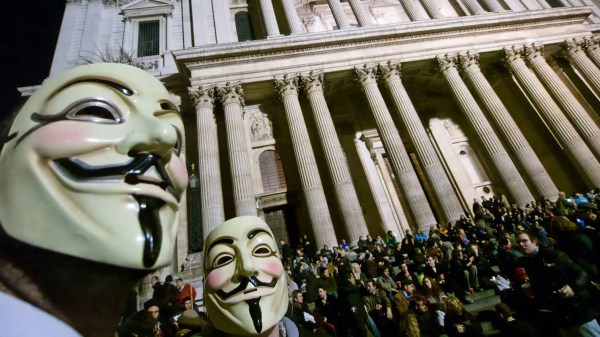
Occupy London protesters wearing Guy Fawkes masks outside St Paul’s Cathedral in 2011
2008: The Financial Meltdown: A decade-long financial bubble based on speculation on housing markets bursts, and several major American banks go bankrupt, precipitating the near collapse of the world’s financial system, including the City in the UK. The Labour government now led by Gordon Brown and the Bank of England jointly bail out financial institutions and businesses deemed “too big to fail” to prevent them from drawing the whole economy into a historic Depression. The burden on the taxpayer is enormous and the country enters several years of recession and austerity policies, which stirs outrage against the irresponsibility and cronyism of the elites, bankers, business leaders and politicians that have led the country into the wall. By 2010, the situation in Europe worsens with the Euro area crisis, which sparks off a wave of migration from southern European countries (Spain, Portugal, and Italy) to the UK. In 2011, an Occupy London anti-capitalist movement modelled on the American Occupy Wall Street grows in the capital.
2009: The English Defence League: The English Defence League is an Islamophobic street movement consisting primarily of young white working-class men. Tommy Robinson, cofounder and leader of the EDL until 2013, becomes the best-known and most influential far-right extremist in the UK in the late 2010s, especially after he is jailed for 13 months in May 2018 for contempt of court. In 2016, Robinson also participates to the launch of the short-lived Pegida UK party, modelled after the German Pegida nationalist and Islamophobic party. Numerous other small anti-Islam groups are created over the period, including Sharia Watch UK and For Britain, both created by Anne Marie Waters in 2014 and 2017 respectively.
2009: The Parliamentary Expenses Scandal: In May, The Daily Telegraph makes revelations about widespread misuse of allowances and expenses by members of the Houses of Commons and Lords, arousing anger among the public and resulting in numerous resignations, sackings, public apologies, and the sentencing to jail of half a dozen MPs and peers.
2010: Conservative Victory in the General Election: Led by David Cameron, the Conservative party wins the general election after 13 years in opposition but, lacking a majority in Parliament, must form a coalition government with the Liberal Democrats. While the country’s struggling economy might have been expected to overshadow all other topics, security and immigration take centre stage during the campaign. Prime Minister Gordon Brown stirs controversy after he is confronted live on television by a Labour voter in Rochdale over immigration from eastern Europe and then caught on microphone dismissing her as a mere “bigoted woman.” On his part, David Cameron pledges to reduce net migration to the UK from 250,000 a year to “the tens of thousands,” he accuses the Labour government’s embrace of multiculturalism of leading Britain on the path of cultural separatism and ghettoisation, and he guarantees that he will defend “British identity.” UKIP, in the meantime, wins almost 1m votes and the BNP 600,000.
2011: The Rotherham “grooming” scandal: In January, The Times makes revelations about the convictions to jail of 5 British-Pakistani men for sexual offences committed against teenage girls from care home backgrounds in the town of Rotherham, South Yorkshire. The reports show that the abuse has long been known by local authorities and overlooked by police forces, out of fear of substantiating racist prejudices and because of the profile of the girls involved. Official inquiries later show that an estimated 1,400 girls have been sexually abused by “grooming gangs” of Asian men in the town between 1997 and 2013. Between 2010 and 2024, prosecutions lead to more 60 jail sentences of up to 25 years, as well as numerous council and police resignations. In the early 2010s, similar cases of child sexual exploitation emerge in other towns in the Great Manchester area (Rochdale and Oldham), as well as Huddersfield and Oxford. All these cases appear to substantiate the hard right’s equation between immigration and crime, as well as its denunciation of the left’s political correctness. Controversy recurs when Elon Musk revives interest in these cases in early 2025 and accuses the Starmer government of being complicit in them.
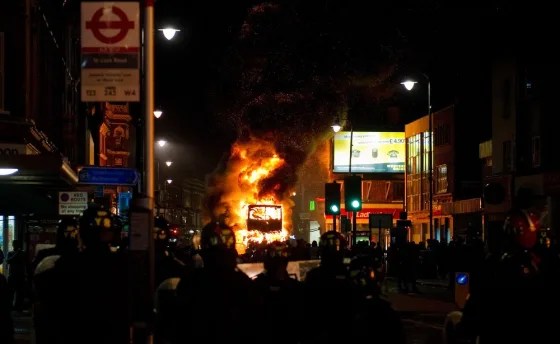
A double-decker on fire on the first night of the August riots in Tottenham, north London
2011: August Riots: In a context of economic stagnation and racial tension, riots erupt in London and several other English cities, which involve looting, arson, a mass deployment of police and the deaths of 5 people. Protests begin after Mark Duggan, a local Black man, is shot dead by the police in London, and evolve into rioting across the city, then Birmingham, Bristol, Coventry, Derby, Leicester, Liverpool, Manchester, and Nottingham, with social media playing an important role, both in terms of the mobilization of rioters and the spread of misinformation. The riots last one week: more than 3,000 arrests are made, and an estimated £200 million worth of property damage are incurred, making these riots the worst case of public unrest in Britain’s modern history.
2011: Britain First: founded by former members of the British National Party, Britain First a neo-fascist hate group that advocates the preservation of traditional British culture and becomes noted for its online activism and its publicity stunts targeting British Muslims, including so-called “Chrisian patrols,” “invasions” of mosques and other actions against elected Muslim officials, such as Sadiq Khan, the mayor of London since 2016. In June 2016, photographs emerge of a Britain First “activist training camp” in the Welsh mountains, where members are given courses in “knife defence.” The same month, Thomas Mair, a white supremacist, is heard screaming “Britain First” while stabbing to death the Labour MP Jo Cox, but the organization denies any association with the assassin.
2012: The Jimmy Savile scandal: In 2012, ITV reveals that Jimmy Savile, one of the country’s most popular television personalities, who died the year before, was guilty of countless sexual offences against children. In the years that follow, similar revelations are made about other celebrities and populations, and about coverups by the media and public authorities. These revelations feed suspicions against the corruption and impunity of the elites and substantiate populist narratives denouncing them.
2013: National Action: This violent neo-Nazi group is designated a terrorist organization by the British government in 2016, making it the first domestic far-right group to be proscribed in the UK since WWII. Nevertheless, NA continues to operate secretly, and members of ulterior white nationalist groups like Patriotic Alternative are suspected of having first trained there. In 2019, a former National Action member, Jack Renshaw, is sentenced to life behind bars for a plot to kill the Labour MP Rosie Cooper the year before.
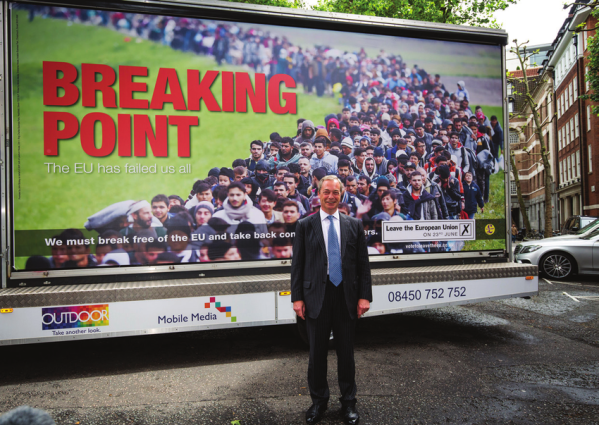
Nigel Farage standing in front of a UKIP poster during the Brexit campaign
2015: The Syrian Refugee Crisis: The violent crackdown of Bashar al-Assad’s government of public demonstrations in Syria sparks off a 13-year civil war, which kills up to 600,000 people, half of them civilians, and leaves more than 15m in need of human assistance. In 2015, the number of people seeking refuge soars, and the UK accepts 50,000 between 2015 and 2019. In the context of a slumping economy, pervasive hostility to immigration, and suspicions against Islamism, if not Islam, the arrival and costs of these refugees become polemical and are increasingly weaponized by the hard right.
2015: The Insurgent General Election: In May, the Conservatives win the general election, while Labour loses ground and the Liberal Democrats collapse. Meanwhile, three political insurgents – each of them populist in its own way, the SNP, UKIP and the Green Party – win unprecedented shares of the votes (4.7%, 12.6%, and 3.8% respectively, i.e., roughly 20% as a whole) in a country accustomed to a majoritarian two-party system. Yet, due to the first-past-the-post system, these results materialize into Parliament seats only for the SNP (which wins a landslide in Scotland and gets 56 seats), these results do not materialize into seats for either UKIP or the Greens, as they only get one MP each.
2015: Jeremy Corbyn becomes Leader of the Labour Party: Ed Miliband resigns after his underwhelming performance as Labour leader, and Jeremy Corbyn is elected in his place in September. He has been a rather isolated backbencher representing the west wing of the party since 1983, but his progressive populism is in tune with a majority of Labour members, and he receives the decisive support of Momentum, a grassroots digital-savvy left-wing organization. During the 2017 general election campaign, Corbyn describes the election as a battle of the establishment versus the people and promised to overturn “a rigged system” that favors the rich and powerful. Labour does better than expected and improves its results from 2015 but remains in opposition. The later years of Corbyn’s leadership are marred by controversy, regarding his tepid engagement against Brexit, the threats that he and his supporters make to deselect Labour MPs deemed too moderate, as well as his inability or unwillingness to address cases of antisemitism in the party. The December 2019 general election is a major disappointment for Labour, the party losing its fourth election in a row despite the unpopularity of the Conservatives in power. Corbyn is replaced in April 2020 by Keir Starmer, who opts for a more consensual middle-of-the-road strategy.
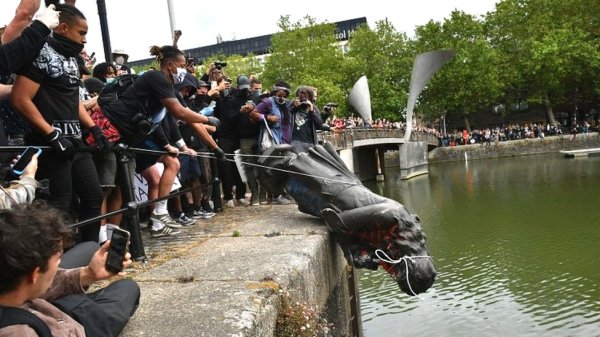
Protesters drop the statue of Edward Colston into Bristol Harbour on 7 June 2020
2016: Black Lives Matter and the anti-Woke Backlash: Black Lives Matter emerges as a movement in the UK in the summer of 2016, with protests against police brutality and racial discrimination. The movement gains traction after the murder of George Floyd in the US in May 2020. In June 2020, a march in Bristol leads protestors to topple the statue of Edward Colston, a local 18th century Tory politician and philanthropist who involved in the slave trade, and push it into the harbor. A few days later, the statue of Winston Churchill on Parliament Square in London is defaced, and the word “racist” is sprayed on it. There are also calls for the statue of Cecil Rhodes – the champion of the colonization of South Africa – at Oriel College, Oxford, to be removed. These actions are condemned by the Johnson government and stir a public backlash against “wokeism” and “cancel culture” in conservative and hard right media. Several BLM protests also end in urban violence, with clashes with the police and brawling against far-right counter-protesters. On June 13, thousands of far-right activists purporting to protect London’s monuments from anti-racism protesters rally around Parliament Square and at the Cenotaph memorial, wearing football shirts, making Nazi salutes, chanting ‘England, England’ and songs in support of Tommy Robinson. The protest ends in violent clashes against the police.
2016: Assassination of Jo Cox: On 16 June, just one week before the Brexit vote, the Labour MP Jo Cox is shot and stabbed to death while campaigning in Yorkshire by Thomas Mair, a 53-year-old white supremacist with connections to the National Front, the English Defence League and the US-based National Vanguard. During the attack, Mair is heard screaming “This is for Britain”, “Keep Britain Independent,” and “Britain first.” This is the first killing of a British MP since the assassination of Conservative MP Ian Gow by the Irish Republican Army in 1990.
2016: Brexit: In the referendum held on 23 June, 51.9% of the British electorate vote to leave the European Union. The result comes as a surprise, as opinions polls predicted a comfortable margin for the Remain vote. The results illustrate a geographic gap – with all regions of England and Wales except London voting in favor of Brexit, and Scotland and Northern Ireland voting against – as well as broad one between the political mainstream and the popular majority, with three-quarters of MPs voting for Remain and only two parties, with a combined total of nine MPs (UKIP with one and the Democratic Unionists with eight) supporting Brexit. The referendum – a rare process in British political history – was a campaign promise of David Cameron’s in 2015, after he had been spooked by UKIP’s success in local elections and importuned by UKIP-inclined MPs on his Conservative benches. The referendum campaign marked a high point for populist politics in the UK. Comprising UKIP and hard-right populist Conservatives (including Boris Johnson, Michael Gove and Rishi Sunak), the Brexiteers emphasized a nationalist, anti-elite rhetoric, arguing for “taking back control” of UK sovereignty. Two main organizations coordinated their campaign: Leave.EU, founded by the multi-millionaire businessman Richard Tice, and most of all Vote Leave, headed by the political strategist Dominic Cummings, who skillfully finetuned the campaign’s messaging online, while the historically Europhobic and anti-immigration tabloid press, notably The Sun and The Daily Mail, hammered their message home. On the other hand, Remainers were divided, tepid in their support to the EU (notably Jeremy Corbyn), and unable to counter the other side’s disinformation. In the end, exit polls show that the first reason for Brexit is casting off rules from Brussels; the second is regaining control of borders. Following the vote, there is a significant rise in xenophobic harassment and violence, particularly against Eastern Europeans and other immigrant communities. One notable case is the fatal assault by a gang of some 20 youths on Arkadiusz Jozwik on August 27, 2016, in Harlow, Essex, where there is a large community of Poles. In July 2016, David Cameron resigns and is replaced as Prime Minister by his former Home Secretary, Theresa May. In March 2017, the government triggers Article 50, which effectively launches the Brexit process and the two-year negotiation period with the EU. In 2019, Boris Johnson becomes Prime Minister, promising to “Get Brexit Done” and framing himself as a leader for the people against parliamentary obstructionists; his chief adviser is Dominic Cummings. The UK eventually leaves the EU on 31 January 2020, just one day after the Johnson government has managed to strike a trade deal.
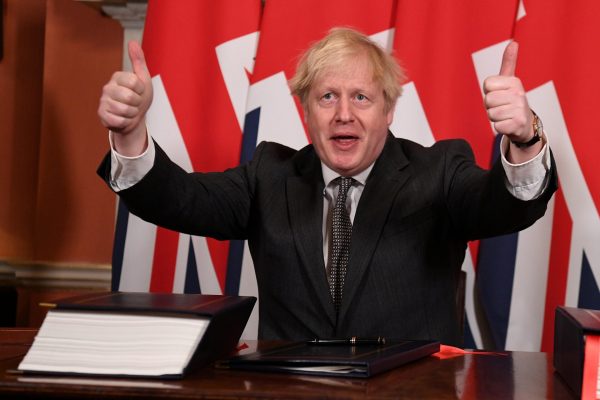
Prime Minister Johnson gives a thumbs up gesture after signing the Brexit trade deal with the EU on December 30, 2020
2017: Manchester Arena Bombing: On May 22, an Islamist suicide bomber kills 22 people and injures 1,000 others at the Manchester Arena, following a concert by American pop singer Ariana Grande. It is the deadliest act of terrorism and the first suicide bombing in the UK since 7/7.
2017: London Bridge Attack: On 3 June, 3 men affiliated to the Islamic State deliberately drive a van into pedestrians on London Bridge and then stab people in the area, killing 8 people and injuring 48 others.
2017: Finsbury Park Mosque Attack: In June, Darren Osbourne, a recently radicalized far-right extremist, drives a van into a crowd of Muslim worshippers outside a mosque in Finsbury Park, north London, killing 1 man and injuring 11 other people.
2018: The Brexit Party: Having left UKIP, whose drift toward the far right he disapproves of, Nigel Farage founds a new party, the Brexit Party, which is modelled on the populist, Eurosceptic Five Star Movement in Italy. The party campaigns for a no-deal Brexit, organizing “Leave Means Leave” rallies around the country. The 2019 European Parliament election, the last in the U.K.’s history, is a resounding success for the Brexit Party, which wins 30.5% of the votes and wins 29 MEP seats; the Lib Dems come second with 19.6% and win 16 seats (up from 1), while Labour wins only 13.6% and loses 10 of their 19 seats, and the Tories are demolished with just 8.8% of the votes and losing 14 of their 18 seats, precipitating Theresa May’s resignation as Prime Minister, and her replacement by Boris Johnson. The Brexit Party has trouble rebounding from its European election triump and is taken by surprise by the snap election called by Boris Johnson in December 2019, winning just 2.6% of the votes and no seats.
2018: Unity News Network: Founded by a former Tory and Labour councillor in Scotland, David Clews, the Unity News Network (UNN) is a far-right conspiracy theory website that is one of the most prolific spreaders of online misinformation and hate speech in the UK. It becomes instantly popular by supporting the protest movement to free the anti-Muslim extremist Tommy Robinson during his spell behind bars the same year and gains further traction by spreading conspiratorial content relating to the COVID-19 pandemic in 2020. David Clews is increasingly connected to the UK’s fascist fringe, and his website describes the West as being in the grip of “cultural Marxist degeneracy” and promotes the “white genocide” conspiracy theory.
2019: Patriotic Alternative: Created by the neo-Nazi Mark Collett, the former director of publicity of the BNP, this fascist hate group grows especially active during the COVID crisis and against Black Lives Matter events and, thanks in large part to digital-savvy propaganda and recruitment strategies on social media, becomes the largest far-right white supremacist movement in the UK.
2019: Teenage neo-Nazis jailed over terror offences: In June, Oskar Dunn-Koczorowski, 18, and Michal Szewczuk, 19, both of them members of British neo-Nazi group Sonnenkrieg Division, are found guilty of making death threats against Prince Harry for marrying a woman of mixed race. They are sentenced to an 18-month detention and training order and to four years in jail respectively. When they arrested them, detectives found them in possession of bomb-making instructions, documents describing how to conduct Islamist terror attacks and a “white resistance” manual.
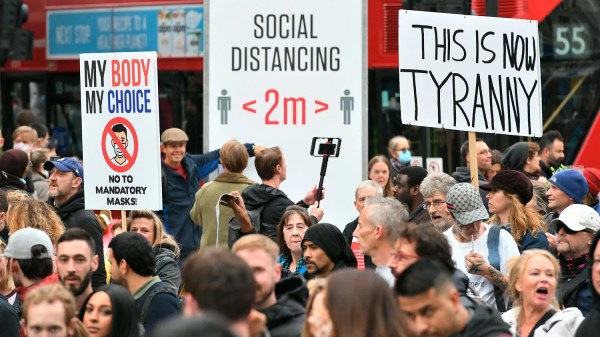
Anti-lockdown and anti-facemask protesters in London in October 2020.
2020: The Covid crisis: After a failed attempt to favour herd immunity, the rapid spread of the COVID-19 virus forces the Johnson government to impose national lockdowns on March 23 and then again on November 5, as well as other public health restrictions, like the mandatory use of face masks in public spaces. During the epidemic, opposition to these measures as well as vaccine skepticism gain traction and stir protests. Conspiracists, far-right but also far-left activists, as well as online influencers (like the media celebrity Russell Brand or the self-styled journalist platform Resistance GB) attempt to capitalize on this covid anxiety, but succeed only marginally compared to the U.S.
2020: The Reclaim Party: Founded by the actor and media personality Laurence Fox, this hard right populist party defends a sovereignist, anti-woke, and anti-gender platform. Fox himself runs for mayor of London in 2021, with the support of Reform UK, but finishes only in sixth place with 2% of the vote. In 2024, Reclaim did not run any candidate but endorsed Reform UK.
2021: Reform UK: Brexit being done, the UK having effectively left the EU, the Brexit Party is renamed Reform UK and campaigns to reduce immigration, support low taxation and oppose net zero emissions. Farage’s explicit strategy is to supplant the Conservative party and, as he previously did with UKIP, he is careful not to let his new party veer to the far-right so as not to antagonize average voters. The party struggles to organize at first, even to find valid candidates in elections, but it starts modernizing rapidly in 2024, under the influence Zia Yusuf, a millionaire entrepreneur who becomes the party’s chairman.
2021: GB News: Launched in June by Angelos Frangopoulos, a former editor of The Sunday Times, this cable news channel intends to challenge the alleged left-to-centrist bias of British broadcasters and to emulate the success of Fox News in the US. With its own unabashed right-wing bias, it however repeatedly violates the rules of impartiality and decency set by Ofcom, the regulatory authority for the British media, and stirs controversy with its hosts and guests’ provocative stances on immigration, race, women, LGBT rights, immigrants, vaccines, the war in Ukraine, etc.
2021: Partygate: In November, The Daily Mirror reports of parties being organized by staff at 10 Downing Street, the Prime Minister’s office and home during the 2020 Christmas season, when public health restrictions prohibited gatherings because of COVID. The government denies the allegations, but further revelations come out in the media about at least 12 such illegal gatherings during lockdowns, causing the police to issue 126 penalties to 83 individuals in government, including Boris Johnson himself and Rishi Sunak, then Chancellor the Exchequer. An inquiry is also undertaken by civil servant Sue Gray, whose report is released in May 2022 and damning for the government. The political scandal contributes to Boris Johnson’s downfall as Prime Minister and his resignation as an MP in June 2022. He is replaced briefly by Liz Truss, his Foreign Secretary, and then by Rishi Sunak.
2022: Dover Firebomb Attack: On 30 October, a firebomb attack is perpetrated against a Border Force center for processing migrants in Dover, injuring 2 people. The suspect, 66-year-old Andrew Leak kills himself immediately after. Investigations show that he had a history of sharing far-right, racist and COVID conspiracist material online.
2023: Online Safety Act: Passed in October by Parliament, this piece of legislation regulates online speech and media, giving the government the power to designate and ban “harmful” material, but also compelling social media platforms but also encrypted messaging services to proactively suppress it. The contents in question include child pornography, but also hate speech, death threats, revenge porn, messages encouraging people to commit suicide, post advertising people-smuggling. All the big Tech companies oppose the plan, as do some free speech advocates.
2023: Anti-Asylum Seeker Rioting: In February, some 500 far-right anti-migrant demonstrators protest against the housing of asylum seekers at a hotel in Knowsley, a Merseyside town near Liverpool. Spurred on by online misinformation about sexual misconduct attributed to the asylum seekers, the protest descends into acts of violence, criminal damage and clashes with the police, leading to 15 arrests.
2024: Attempted assassination of Eritrean asylum seeker: On 2 April, Callum Parslow, a 31-year-old neo-Nazi is arrested after stabbing an Eritrean asylum seeker in the chest in Worcester. Prior to his act, Parslow wrote a white supremacist manifesto railing against Jews, Marxists, “globalists,” “queer indoctrination” and the “demonising [of] masculinity, meat consumption, Christianity, white people and all European culture”. In January 2025, he is jailed for life.
2024: General election betting scandal: In June, The Guardian reveals that Craig Williams, a Conservative MP candidate and close adviser to Prime Minister Rishi Sunak, placed a £100 bet that the next general election would be in July three days before Sunak announced the election to the public. In the following days, further revelations of political betting are made involving police officers and MPs.
2024: General election: After 14 years in opposition, Labour wins the general election with a majority of 411 seats in Parliament, though just 33.7% of the votes. The result nevertheless appears to vindicate Keir Starmer’s non-populist strategy. The Conservative falls down to 23.7%; Rishi Sunak resigns as Conservative leader and is replaced by Kemi Badenoch in November. Reform UK comes third in the election, surpassing the Liberal Democrats, with 14.3%. Some opinions polls predicted Reform UK would surpass the Tories, but controversies stirred by several candidates in the last days of the campaign appear to alienate voters. Due to the first-past-the-post system, Reform UK ends up with just 5 MPs, including its leader, Nigel Farage, and its deputy leader, the multi-millionaire businessman and founder of Leave.EU, Richard Tice.
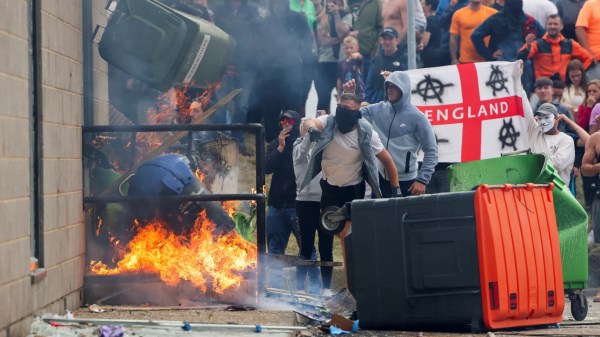
Far-right rioters attack asylum seeker hotel in Rotherham on August 4, 2024
2024: Far-right riots: Between July 30 and August 5, racist riots erupt across numerous cities and towns in England following the stabbing to death of three girls (and the injuring of 8 other children and 2 adults) during a Taylor Swift dance class in the northwestern city of Southport. Right-wing networks in the U.K., the U.S. and Russia spread false rumors about the attacker being a Muslim asylum seeker recently arrived on Britain’s shores on a small boat across the English Channel (the perpetrator, Axel Rudakubana, 18 years old, is in fact a British citizen and a Christian, born in Wales to Rwandan parents, suffering from deep mental problems and eventually sentenced to 52 years in jail). Rioters attack a local mosque, smash up and loot local businesses, and the fury extends to other cities, with cases of racist attacks, arson and looting occurring in Burnley, Liverpool, Middlesborough, Rotherham, and Sunderland, making this the worst disorder in the UK since the 2011 riots. Newly-elected Labour Prime Minister Keir Starmer calls the riots “far-right thuggery,” condemns the Islamophobia behind attacks on Muslims and denounces the spread of disinformation online designed to stoke the unrest. An unprecedented 6,000 riot-trained officers are dispatched in the towns and cities concerned. More than 1,500 rioters are arrested and 1,000 are charged.
2024: Elon Musk Pledges his Support to Reform UK: Having actively fed disinformation on his online platform X about the summer riots in England and then accusing Keir Starmer of being complicit to the Rotherham “grooming” scandal, Elon Musk pledges his support to Reform UK and floats the idea of offering the party up to $100 million after meeting Nigel Farage at Donald Trump’s estate at Mar-a-Lago, Florida. Musk, who is the richest man in the world and who has been instrumental in Trump’s victory in the 2024 U.S. presidential election, likewise pledges support to the German far-right party AFD. In January 2025, however withdraws his support from Farage and calls for him to step down, blaming him for not being supportive enough of Tommy Robinson and for sticking to a right-wing populist strategy rather than openly veering to the far-right.
2025: Liz Truss participates to CPAC: In February, the former British prime minister speaks at the Conservative Political Action Conference, a right-wing conference held annually in Maryland, USA and attended by hard-right leaders from around the world. The Conservative politician, who lost her parliamentary seat in the 2024 general election and has attempted to position herself as the face of populist nationalism in her country, says that Britain is “failing,” betrayed by the “deep state,” unelected judges and bureaucrats, and needs a MAGA movement to save it. In May the same year, Truss participates to a similar event in Hungary, in which she criticizes the absence of free speech in the UK, denounces the action of a “well-funded… globalist network,” voices her support for Marine Le Pen and the German far-right party AFD, and calls for “a Trump-style revolution across the European continent”.
2025: Reform UK wins the local elections: In the May 2025 local elections, Reform UK wins the most seats (677, against 370 for the Lib Dems, 317 for the Tories, and 98 for Labour) and takes control of 10 local authorities (up from 0). The governing Labour Party and opposition Conservative Party suffer historic losses, receiving just 14% and 10% of the votes respectively. Additionally, Reform UK wins a very close by-election in Runcorn and Helsby, in north-west England, after the local MP, Mike Amesbury, elected for Labour in 2024, resigned, having been convicted of assault after a drunken street brawl. The victor, Sarah Joanne Pochin, is a former Tory councillor, which stirs concerns within the Conservative party about more and more defectors changing parties: indeed, between early 2024 and September 2025, no less than 12 active or former Tory MPs, including several former Cabinet members, defect to Reform UK.
2025: Three neo-Nazis convicted of terrorism: On May 14, three far-right extremists who amassed an arsenal of 200 weapons, including a 3D gun built from instructions found on the web, and discussed targeting mosques and synagogues in England were convicted of planning a terrorist attack. The three men were Brogan Stewart, 25, from West Yorkshire, Christopher Ringrose, 34, from Cannock, and Marco Pitzettu, 25, from Derby, and who formed a virtual cell and had never met. They were sentenced to 11, 10 and 8 years of jail respectively.
2025: The Ballymena riots: On June 9, violent protests erupt in Northern Ireland, after two Romanian-speaking teenagers are charged with sexually assaulting a teenage girl in in Ballymena, a town north of Belfast. The violence spreads to other towns, targeting ethnic minorities and the police, especially in areas under loyalist influence. Two weeks of disorder ensue, causing 107 police officers to be injured and 56 rioters to be arrested. Numerous violent incidents of xenophobic violence are reported in Northern Ireland in the following months.
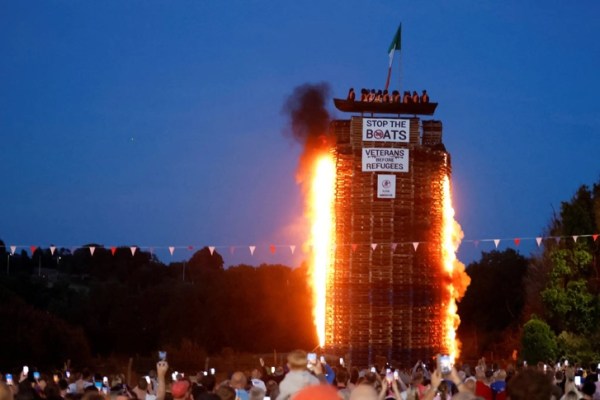
The bonfire in Moygashel
2025: The Moygashel bonfire: Every month of July, parades and bonfires are organized by loyalists across Northern Ireland, as part of the annual celebration of the victory of King William III’s Protestant forces over Catholics at the battle of the Boyne in 1690. On 11 July, a loyalist bonfire in the County Tyrone village of Moygashel features effigies of refugees, dark-skinned, life-size mannequins with lifejackets, sitting in a boat and placards beneath the boat stating “stop the boats” and “veterans before refugees.” News of the bonfire stir controversy in all of the UK and the Republic Ireland, and the police investigates the event as a hate crime.
2025: Operation Raise the Colours: In August, an online campaign group is created in Birmingham to encourage people to tie flags of the Union Jack and Saint George’s Cross to lampposts and paint them onto mini roundabouts. In the weeks that follow, the movement grows to the whole of the Birmingham area, Worcestershire, Yorkshire and other parts of England. The movement however stirs controversy, being pushed by hard right political leaders and movements, and being increasingly perceived as a nationalist anti-immigration publicity stunt.
2025: Anti-migrant protests in Epping: In July, a series of protests are held outside the Bell Hotel in Epping, Essex, one of the 200 or so hotels across the country which house asylum-seekers, after a 38-year-old asylum seeker from Ethiopia was charged with sexual offences against a teenager, just 8 days after his arrival by boat in England. (After having been involuntarily set free from prison, he is eventually deported to Ethiopia on October 29.) In what threatens to become a repeat of the summer 2024 riots, the initially peaceful protests grow violent, with prominent members of the far right, including activists from UKIP, the BNP, Britain First, Patriotic Alternative and neo-Nazi group Blood & Honour involved. Several weeks later, the Epping Forest district council calls on the Home Office to close the Bell hotel to asylum seeker due to the disruption. On August 19, a high court grants the council its wish. The Labour government later announces that it intends to end the use of hotels to house the 30,000 or so asylum seekers in the country by 2029.
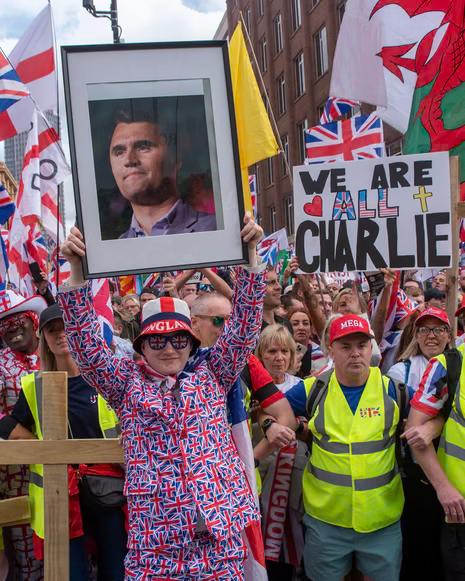
The United the Kingdom rally
2025: The Unite the Kingdom rally in London: On September 13, some 150,000 people join the Unite the Kingdom rally organized in London by Tommy Robinson. Taking place just three days after the assassination of Charlie Kirk, the Christian nationalist American activist, the theme of the march is ostensibly the defence of free speech, but the rallying cries and placards emphasize nationalist, anti-immigration and anti-establishment messages, making the event the largest far right rally in British history.

