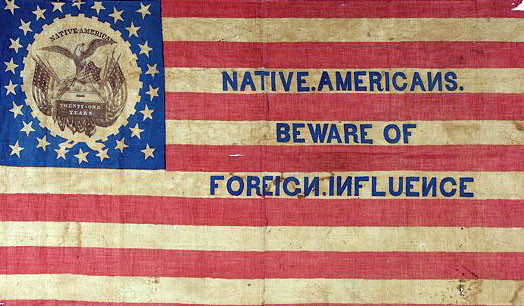
1844 flag of the Know Nothings.
1829-37: Andrew Jackson’s populist presidency: The first American president not belonging to the Massachusetts or Virginia elites but born in a humble South Carolina family, Andrew Jackson is elected by appealing to an emerging popular coalition that later forms the base of the Democratic party. Nicknamed the “People’s President,” his time in office is characterized by protectionist economic policies and opposition to federal institutions like the Second Bank of the United States (the country’s central bank at the time) and the U.S. Supreme Court.
1844-60: The Know Nothings: Growing out of a Protestant secret society called the Order of the Star-Spangled Banner, the Know Nothings are named so on account of their strict code of secrecy and are the earliest example of a far-right, nativist, anti-Catholic and anti-immigrant organization in U.S. history. In 1854, the Know Nothings officially form the American Party and win the Massachusetts legislature, but they lose support when they leaders refused to take any official position regarding slavery. By 1860, most party members jump ship to join the Republicans.
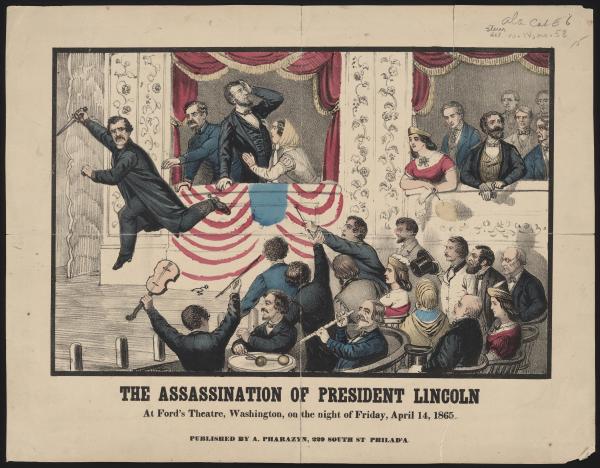
Lithograph by Alfred Pharazyn, 1865.
1865: Lincoln is assassinated: On April 14, just six days after the passing of Amendment XIII, which abolished slavery in the U.S., Republican President Abraham Lincoln is assassinated by John Wilkes Booth, a white supremacist Southerner and an actor hoping to revive the Confederate cause. Booth is said to have shouted “Sic semper tyrannis,” a Latin phrase meaning “thus always to tyrants,” which is also the state motto of Virginia.
1865: The Ku Klux Klan: Founded by defeated officers of the Confederate Army in Tennessee on December 24, the Ku Klux Klan is the oldest American underground white supremacist organization. During the Reconstruction era, independent chapels mushroom across the South, fighting against the abolition of slavery, harassing freedmen and Republicans, and attempting to “purify” Southern culture (notably from Catholic, Jewish, and later left-wing influences) through political intimidation, rioting and lynchings. The history of the Klan has three main phases: the First Klan (1865-1872), the Second Klan (1915-1944), the organization’s heyday, when its racist but also its anti-labor doctrine resonates with up to 6m Americans, before division and scandal causes it to fade away, and the Third Klan (since 1946), which sees new chapters form against civil rights and desegregation in the South.
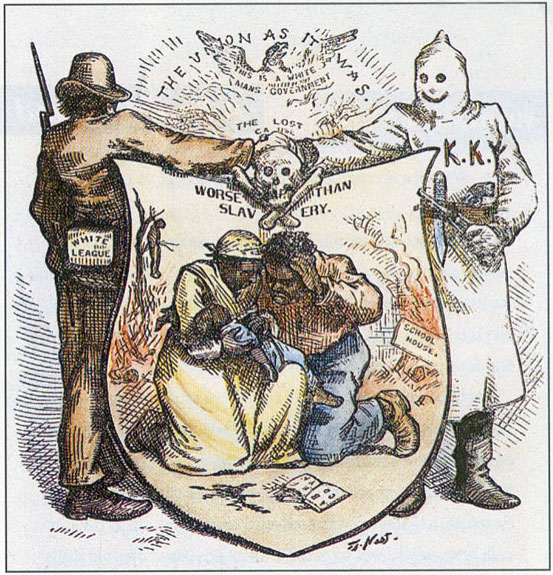
White League and Ku Klux Klan alliance in an illustration by Thomas Nast published in Harper’s Weekly, October 24, 1874.
1874-6: The White League: Created in Louisiana, this white supremacist paramilitary group launches a campaign of intimidation and violence against Blacks and Republicans in the state, which culminates in the attempt to overthrow the Republican Governor in New Orleans in September 1874.
1874-89: The Greenback Party: In the second half of the 19th century, people in rural areas are increasingly angry at the politicians, bankers and business elites in big cities in the northeast who are accused of producing nothing yet extorting fortunes from farmers through high credits on loans. Agrarian political movements start channeling the mounting anger in western regions and the Great Plains. One of the earliest examples of this “prairie populism” is the Greenback Party, which runs candidates in three presidential elections between 1876 and 1884, before fading into obscurity, with its basic program reborn under the aegis of the People’s Party.
1875: The Red Shirts: White supremacist paramilitary groups composed mostly of poor whites wearing red shirts start acting as the military arm of the Democratic Party in Mississippi and the Carolinas, before fading away in the early 1900s.
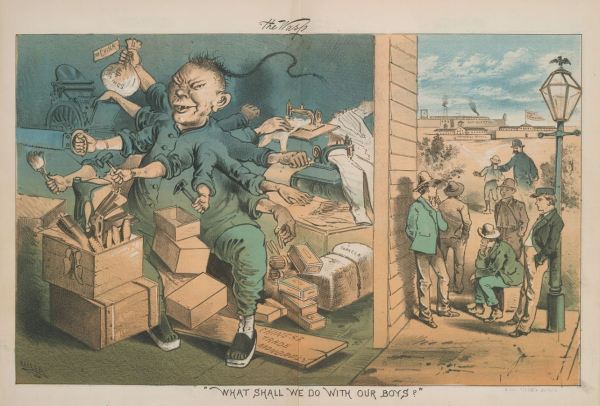
Anti-Chinese caricature by George Frederick Keller published in The Wasp on March 3, 1882.
1882: The Chinese Exclusion Act: As waves of newcomers increase (2.7m in the 1870s, 5.2m in the 1880s), so does anti-immigrant xenophobia, notably against the Chinese. Labor leaders like Denis Kearney make a career out of attacking the “Chinaman”, outbreaks of violence against them spread throughout the West, and Congress eventually suspends immigration from China for 10 years.
1892 -1909: The Populist Party: The People’s Party – or Populist Party – defends small businesses and farmers against corporate interests. It supports direct election of Senators, state control of the railroads, collective bargaining, a graduated income tax, and a shorter workweek. In 1892, the Populist candidate for President James B. Weaver wins 8.5% of the popular vote and carries four states. But victories for the party are isolated to the west and the Deep South and it decides to support the candidate of the Democratic Party, William Jennings Bryan, in 1896. Bryan sweeps the South and Midwest but still loses to the Republican candidate, William McKinley. Populism gradually loses momentum and evolves towards nativism. By 1908, the party is finished, but many of its ideas about social justice are taken up by Progressive politicians like Theodore Roosevelt and Woodrow Wilson
1913: The Anti-Defamation League (ADL): created immediately after the lynching of Leo Franck in Atlanta, Georgia, this New York City-based organization becomes the biggest national one fighting antisemitism, bigotry, and discrimination.
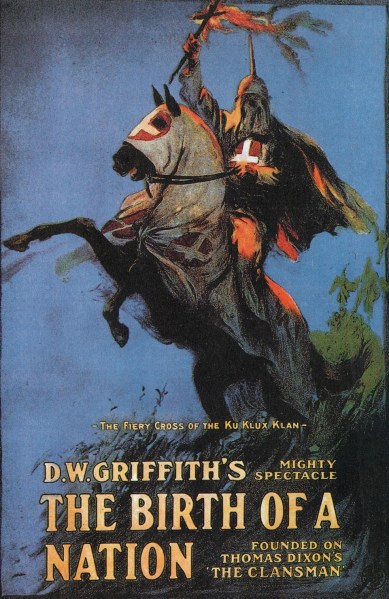
Theatrical release poster for The Birth of the Nation, 1915.
1915: The Birth of a Nation: AAdapted from Thomas Dixon Jr’s 1905 novel The Clansman,D.W. Griffith’s controversial film The Birth of a Nation is released, presenting a view of the Civil War and Reconstruction biased in favor of the Confederacy, as well as a heroic portrayal of the First Klan.
1921: The Tulsa race massacre: On May 31, mobs of white residents of Tulsa, Oklahoma, attack Black residents and destroy homes and businesses in a neighborhood known as Black Wall Street, killing tens of people and injuring hundreds.
1925: The Scopes Monkey Trial: In a high-profile trial in Tennessee, a high school teacher, John T. Scopes, is charged with violating a state law banning the teaching of human evolution in local schools. Scopes is found guilty by the court, but he is acquitted on a technicality and in the court of public opinion. The trial publicizes the fundamentalist/modernist controversy which sets fundamentalists, who say the word of God takes priority over all human knowledge, against modernists, who question the literal truth of the Bible and say evolution can be consistent with religion.
1925: The Ku Klux Klan march on Washington: In a stunning show of force, 30,000 members of the KKK parade in Washington, D.C. on August 8. There are now an estimated 4 to 6 million Klan members in the country, mostly in the South and the Midwest.
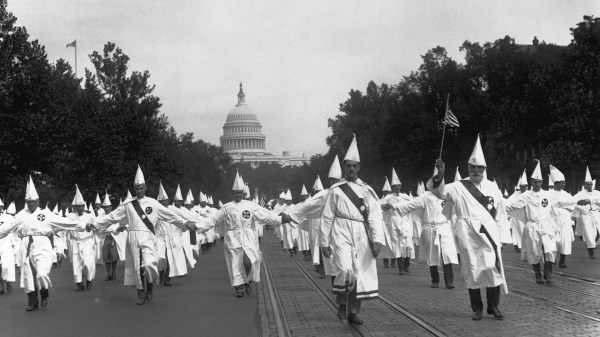
Ku Klux Klan members in white robes parade down Pennsylvania Avenue in Washington on August 8, 1925.
1935: Huey Long is assassinated: A left-wing populist member of the Democratic Party, Huey Long becomes Governor of Louisiana, then U.S. Senator, and considers running for President, before being assassinated in 1935. A highly controversial figure, Long is celebrated by some as a champion of the poor and denounced by others as a corrupt fascist demagogue.
1935: Father Coughlin co-creates the Union Party: A Catholic priest based in Michigan, Charles Coughlin, the “Radio Priest,” has a weekly radio show followed by 30m people, making him an early example of a media populist figure and televangelist. A supporter of Franklin D. Roosevelt at first, he then accuses him of being too lenient on capitalists. In 1935, he co-creates a short-lived populist party, the Union Party. In 1936, he creates the newspaper “Social Justice,” which becomes obsessively anticommunist and antisemitic and starts praising Fascist Italy and Nazi Germany. After the U.S.’s entry into the war, Coughlin’s broadcasts are taken off the air, and the Catholic archbishop of Detroit forces him to cease his political activities.
1936: The German American Bund: Founded in 1936, this organization gathers American citizens of German descent, and its main goal is to promote a favorable view of Nazi Germany in the U.S. The high point of its activities is a rally at Madison Square Garden in NYC on February 20, 1939, with some 20,000 people in attendance. The same year, however, the Bund’s leader, Fritz Julius Kuhn, is convicted of embezzlement and deported to Germany, and after the U.S. enters the war, the organization is outlawed when it encourages people not to submit to the military draft.
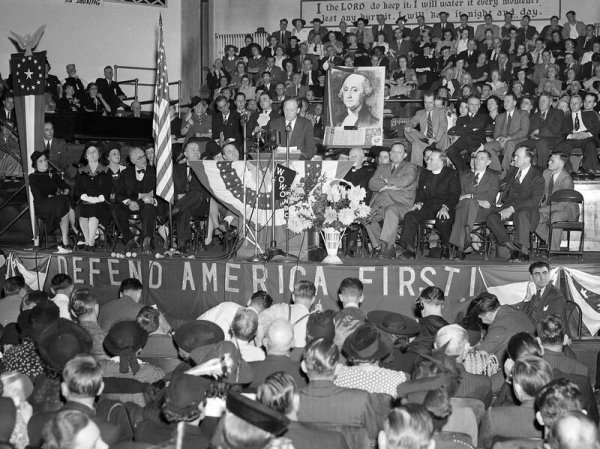
4,000 people gather to hear Charles Lindbergh address an America First Committee rally in Fort Wayne, Indiana, in 1940.
1940: The America First Committee: Created in September 1940, this isolationist pressure group surpasses 800,000 members at its peak. Some of its high-profile members, including the carmaker Henry Ford and the aviator Charles Lindbergh, use an increasingly strident anti-Semitic and pro-fascist rhetoric in their speeches, accusing decadent Europeans and well-connected Jews of conspiring to drag the U.S. into the war. In a famous speech he gives in September 1941, Lindbergh thus warns that “the greatest danger to this country” lies in Jews’ “large ownership and influence in our motion pictures, our press, our radio and our government.” The group dissolves four days after the attack on Pearl Harbor.
1947-60: McCarthyism: Right-wing populism peaks during the Second Red Scare (1947-1960). Although the U.S. has emerged from World War II as the world’s most powerful country economically and militarily, the U.S.S.R. has also been strengthened, spreading in Eastern Europe and Southeast Asia, and there are rising concerns about communist espionage and interference in the U.S. In 1947, the House Un-American Activities Committee launches a vast investigation into alleged communist propaganda and influence in the Hollywood industry. In 1950, Joseph McCarthy, a Republican Senator from Wisconsin, then claims that there are 200 communist spies in the State Department. A witch-hunt begins. Blacklists are established in many industries restricting the employment of suspected nonconformists, and libraries are pressured to remove books and periodicals that are considered suspect. The excesses of the witch-hunters, notably those of demagogues like McCarthy, who goes so far as to accuse the Army of being infiltrated with communists during Senate hearings in 1954, eventually lead to their own demise.
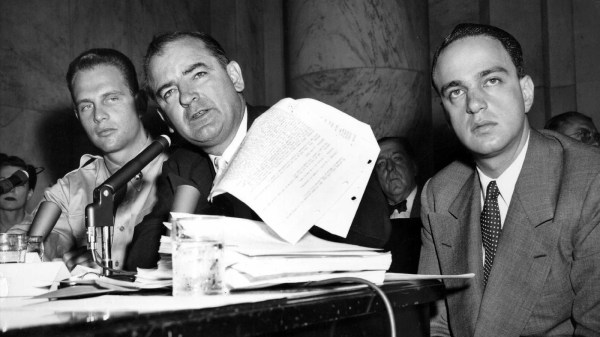
Joseph McCarthy during a Senate hearing in 1954; on his left is his chief counsel, Roy Cohn, who will later be Donald Trump’s lawyer.
1948: Strom Thurmond runs for President: Strom Thurmond, the Democratic Governor of South Carolina, runs for president against Harry Truman, the official candidate of his party, who is favorable to civil rights. Thurmond runs as leader of the Dixiecrat Party, a short-lived segregationist organization, declaring, “There’s not enough troops in the Army to force the Southern people to break down segregation and admit the Negro race into our theaters, into our swimming pools, into our homes and into our churches.” He receives over a million votes, winning four southern states.
1955: William F. Buckley Jr. founds National Review: Born in 1920 and educated at Yale, Buckley becomes one of the most influential public intellectuals in the U.S. in the post WW2 era and the most influential voice in the American conservative movement, notably as founder and editor of National Review. Buckley is a proponent of fusionism, i.e., the alliance of social conservatives, economic libertarians, anti-communists and advocates of a hawkish foreign policy within the Republican Party, and makes it his life’s work to prevent the party from veering to the far-right.
1958: The John Birch Society: Founded in 1958 by the wealthy candy-maker Robert W. Welch Jr, the John Birch Society is the most influential far-right anti-communist advocacy group, espousing the conspiracism of its founder, who claims that a “furtive conspiratorial cabal of internationalists, greedy bankers, and corrupt politicians” want America to be run by a socialist United Nations and that even Republican President Dwight Eisenhower is “a conscious, dedicated” communist agent. The influence of the Birchers grows in the 1960s, and Barry Goldwater and Richard Nixon become the Republican presidential nominees in 1964 and 1968 in part thanks to their efforts. That influence declines, however, in the 1980s.
1963: The Bombing of 16th Street Baptist Church: On September 15, the Ku Klux Klan detonates a bomb in a church with a predominantly Black congregation in Birmingham, Alabama, killing 4 young girls. As a whole, the KKK is linked to upward of 50 explosions targeting African Americans between 1947 and 1965 in the city, earning it the grim nickname “Bombingham”.
1964: The Civil Rights Act: This landmark civil rights and labor law outlaws discrimination based on race, color, religion, sex, and national origin in the U.S.The legislation is proposed by President John F. Kennedy and then pushed forward by his Democratic successor, Lyndon B. Johnson. The bill however causes the Democratic Party to lose the segregationist South’s support, and a massive number of Southern Democratic politicians like Strom Thurmond, U.S. Senator from South Carolina, change their allegiances to the Republican Party immediately after it passes.
1964: Barry Goldwater runs for President: Running on a populist, ultraconservative, anticommunist and anti-civil rights platform, Barry Goldwater, a Senator from Arizona, defies the Republican establishment and becomes the G.O.P.’s nominee for president. He is defeated in a landslide by incumbent Democratic President Lyndon B. Johnson, winning just 6 Southern states.
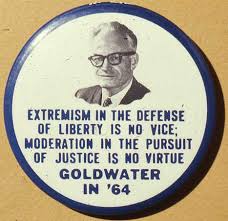
A campaign button for Barry Goldwater’s 1964 presidential bid quotes from his speech accepting the GOP nomination.
1968: George C. Wallace runs for President: George C. Wallace, the Democratic Governor of Alabama, who is known nationally for his hard pro-segregation stance, runs as the candidate of the American Independent Party (AIP). Painting himself as a champion of the common man, he carries 5 states in the South and wins almost 10 million votes, i.e., 13.5% of the ballots cast.
1969: The Manson family killings: Initially a hippie cult based in California, the Manson family evolves toward Satanism and white supremacism after its leader, Charles Manson, has visions of an upcoming race war he calls Helter Skelter (after the Beatles song): to accelerate it, Mason incites his followers to commit several murders, notably the one of film actress Sharon Tate in August 1969.
1969: Brandenburg v. Ohio: In this landmark decision involving a Ku Klux Klan leader, the U.S. Supreme Court rules that the government cannot punish inflammatory speech unless it is “directed to inciting or producing imminent lawless action and is likely to incite or produce such action.” The ruling greatly broadens interpretations of the kinds of hate speech protected by the First Amendment.
1971: The Southern Poverty Law Center (SPLC): based in Montgomery, Alabama, the organization becomes well-known for its information work on hate groups and legal cases against white supremacist groups, as well as promoting tolerance education programs.
1972: Richard Nixon’s silent majority: In November, incumbent President Richard Nixon is reelected in a landslide, in large part due to his ability to speak for the “silent majority” – a catchphrase for mainstream Americans – and portrays his Democratic opponent, George Mc Govern, as a champion of raucous intolerant liberal elites, campus radicals, race rioters and flag-burning opponents to the Vietnam war.
1978: Publication of The Turner Diaries: William Luther Pierce, a prominent neo-Nazi, publishes The Turner Diaries under the pseudonym Andrew Macdonald. This racist dystopian novel tells the story of an insurrection by a “Patriotic” group called The Order against a government that promotes egalitarian values and gun control. The novel supposedly sells 500,000 copies and resonates with far-right militias in the decades ahead, inspiring numerous hate crimes and acts of terrorism.
1979: Greensboro Massacre: In Greensboro, North Carolina, five participants in a march against the KKK organized by the Communist Workers Party are shot killed by a mob of Klan members. Six of them are prosecuted but acquitted by an all-white jury considering they acted in self-defense.
1979: The Moral Majority: Created by Jerry Falwell, a Baptist televangelist and founder of the megachurch and Liberty University in Lynchburg, Virginia, this organization accelerates the rise of the Christian Right as a political force, playing a key role in the mobilization of conservative Christians in favor of Republican candidates and right-wing social themes throughout the 1980s. The organization dissolves in 1989, but its influence has lasted since then.
1984: The Populist Party: Unrelated to its 19th century namesake, a small new Populist Party is created by Willis Carto, a far-right conspiracist and antisemitic activist. It serves as an electoral vehicle for successive candidates in three presidential elections between 1988 and 1992, including David Duke, the former Grand Wizard of the Knights of the Ku Klux Klan, in 1988.
1984: Alan Berg is assassinated: On June 18, Alan Berg, a popular Jewish and liberal radio host in Denver, Colorado, is murdered by members of The Order, a neo-Nazi terrorist organization that aims to spark off a white supremacist revolution inspired from The Turner Diaries.
1987: Abolition of the Fairness Doctrine: Introduced in 1949 by the Federal Communications Commission (the agency regulating the media in the U.S.), the fairness doctrine required broadcasters to give equal treatment to competing points of view on issues of public importance. In 1987, however, the FCC repeals it, which allows opinionated channels to mushroom on the radio and TV, and encourages broadcasters to favor radical programs rather than consensual ones.
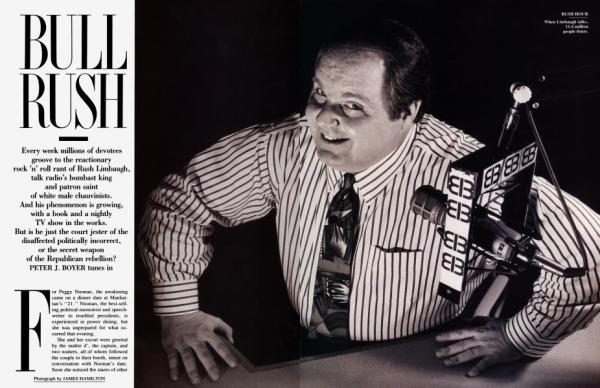
Feature on Rush Limbaugh published in Vanity Fair in May 1992.
1988: The Rush Limbaugh Show goes national: Since 1984, Rush Limbaugh, an American conservative radio host, has been hosting a very popular talk show on KFBK, a station in Sacramento, California. In 1988, the repeal of the fairness allows his show to be syndicated nationally, making him the media figure with the largest reach in the country, and paving the way for the next generation of right-wing and far-right media commentators, entertainers, and influencers.
1988: Pat Robertson challenges George H.W. Bush in the Republican Primary: Pat Robertson, a conservative televangelist, challenges the incumbent Vice-President, in the Republican presidential primary under the slogan, “Restore the Greatness of America Through Moral Strength.” He loses but his campaign is a milestone in the rising influence of the Christian Right on the G.O.P.
1990: American Renaissance: Founded by Jared Taylor, the New Century Foundation is a white supremacist think tank that promotes pseudo-scientific racist studies and research. It is best known for its American Renaissance magazine, which regularly features proponents of racism and eugenics.
1991: David Duke runs for Governor of Louisiana: The former Grand Wizard of the Knights of the Ku Klux Klan, David Duke, runs for Governor of Louisiana as a Republican, though the GOP’s establishment disavows his candidacy. Presenting himself as a born-again Christian and spokesman for the “white majority,” he garners national media attention and eventually loses the race, but he does win a majority of 55% of the white vote in the state.
1992: The Ruby Ridge standoff: In August, U.S. Marshals lay siege to a cabin in Ruby Ridge, Idaho, occupied by Randy Weaver and his family, who are suspected of possessing illegal firearms. During the exchange of fire, Weaver’s wife and son are killed. In the trial that follows, Weaver is acquitted and is later granted a settlement of $3.1m. The behavior of the federal agents during the events draws intense scrutiny, and both Ruby Ridge and Waco six months later are cited by later far-right terrorists as motivations for their actions against a government they deem tyrannical.
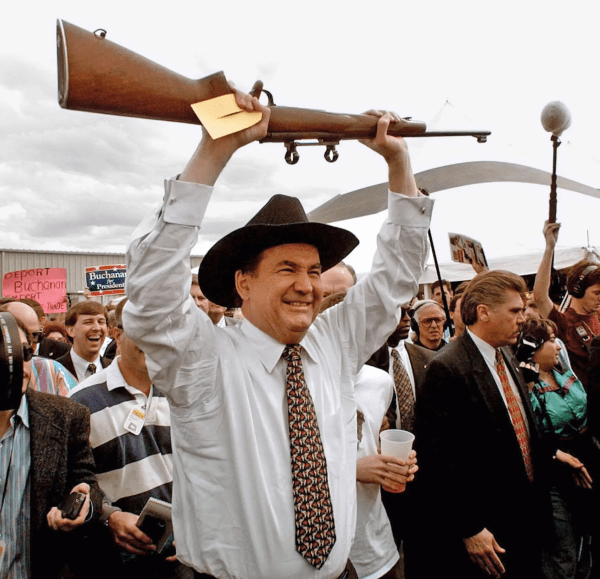
Pat Buchanan campaigning in 1996.
1992-6: The Pat Buchanan insurgency: In two successive presidential elections, Pat Buchanan, a former White House aide to Presidents Richard Nixon and Ronald Reagan and a media-savvy TV personality, runs memorable primary campaigns, notably during his 1992 challenge to the sitting President George H.W. Bush. Borrowing the slogan “America First” from the anti-interventionist group that opposed U.S. involvement in WW2, Buchanan runs against free trade and unnecessary wars such as the 1991 invasion of Iraq, and he calls for a complete stop of immigration, pledging to build a fence all along the border with Mexico. In August 1992, he also famously warns his party’s national convention that America faces a “culture war” against the left on issues of class, culture, religion and race. In 1996, he wins the New Hampshire primary after another strident populist surge that makes him declare, “The peasants are coming with pitchforks.” He runs a third time in 2000 as nominee of the Reform Party, but with little success, and stirs controversy with anti-Semitic remarks about Jewish influence in American culture and politics. His long-term influence on the American right is nevertheless noticeable, for instance in the G.O.P.’s increasingly nativist take on immigration. His campaigning style and proneness to grab outrage also make him a precursor of Donald Trump.
1992-6: The Ross Perot insurgency: Another precursor of the Caesarist posture and rhetoric that Donald Trump used to be elected President, the Texas billionaire Ross Perot, a pioneer of the computer-services industry, runs as an independent against Republican President George H.W. Bush and Democratic candidate Bill Clinton in 1992, and wins almost 20% of the ballots cast. Neither entirely right-wing nor left, his “United We Stand, America” campaign positions him as an alternative to the two mainstream parties and combines a broad range of right-wing concerns like opposition to NAFTA and fiscal conservatism, with liberal ideas about education and original proposals about enforcing e-democracy for direct decision-making. Using folksy populist language, Perot promises the American people that he will “clean out the barn” in Washington, D.C. In 1996, he again runs as leader of the newly founded Reform Party against President Clinton and Republican candidate Bob Dole but attracts only 8.4% of the ballots cast.
1993: Assassination of Dr. David Gunn: On March 10, Dr. David Gunn is fatally shot by Michael Frederick Griffin, a fundamentalist Christian, in front of Gunn’s Pensacola Women’s Medical Services clinic in Florida. This is the first documented killing of an obstetrics and gynecology doctor in an act of anti-abortion violence in the United States and illustrates the escalating tactics of the far-right against doctors, clinics and planned parenthood facilities in the country.
1993: Waco: In April 1993, the U.S. Bureau of Alcohol, Tobacco, and Firearms launches a raid on a compound in Waco, Texas, held by the Branch Davidians, a fundamentalist Christian sect led by David Koresh, a charismatic long-haired cult leader, and suspected of illegally converting semi-automatic rifles into fully automatic weapons. The raid turns into a violent 51-day siege that costs the lives of 82 Davidians, including Koresh, and 4 federal agents. The raid, intended as a show of A.T.F. competence, devolves into a prolonged spectacle of defeat, live on cable news channels 24/7. It enables Koresh’s transmutation into a martyr and kicks the militia movement into high gear in the years that follow.
1994: The Republican Revolution: Rallying for the first time behind a single national program (the so-called “Contract with America,” much of which was drafted by the right-wing think-tank The Heritage Foundation) rather than campaigning independently in each district, the Republicans win the midterm elections and take back the U.S. House of Representatives from the Democrats for the first time since 1955. Newt Gingrich, a Congressman from Georgia, becomes Speaker, and his uncompromising attitude towards President Clinton and the Democratic House minority accelerates the political polarization in the country.
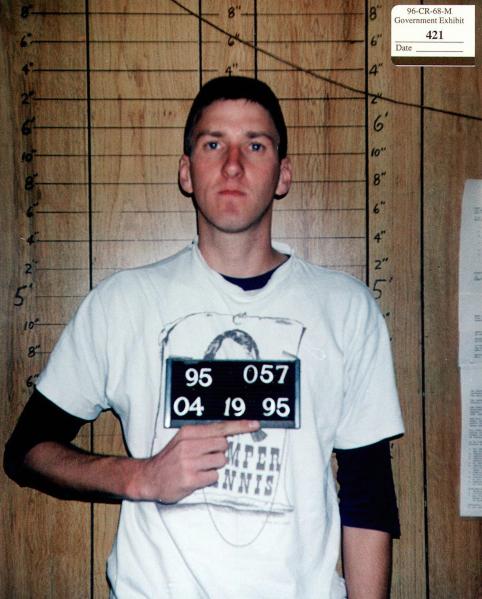
Mug shot of Timothy McVeigh after his arrest, wearing a t-shirt with an image of Abraham Lincoln and the words “Sic semper tyrannis” attributed to John Wilkes Booth when he assassinated the President.
1995: The Oklahoma City Bombing: On April 19, the second anniversary of the end of the Waco siege, a terrorist bomb detonates at a federal building in Oklahoma City, killing 168 people, injuring 684 others, and causing an estimated $650 million worth of damage. The two men responsible are army veterans who hoped to inspire a revolution against a federal government they deemed tyrannical: Terry Nichols and, most of all Timothy McVeigh, who has a white supremacist background.
1995: The Drudge Report: Matt Drudge, a right-wing gossip journalist launches a weekly news email dispatch. In 1998, it breaks the Clinton-Lewinsky scandal and evolves into a news aggregation website that grows very influential on the American far right.
1996: The Centennial Olympic Park Bombing: On July 27, during the Olympics, a terrorist bombing at the Centennial Olympic Park in Atlanta, Georgia, kills 1 person and injures 111 others. It is the first of four bombings committed by white supremacist Eric Rudolph in a terrorism campaign against the U.S. government which he accuses of championing “the ideals of global socialism” and “abortion on demand”.
1996: The Fox News Channel: Owned by Australian-born businessman Rupert Murdoch and chaired by conservative consultant Roger Ailes, the Fox News Channel, a cable news channel, is launched on October 7. Though officially “fair and balanced” (its motto), the channel soon proves to have a very conservative, pro-Republican bias which even evolves towards the far-right during the Obama presidency. Its most famous hosts have included: Bill O’Reilly, Lou Dobbs, Sean Hannity, Laura Ingraham, Glenn Beck, Megyn Kelly, Tucker Carlson, and Jesse Watters.
1998: Newsmax: Newsmax.com is launched by journalist Christopher Ruddy as a conservative news website; in 2014, its success online allows the media to grow into a cable news channel, with a right-wing editorial policy similar to Fox News.
1998: The Clinton-Lewinsky scandal: Revelations about the sexual relationship between President Clinton and White House intern Monica Lewinsky lead to charges of perjury against him and to his impeachment by the U.S. House of Representatives. News of the scandal first break in January on the Drudge Report. Defenders of the President, notably his wife Hillary Clinton, blame a “vast right-wing conspiracy” against him, involving right-wing media, independent counsel Kenneth Starr and other ultra-right lawyers, activists in the Christian Right and part of the G.O.P. leadership.
1999: InfoWars: Founded by Alex Jones, a far-right talk show host, this website becomes one of the most prominent fake news and conspiracy theory media in the U.S.
2001: 9/11: The September 11 attacks carried out by the al-Qaeda Islamist organization cost the lives of 3,000 people, making it the deadliest terrorist attack in history. The attack sends an unprecedented shockwave across the U.S., both stirring a sense of national unity and a backlash against Muslims and Middle Easterners, with a long-term rise in Islamophobia and a surge in the number of hate crimes perpetrated. 9/11 also gives birth to abundant “truther” conspiracy theories, mostly in the far right but also the far left.
2003: 4chan: this imageboard website hosts boards dedicated to a wide variety of topics, from video games and television to cooking, weapons, fitness, politics, and sports. As a result of its lax censorship and moderation policies, it becomes one of the most popular online platforms in the U.S., growing into a hub of Internet subculture, its community being influential in the popularization of Internet memes. The site also popularizes hacktivist and political movements, such as Anonymous and the alt-right, but also conspiracism and controversial and/or illegal online practices such as coordinated pranks and harassment, doxing, etc.
2007: Breitbart News: Created by Andrew Breitbart, a conservative political commentator, as “the Huffington Post of the right,” this news website gradually becomes the main media outlet of the alt-right, notably after Steve Bannon becomes its executive chairman in 2012.
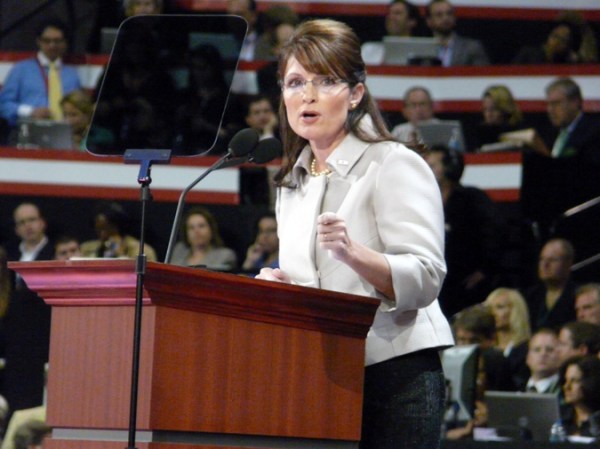
Sarah Palin delivers her speech at the 2008 Republic National Convention in St Paul, Minnesota.
2008: Sarah Palin becomes the Republican vice-presidential nominee: On August 29, Republican presidential candidate John McCain announces that Sarah Palin, the Governor of Alaska, is his VP pick, making her the first female vice-presidential nominee in the G.O.P.’s history. McCain intends to capitalize on Palin’s outspoken, populist style, but while she does energize the party base, her inexperience, her blunders, and some of her inappropriate attacks against the Democratic presidential nominee, Barack Obama, are eventually detrimental to the Republican ticket. The election nevertheless raises her national profile, and she becomes an icon of the Tea Party movement as well as a popular personality in the conservative media.
2008: Barack Obama is elected President of the U.S.A: On November 4, Barack Obama becomes the first Black person to be elected president. Whereas his victory is celebrated as a milestone, the campaign itself and his ensuing presidency show that Americans have not turned the page on their history of racism. During and after the campaign, false rumors call into question Obama’s religious belief, insinuating that he is a closet Islamist. An obvious dog whistle to question the legitimacy of a president being black, the birther conspiracy theory then falsely asserts that he is not a natural born citizen, that his birth certificate is a forgery, and/or that he was not born in Hawaii but Kenya, and therefore that he should have been ineligible to be president. In 2011, Donald Trump himself starts routinely calling into question Obama’s birth certificate in the media.
2008: The Three Percenters: given impetus by the election of Barack Obama as president of the U.S., this far-right militia advocates gun ownership rights and resistance to the U.S. federal government. Multiple factions of the group participate to the January 6 U.S. Capitol attack, and on February 21, 2021, the leadership dissolves it in response, condemning the violence.
2009: The Matthew Shepard and James Byrd Jr. Hate Crimes Prevention Act: As a response to the murders of two men, one gay, the other one black, Congress passes this law which makes it possible to prosecute as hate crimes violent acts committed against victims because of their race, color, national origin, religion, gender, gender identity or disability. The law provides stringent maximum penalties, including life imprisonment, if someone is killed during a hate crime.
2009: The Oath Keepers: founded by Elmer Stewart Rhodes, this far-right anti-government militia grows into a large organization of almost 40,000 members, many of whom are involved in the January 6 U.S. Capitol attack. Rhodes himself is sentenced in 2023 to 18 years for seditious conspiracy.
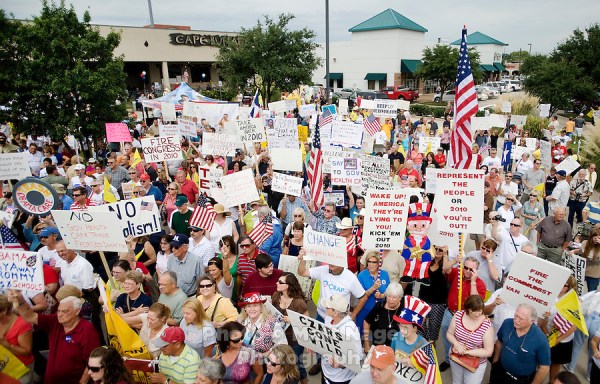
Tea Party protest in Dallas, Texas, in September 2009.
2009: The Tea Party: Referencing the Boston Tea Party of 1773, an anti-tax protest against the British government that accelerated the American Revolution, this conservative movement rises in early 2009 against the bailout of the financial system, the economic stimulus package and the healthcare reform legislation proposed by the Obama administration. Comprising mostly fiscal conservatives and libertarians at first, the Tea Party grows into a massive populist movement that plays an important role in the G.O.P.’s victory in the 2010 mid-term election and accelerates its radicalization towards the far right. Among the right-wing personalities that align the most with the ideas of the Tea party in the 2010s, one must mention the Fox News host Glenn Beck, and GOP leaders like Sarah Palin, Ted Cruz, Jim DeMint, Jeff Sessions, Mike Lee, and Ron Johnson.
2010: Citizens United: On January 21, in Citizens United v. Federal Election Commission, the U.S. Supreme Court holds by 5 votes to 4 that freedom of speech prohibits the government from restricting corporate contributions to political campaigns, thus repealing previous regulations and caps. This controversial decision gives special interests and lobbyists even more power in Washington, D.C. and allows unprecedented amounts of money to flood into American politics and thwart elections.
2011: Occupy Wall Street: starting in Zuccotti Park, in New York’s Financial District, and growing into other protests across the U.S., this left-wing movement results from public distrust in the private sector after the 2008 subprime crisis. Claiming to speak for “the 99%” who lost out as a consequence of the Great Recession, its members stage mass marches and build semi-permanent protest camps in urban areas. The movement falters as a consequence of a lack of central leadership, forceful removals, and the cold winter of 2011, but it accelerates the rise of new leaders on the left, including the Senator from Vermont Bernie Sanders, who launches an unexpectedly vigorous challenge against Hillary Clinton in the 2016 Democratic presidential primary with a platform of tackling economic inequality.
2012: The Wisconsin Sikh temple shooting: On August 5, white supremacist Wade Michael Page shoots and kills 6 people and wounds 4 others at the Sikh temple in Oak Creek, Wisconsin.
2012: Sandy Hook Elementary School Shooting and Conspiracy Theory: On December 14, 20-year-old Adam Lanza shoots and kills 26 people, including 20 children between 6 and 7 years old, and 6 adult staff members, at the Sandy Hook Elementary School in Newtown, Connecticut. The incident is the deadliest shooting at an elementary school in U.S. history, but it is subject to numerous far-right conspiracy theories claiming that it is a staged hoax perpetrated by opponents of the Second Amendment. This is the case of talk show host Alex Jones, who is prosecuted for defamation and eventually ordered to pay $965 million in damages to the families of Sandy Hook in October 2022.
2013: One America News Network (OANN): Founded by the businessman Robert Herring Sr., OANN is the third major far-right cable news channel after Fox News and Newsmax and becomes controversial for its conservative bias and for spreading fake news and conspiracy theories.
2013: Black Lives Matter: This decentralized political and social movement emerges in response to the killings of Black men by police officers and vigilantes since the early 2010s, including Trayvon Martin (2012), Michael Brown (2014), Eric Garner (2014) and later George Floyd (2020). Starting out as the hashtag #BlackLivesMatter on social media following the acquittal of George Zimmerman, the man responsible for the death of Trayvon Martin in 2013, the movement aims to highlight racism, discrimination, and police brutality against Blacks in the U.S. In the late 2010s and early 2020s, the movement also generates an ideological backlash among conservatives and in the far right.
2014: The Isla Vista killings: On May 23, 22-year-ol Elliot Rodger kills 6 people and injures 14 others near the campus of the University of California, Santa Barbara, in an attempt to instigate a “war on women” for “depriving [him] of sex,” as he explains in a video posted on YouTube before the attack. The event becomes a milestone in the rise of the incel ideology in the U.S.

Created by the cartoonist Matt Furie, the character Pepe the Frog starts becoming a favorite meme among alt-right activists around 2014.
2014: GamerGate: Using the hashtag #Gamergate, this misogynistic online harassment campaign starts targeting female video game developers Zoe Quinn and Brianna Wu, as well as feminist media critic Anita Sarkeesian, along with their online supporters. What begins as a polemic about the integrity of video games turns into a culture war, and remains a significant stage in the emergence of the alt-right notably on online platforms – 4chan, 8chan, and Reddit – frequented by gamers.
2015: The Daily Wire: Created by conservative political commentator Ben Shapiro and film director Jeremy Boreing, this news website and podcast company becomes one of the most influential one in the alt-right, hosting right-wing personalities like Candace Owens and Jordan Peterson.
2015: The Charleston Church shooting: On June 15, Dylann Roof, a 21-year-old white supremacist murders 9 Black people at the Emanuel African Methodist Episcopal church in Charleston, South Carolina. One week later, South Carolina’s governor, Nikki Haley, announces that the Confederate flag will be taken down from its position on the grounds of the state capitol. Similar decisions are made in Mississippi and Alabama.
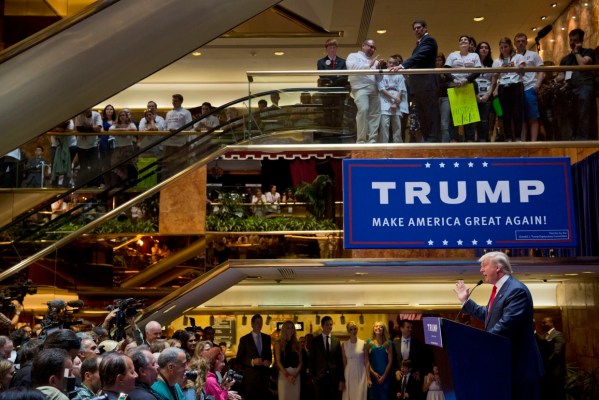
Donald Trump announces that he is a candidate for the Republican nomination in the 2016 United States presidential election.
2015: Donald Trump declares candidacy for President: On June 16, real-estate millionaire and reality television celebrity Donald J. Trump announces from the basement of his Trump Tower building in Manhattan that he is running as a Republican. This first speech sets the populist tone of his campaign. He proclaims the American dream to be dead but pledges to make America great again (MAGA), and he accuses Mexico and China of swarming the country with criminals and stealing American jobs respectively.
2015: The San Bernardino attack: In December, an American couple of Pakistani descent who have pledged allegiance to Islamist jihadism kill 14 people at a government building in San Bernardino, California. Shortly after, Donald Trump calls for a “total and complete shutdown” of Muslims entering the U.S. until the government can “figure out” the threat of terrorism.
2016: The Public Facilities Privacy & Security Act: In March, the Republican-dominated North Carolina legislature passes this legislation commonly known as House Bill 2 (HB2), which compels schools and state and local government facilities containing single-gender bathrooms to only allow people of the corresponding sex as listed on their birth certificate to use them. The ulterior motive is to prevent transgender people from having access to bathrooms other than for the sex they were assigned at birth, and insinuate that they are predators. This is the first of many similar “bathroom bills” across the country, which stir controversy about transgender rights.
2016: The Pulse nightclub shooting: On June 12, a 29-year-old Islamist Afghan-American terrorist kills 49 people at a gay nightclub in Orlando, Florida. Hours after the shooting, Donald Trump tweets, “Appreciate the congrats for being right on radical Islamic terrorism,” and, interviewed later on Fox News, he hints that President Obama might be a secret terrorist sympathizer, saying, “We’re led by a man that either is not tough, not smart, or he’s got something else in mind.”
2016: The Public Facilities Privacy & Security Act: In March, the North Carolina legislature passes this legislation commonly known as House Bill 2 (HB2), which compels schools and government facilities containing bathrooms to only allow people of the corresponding sex as listed on their birth certificate to use them. The ulterior motive is to prevent transgender people from having access to bathrooms other than for the sex they were assigned at birth. This is the first of many similar “bathroom bills” across the country, which stir controversy about transgender rights.
2016: Pizzagate: Social media start spreading a far-right conspiracy theory according to which high-ranking members of the Democratic Party have organized a pedophilia ring, using a number of restaurants like the Comet Ping Pong pizzeria in Washington, D.C. Pizzagate is generally considered a predecessor to the QAnon conspiracy theory.
2016: The Proud Boys: Founded by Gavin McInnes, a co-founder of the magazine Vice, this violent “hipster racist” organization becomes one of the most active ones in the alt-right. Many of its members participate to the January 6 U.S. Capitol attack and are prosecuted for seditious conspiracy.
2016: Donald Trump is elected president: On November 8, Trump wins the presidency on a vigorous populist platform advocating for protectionist and anti-immigration measures, after successively defeating the two candidates epitomizing the political establishment of the past 40 years: Jeb Bush (the son and brother of the 41st and 43rd U.S. presidents respectively) in the Republican primary, and Hillary Clinton (the wife of the 42nd president) in the presidential election proper.
2017: The MeToo Movement: After the exposure of numerous sexual-abuse allegations against film producer Harvey Weinstein in October 2017, millions of women reveal on social media that they have undergone similar abuse, using the viral hashtag #MeToo. The phenomenon grows into a global social movement and awareness campaign against sexual abuse, sexual harassment and rape culture. The movement also stirs criticism about rumors and false accusations being levelled against men, as well as an ideological backlash in conservative and far-right antifeminist and sexist circles.
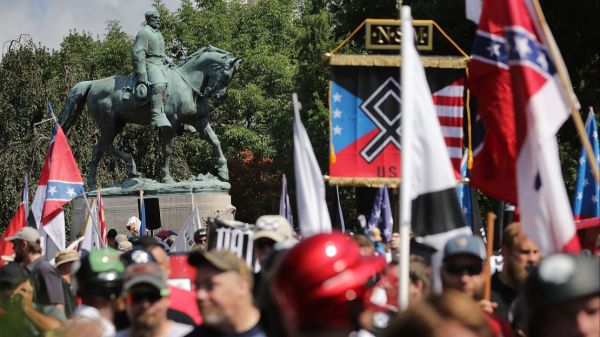
The statue of Robert E. Lee stands behind a crowd of hundreds of white nationalists, neo-Nazis and members of the alt-right during the Unite the Right rally in August 2017 in Charlottesville, Virginia.
2017: The Unite the Right rally: Organized in Charlottesville, Virginia, on August 11 and 12, this rally intends to oppose the removal of the statue of General Robert E. Lee, the commander of the Confederate army, and unite the white nationalist movement with the goal of playing a larger role in American politics. Protesters clash with counter-protesters, resulting in more than 30 people injured. On August 12, white supremacist James Alex Fields Jr. deliberately rams his car into a crowd of counter-protesters, killing 1 person and injuring 35 others. President Trump stirs controversy by emphasizing there were “very fine people on both sides”, thereby implying a moral equivalence between the white supremacist protesters and the counter-protesters, before amending his words: “I’m not talking about the neo-Nazis and the white nationalists, because they should be condemned totally, but you had many people in that group other than neo-Nazis and white nationalists”.
2017: Pardon of Sherif Arpaio: In August, President Trump pardons 85-year-old Joe Arpaio, the former Sherif of Maricopa County, Arizona, who was convicted of criminal contempt just a month before, and who earned national notoriety for 30 years for his harsh treatment of prisoners, zealous pursuit of illegal immigrants, and unabashed use of racial profiling.
2017: QAnon: In October 2017, an anonymous account calling itself ‘Q Clearance Patriot’ (and later simply ‘Q’) and claiming to have access to top-secret information starts publishing cryptic messages on 4chan and then other platforms about a secret cabal of powerful Satan-worshipping pedophiles, sex traffickers and cannibals, involving top Democrats, Hollywood celebrities, progressive businesspeople and religious figures like Pope Francis and the Dalai Lama. The conspiracy theory adds that President Trump was secretly recruited by top military generals to wage a patriotic crusade against the cabal and eventually reveal the truth at a time known as ‘The Storm’. After a while, QAnon grows into a big tent conspiracy theory that incorporates elements of many other conspiracy theory communities.
2018: The Parkland high school shooting: On February 14, Nikolas Cruz, a 19-year-old white supremacist, shoots and kills 17 people and injures 17 others at a high school in Parkland, Florida. This is the deadliest mass shooting at a high school in U.S. history but in the following years, numerous far-right and anti-gun control conspiracy theories circulate around the shooting, claiming it is a false flag operation or a hoax involving crisis actors.
2018: The Pittsburgh synagogue shooting: On October 27, Robert Gregory Bowers, a 46-year-old antisemitic activist shoots and kills 11 people and injures 6 others, at the Tree of Life synagogue in Pittsburgh, Pennsylvania. This is the deadliest attack on a local Jewish community in U.S. history.
2018: United States mail bombing attempts: Between October 22 and November 1, law enforcement agencies across the U.S. intercepts 16 packages containing explosives mailed by Cesar Sayoc, Jr., a radicalized Trump supporter, to high-profile Democratic Party politicians (including Barack Obama, Joe Biden, Hillary Clinton, and Kamala Harris), prominent critics of President Trump (including ex-CIA Director John Brennan, billionaire George Soros, actor Robert De Niro) and CNN.
2019: El Paso Walmart Shooting: On August 3, Patrick Wood Crusius, a 21-year-old white supremacist kills 23 people and injures 22 others at a Walmart known to be frequented mostly by Latino customers in El Paso, Texas. Shortly before the attack, the killer posts a manifesto on 8chan, citing the Christchurch mosque shootings and the Great Replacement conspiracy theory as inspiration for the attack. The shooting is the deadliest hate crime against Latinos in American history.
2020: George Floyd protests in Portland and Kenosha: Starting in May, protests following the murder of George Floyd are held in many cities in the U.S. The majority of the protests are peaceful, but many evolve into rioting, confrontations with law enforcement and counter-protesters, vandalism and looting. On August 29, in Portland, Oregon, a supporter of the far-right group Patriot Prayer is shot and killed by an antifa activist, who is in turn shot and killed by law enforcement. In Kenosha, Wisconsin, riots erupt after Jacob Black, a 29-year-old local Black man is shot by the police, and 2 protesters are fatally shot by Kyle Rittenhouse, a 17-year-old supporter of the pro-law enforcement “Blue Lives Matter” movement, who traveled from his home in Illinois in response to online appeals from a right-wing militia group to protect businesses, property and lives from rioters. Rittenhouse is hailed by the right, including President Trump, as an example of a “citizen soldier.” At his trial in 2021, Rittenhouse argues that he acted in self-defense and is found not guilty of murder.
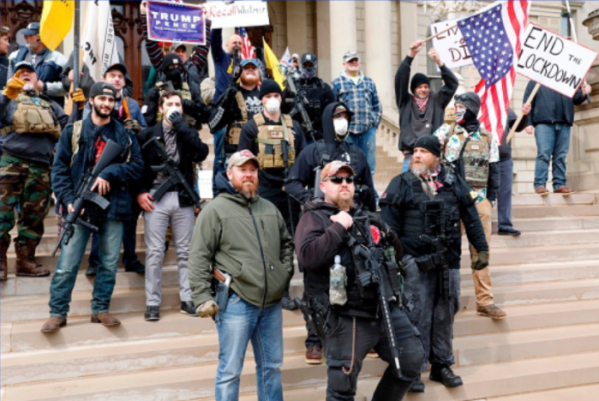
Armed far-right militias demonstrate against Governor Whitmer’s COVID-19 stay-at-home order at the Michigan State Capitol in April 2020.
2020: Gretchen Whitmer kidnapping plot: On October 8, the FBI arrests 13 members of a far-right militia, the so-called the Wolverine Watchmen, suspected of planning to kidnap and execute Gretchen Whitmer, the Democratic Governor of Michigan. For months, Whitmer has been targeted by anti-government groups as well as COVID-skeptics due to her early response to the epidemic in her state, in which she enacted strict statewide mitigation measures such as a lockdown. The incident illustrates the political radicalization accelerated by the pandemic.
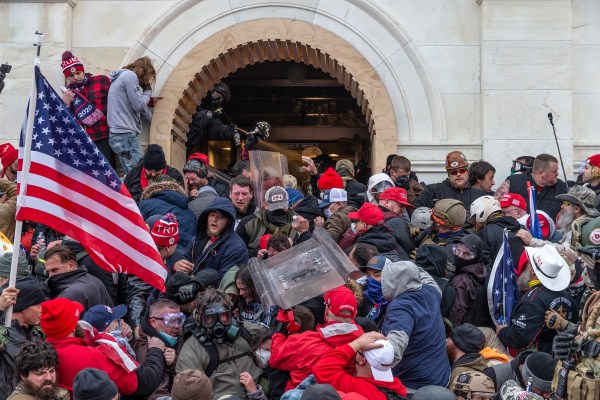
Rioters breach into the U.S. Capitol on January 6, 2020.
2021: January 6 U.S. Capitol attack: The U.S. Capitol Building in Washington, D.C., is attacked by a mob of some 2,000 supporters of President Trump in an attempted coup. They support Trump’s false claims that the 2020 presidential election has been “stolen” by the Democrats and seek to keep him in power by preventing a joint session of Congress from counting the Electoral College to formalize the victory of President-elect Joe Biden. Some of the rioters participate in vandalism and looting, including in the offices of the House speaker Nancy Pelosi, assault Capitol Police officers and reporters, attempt to capture and harm lawmakers, and occupy the empty Senate chamber. A gallows is erected in front of the Capitol, with rioters chanting to “Hang Mike Pence” after the Vice-President rejected calls to overturn the election results. Among the rioters are leaders of the Proud Boys and the Oath Keepers militia groups. One attacker is shot by Capitol Police, and many people are injured, including 174 police officers. The attack is ultimately unsuccessful, and Pence declares President-elect Biden and Vice President-elect Kamala Harris victorious. Trump later concedes to an orderly transition of power in a televised statement, but a week after the attack, the House of Representatives impeaches him for incitement of insurrection, making him the only U.S. president to be impeached twice. In February, the Senate votes 57–43 in favor of conviction, but falls short of the required two-thirds, resulting in his acquittal. The House nevertheless holds 9 televised public hearings on the attack, votes to subpoena Trump, and recommends that the Department of Justice prosecute him. On August 1, 2023, following a special counsel investigation opened by U.S. Attorney General Merrick Garland and headed by federal prosecutor Jack Smith, Trump is indicted on four charges. By May 2024, of the 1,424 rioters charged with federal crimes relating to January 6, 884 defendants have been sentenced, 541 of them receiving jail sentences. Numerous members of far-right extremist groups like the Oath Keepers, Proud Boys, and Three Percenters are convicted of seditious conspiracy. Since then, Trump and elected Republican officials nevertheless promote a revisionist history of the event by downplaying the severity of the violence, spreading conspiracy theories about the whole event being staged and/or provoked by government operators, and portraying those charged with crimes as hostages and martyrs.
2022: Attack against Nancy Pelosi’s husband: On October 28, Canadian far-right conspiracy theorist David DePape breaks into the San Francisco home of Nancy Pelosi, Speaker of the United States House of Representatives, in the hope of taking her hostage. Once there, he attacks Pelosi’s husband Paul with a hammer, leaving him with a fractured skull that requires surgery.
2022: Buffalo Shooting: On May 14, 18-year-old white supremacist Payton S. Gendron shoots and kills 10 people, all of them African Americans, at a supermarket in Buffalo, New York. Before the shooting, Gendron writes a manifesto voicing support for the far-right Great Replacement conspiracy.
2023: Fox News dismisses Tucker Carlson: On April 18, Fox News agrees to pay €787.5 to Dominion Voting Systems, an electronic voting machine company which filed a lawsuit against the cable news channel after it broadcast false statements saying its machines were rigged to steal the 2020 presidential election from Donald Trump. Fox News’s decision comes after the disclosure of damning emails and text messages between some of the channel’s biggest personalities which show that, in private, they never believed a word of Trump’s election denialism. Six days later, Fox News fires Tucker Carlson, whose disclosed private messages are the most inflammatory of the lot. Carlson’s is the most watched cable news program in the U.S., and he is the most influential American far-right political commentator, but he bounces back by creating his own independent show on Twitter / X, which stirs even more controversy.
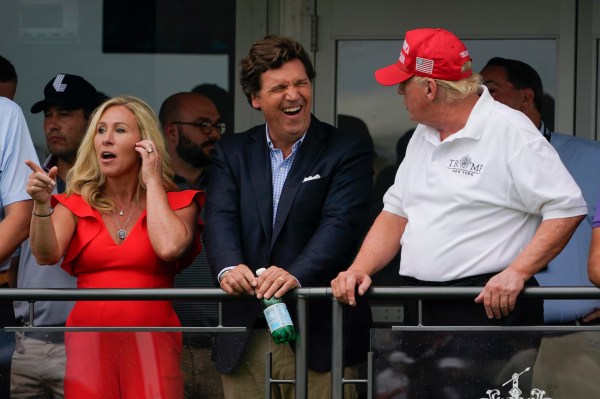
Marjorie Taylor Greene, Republican Congresswoman from Georgia, Tucker Carlson and Donald Trump at the Trump National Golf Club in Bedminster, New Jersey, in July 2022.
2023: Allen mall shooting: On May 6, Mauricio Martinez Garcia, a 33-year-old far-right extremist shoots and kills 8 people at a store in Allen, Texas. His extensive online writings show that he self-radicalized, adopting and promoting white supremacist, neo-Nazi, and incel ideologies, and posting hateful comments against women, Jews and racial minorities in the lead-up to the attack.
2024: Donald Trump is reelected President of the U.S.:Donald Trump defeats Kamala Harris in November and is inaugurated as the 47th president of the U.S. on January 20, 2025. Far-right operatives are appointed at every level of the new administration and start enforcing the agenda delineated in the Heritage Foundation’s Project 2025. The 1,500 rioters involved in the January 6 U.S. Capitol attack are pardoned and a massive national campaign begins against illegal immigration, shuts down. A purge is launched against D.E.I. across the federal government and the whole of society, while traditional, patriotic and right-wing values are championed. The administration also orchestrates a diplomatic rapprochement with hard right and illiberal regimes, including Hungary and Russia. Authoritarian measures are taken against the press, independent bodies and local authorities, and Trump himself floats the idea of ignoring the Constitution and running for a third term in 2028.
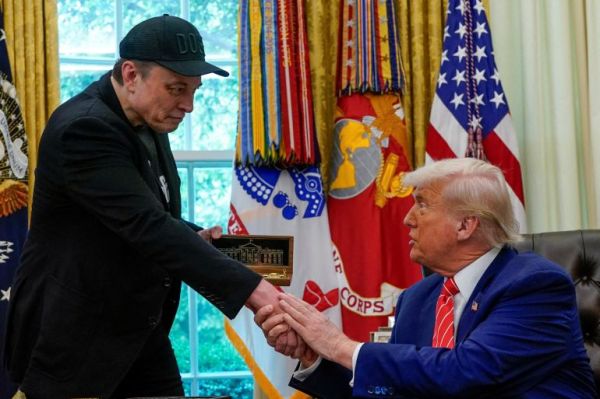
Elon Musk receives a golden key from President Donald Trump in the Oval Office on May 30, 2025
2025: Elon Musk’s America Party: In June, the tech billionaire Elon Musk announces that he intends to launch a new political party called “America Party” to challenge what he calls the country’s “one-party system”. Musk has been a staunch supporter of Donald Trump, calibrating X’s algorithms in his favor and contributing more than $200 billion to his presidential campaign. He then ran the so-called DOGE department, which slashed public spending and federal jobs for several months. But a fallout between the two men began in May due to the passing of the Republican Party’s so-called One Big Beautiful Bill, which Musk, a fiscal hawk, has predicted will create massive deficits and bankrupt the country. Observers wonder whether Musk aims at emulating Ross Perot’s populist political campaigns, though, not being a natural-born citizen, he will not be allowed to run for president.
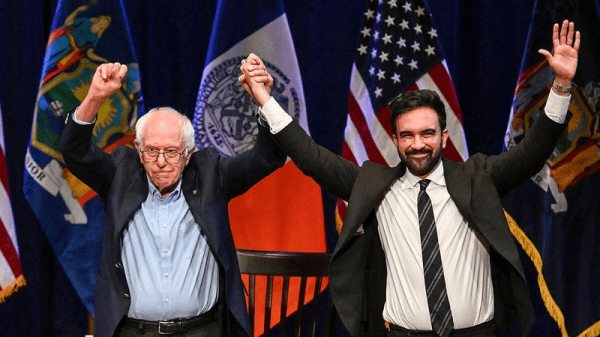
Bernie Sanders and Zohran Mamdani hold hands during a town hall in New York City in September 2025.
2025: Zohran Mamdani to become Mayor of New York City : In June, in a major upset victory, Zohran Mamdani, a democratic socialist, defeats former Governor Andrew Cuomo in New York City’s Democratic primary and becomes his party’s nominee and the frontrunner in the mayoral election to be held on November 4. Supported by Vermont Senator Bernie Sanders and other progressive leaders in the Democratic party, Mamdani’s victory energizes the populist left across the country.
2025: Shootings of Minnesota legislators: On June 14, while “No Kings” protests are held all across the U.S. to denounce the authoritarianism of the Trump administration, two Democratic lawmakers and their spouses are shot at their homes in Minnesota by a gunman impersonating a police officer, causing the deaths of State Representative Melissa Hortman and her husband. The perpetrator, Vance Luther Boelter, a far-right radical, is arrested the next day; in his car, the police discover a kill list of more than 70 other progressive politicians.
2025: Charlie Kirk is assassinated: On September 10, Charlie Kirk, a high-profile far-right political activist, founder of the conservative student organization Turning Point USA, is assassinated while making a speech at a college campus in Utah. The murder provokes a tense national debate about the increasing political violence in the country. The Trump administration and Republican leaders blame the Democrats and considers officially designating antifa as a terrorist group, though in this particular case, the motives of the perpetrator, 22-year-old Tyler James Robinson, remain ambiguous.
 The CONDORCET