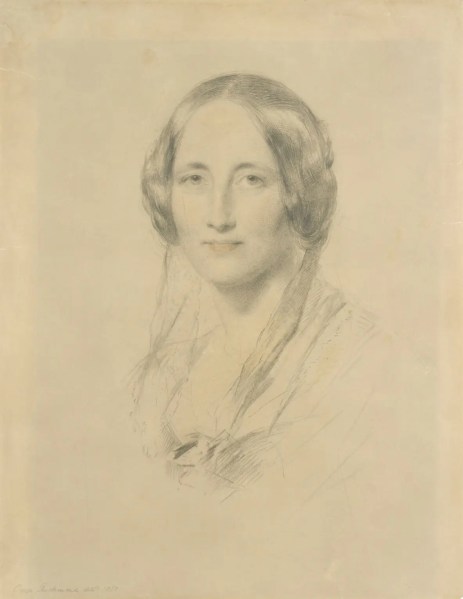
Chalk portrait of Elizabeth Gaskell by George Richmond, 1851.
1797: The parents of Elizabeth Gaskell (EG), William Stevenson and Elizabeth Holland, marry in Cheshire.
1798: EG’s elder brother, John, is born.
1805: William Gaskell is born in Warrington, Cheshire.
1806: William Stevenson moves to London and becomes Keeper of the Papers at the Treasury. His family joins him in 1809, in a house in Chelsea.
1810: EG is born on 29 September.
— Luddites break machinery in Nottingham, sparking off wide unrest and opposition to the Industrial Revolution across the country.
1811: EG’s mother dies; EG leaves for Knutsford, Cheshire, to be cared for by her maternal aunt, Hannah Lumb.
1813: Jane Austen publishes Pride and Prejudice.
1814: EG’s father remarries to Catherine Thomson and has two children with her.
1815: Parliament passes the Corn Laws, tariffs on imported grains, which drive up prices and have devastating consequences for the poor.
1817: Jane Austen dies.
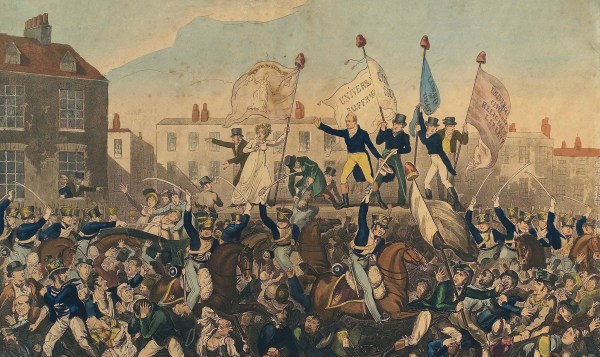
Engraving of the Peterloo Massacre published by Richard Carlile, 1 October 1819.
1819: The Peterloo Massacre: the cavalry charges into a crowd of peaceful protesters at St Peter’s Fields, Manchester, resulting in 18 deaths and several hundred people injured.
— Parliament passes the Six Acts to prevent outbreaks of public disorder.
1820: William Gaskell starts studying at Glasgow University.
— George III dies and is succeeded by George IV, Regent since 1811.
1821: EG attends the Byerley sisters’ boarding school at Barford, then at Avonbank, until 1826.
— The Manchester Guardian, precursor to the Guardian daily, begins publication.
1822: EG’s brother, John, joins the merchant navy.

Engraving of the The Royal Institution, Manchester.
1823: Local Unitarians cofound the Institution for the Encouragement of Fine Arts, later the Royal Manchester Institution.
1824: The Mechanics’ Institute is founded in Manchester; William Gaskell later teaches English literature there.
— The Combinations Acts of 1799-1800, which prohibited unions and labour strikes, are repealed.
1825: William Gaskell begins his studies to become a Unitarian minister at Manchester New College, then at York.

Portrait of Elizabeth Cleghorn in the late 1820s by William John Thomson.
1828: William Gaskell is appointed to Cross Street Chapel, Manchester.
— John Stevenson, EG’s elder brother, is lost at sea in India.
— The repeal of the Test and Corporations Acts removes restrictive measures against Dissenters.
1829: William Stevenson, EG’s father, dies.
— Industrial unrest spreads in Rochdale, Macclesfield, and Manchester.
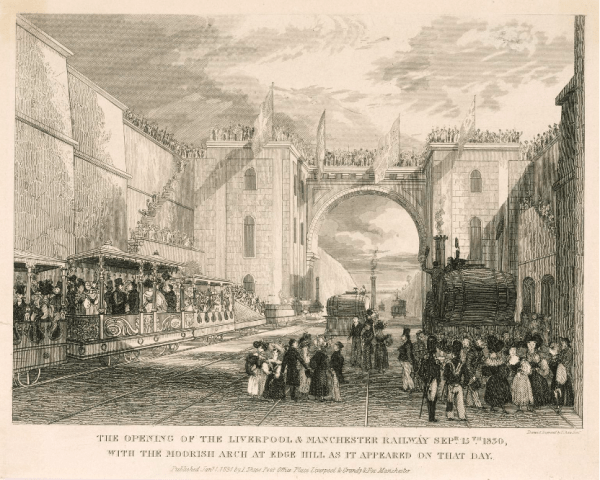
The opening of the Liverpool-Manchester railway, on 15 September 1830.
1830: The Liverpool and Manchester railway, the world’s first inter-city passenger railway, opens, accelerating the growth of Cottonopolis.
— George IV dies and is succeeded by King William IV.
1831: Thomas Ashton, an important local mill-owner, is murdered in Manchester by striking workers.
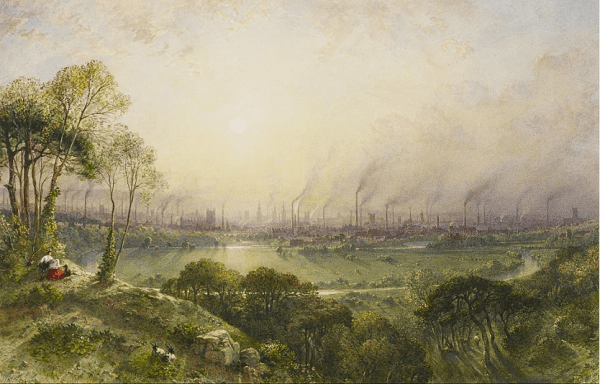
William Wyld, Manchester from Kersal Moor, with Rustic figures and goats, 1852.
1832: EG marries William Gaskell in Knutsford, Cheshire; the newly-weds settle in Manchester.
— Harriet Martineau publishes Illustrations of Political Economy, which includes “A Manchester Strike”.
— Sir James Kay-Shuttleworth publishes a treatise warning about the conditions of the cotton operatives in Manchester.
— Parliament passes the First Reform Bill.
— Jeremy Bentham, the father of utilitarianism, dies.
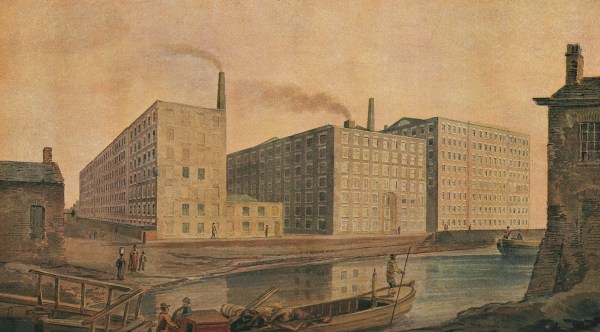
McConnel & Company’s cotton mills in Ancoats, Manchester, 1820
1833: EG gives birth to a stillborn girl.
— The Factory Act is passed: children under 9 can no longer be employed in the cotton mills, while hours for children under 13 are limited to 48 per week.
— Slavery is abolished.
1834: Marianne Gaskell, EG’s eldest daughter is born, followed by Margaret Emily, known as Meta (1837), Florence Elizabeth (1842), William (1844) and Julia Bradford (1846).
— The Poor Law Amendment Act creates the workhouse system.
1836: Charles Dickens publishes the first instalments of Pickwick Papers, with Chapman & Hall.
— Manchester manufacturers form a Master’s Association to resist social reform and legislative interference in the running of the industry.
1837: EG and William Gaskell’s poem “Sketches among the Poor” is published in Blackwood’s Magazine.
— Hannah Lumb, EG’s aunt, dies.
— Charles Dickens publishes Oliver Twist.
— Thomas Carlyle publishes The French Revolution.
— William IV dies and is succeeded by Queen Victoria.
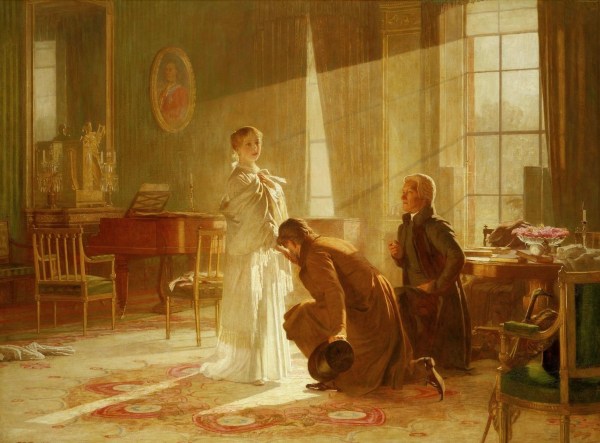
Victoria receives the news of her accession from Lord Conyngham and the Archbishop Howley. Painting by Henry Tanworth Wells, 1887.
1838: William Howitt publishes Visits to Remarkable Places, containing a description of Clopton Hall credited to “A Lady,” the first work written solely by EG.
— The Anti-Corn Law League is formed.
— The “People’s Charter” is published, marking the official act of birth of Chartism.
1839: William Gaskell publishes a book of Temperance Rhymes anonymously.
— Thomas Carlyle publishes Chartism.
1840: William Howitt releases The Rural Life of England, which includes EG’s second published work, entitled “Notes on Cheshire Customs”.
— William Gaskell becomes secretary of Manchester New College; in 1846, he is promoted to Professor of English Literature and History there.
— Economic crisis evolves into depression in Manchester, causing many workers to be unemployed and fall into poverty. The period comes to be called the “hungry forties”.
— Queen Victoria marries Prince Albert of Saxe-Coburg-Gotha.
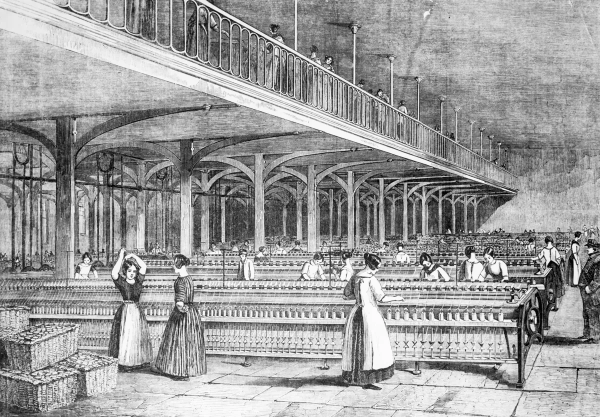
The interior of Deane Mills, Manchester, 1851
1842: The German sociologist and political theorist Friedrich Engels moves to Manchester for two years, to take care of a family factory located there.
— Social unrest increases in Manchester, with strikes, mob gatherings and riots.
1843: William Wordsworth becomes Poet Laureate.
— Thomas Carlyle publishes Past and Present.
1844: EG gives birth to a son, who dies of scarlet fever the next year.
— The Factory Act prescribes a maximum 12-hour workday for women and a 6-hour day for children.
— Friedrich Engels publishes The Condition of the Working Classes in England in Germany; the book is translated in English in 1892.
— Benjamin Disraeli publishes the Condition of England novel Sybil, or the Two Nations.
1845: Potato blight develops in Ireland, leading to the wiping out of the crop, the starting point of the Great Famine.
1846: The Corn Laws are repealed.
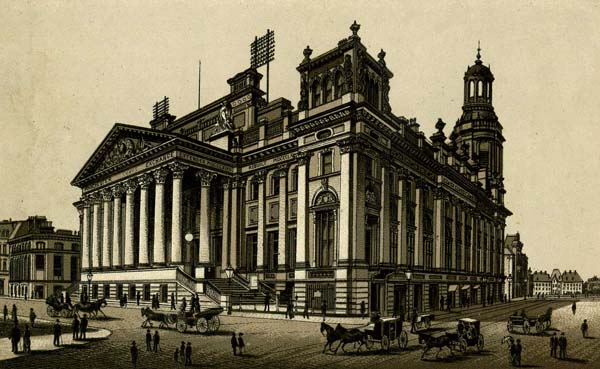
The Royal Exchange, the main trading hall for cotton in the city center.
1847: EG publishes her first short stories in Howitt’s Journal under the name Cotton Mather Mills.
— Irish immigrants escaping the Great Famine start flocking to Manchester.
— Parliament passes the Town Improvement Causes Act.
— Parliament passes the Ten Hours Act, which requires a 10-hour workday for women and for men under 18.
— Charlotte Brontë publishes Jane Eyre.
— Emily Brontë publishes Wuthering Heights.
— Anne Brontë publishes Agnes Grey.
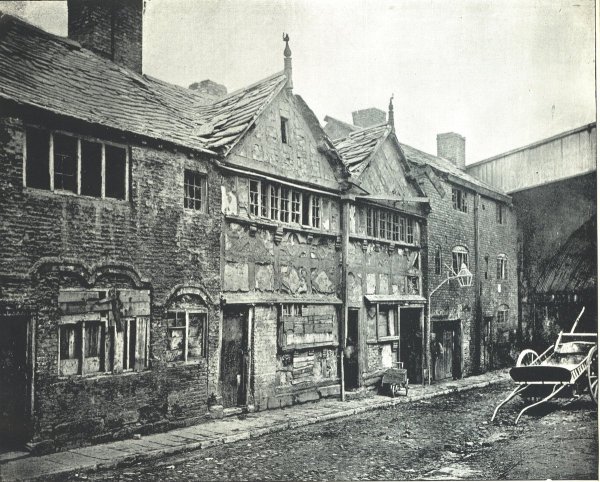
A 19th century slum area in Manchester known as Angela Meadow, and called « Hell upon Earth » by Friedrich Engels in 1844.
1848: EG publishes her first novel, Mary Barton: A Tale of Manchester Life, anonymously.
— John Stuart Mill publishes Principles of Political Economy.
— The Pre-Raphaelite brotherhood is founded by painters Holman Hunt, D.G. Rossetti and John Everett Millais.
— The springtime of the people spreads across Europe.
1849: EG goes to London for several weeks and meets the capital’s most prominent intellectuals.
— William Gaskell becomes chairman of the Manchester Portico Library.
— Charles Kingsley publishes the Condition of England novel Alton Locke.
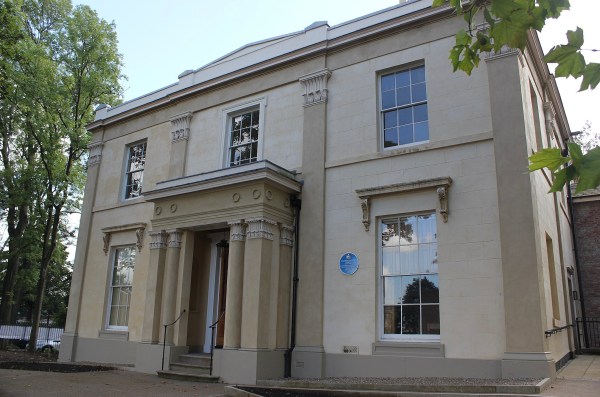
The front facade of 84 Plymouth Grove, once the home of author Elizabeth Gaskell and her husband, now a museum known as Elizabeth Gaskell’s House.
1850: EG becomes friends with Charlotte Brontë.
— The Gaskells moved to a larger villa in Manchester at 84 Plymouth Grove.
— Dickens invites EG to contribute to his new journal, Household Words.
— William Wordsworth dies; he is replaced as Poet Laureate by Lord Tennyson.
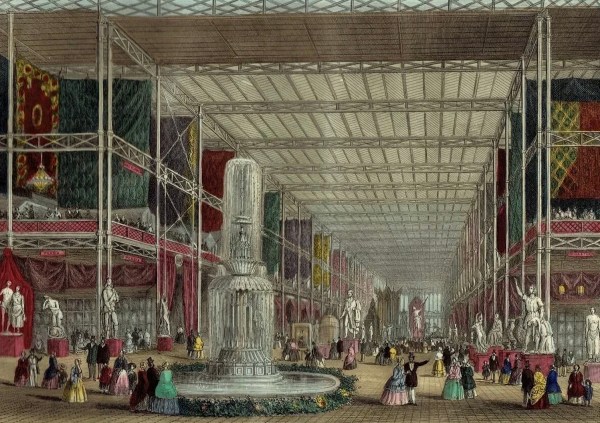
Opening ceremony of the Great Exhibition in May 1851
1851: On 1 May, Queen Victoria inaugurates the Great Exhibition; EG visits on three occasions.
1853: EG’s second novel, Ruth, is published by Chapman & Hall.
— EG’s third novel Cranford is published by Chapman & Hall.
— A strike is launched by weavers in the industrial town of Preston, Lancashire, lasting seven months and paralysing the local cotton industry.
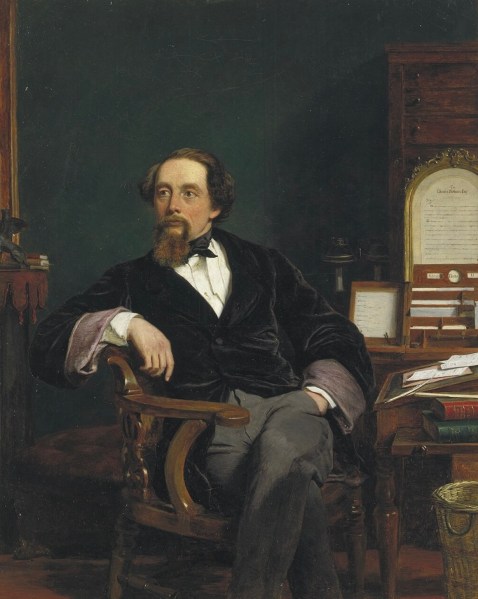
Charles Dickens in his study: painting by William Power Frith, 1859.
1854: Charles Dickens publishes the Condition of England novel Hard Times.
— EG’s fourth novel, North and South, is serialized in 22 weekly instalments in Household Words; it is published in book form by Chapaman & Hall the following year.
— A fifth edition of EG’s Mary Barton is published, with lectures on the Lancashire dialect by her husband included.
— France and England declare war on Russia: the Crimean war begins.
— Florence Nightingale leaves for Crimea, with nurses and equipment.
1855: Charlotte Brontë dies; Patrick Brontë asks EG to write a biography of his daughter.
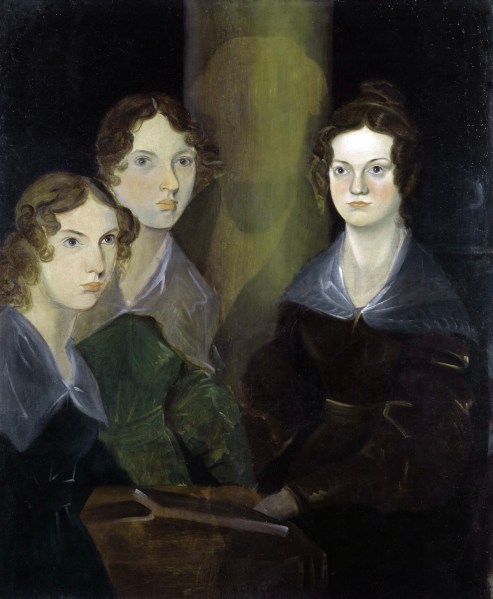
The Brontë sisters (Anne, Emily, Charlotte): painting by Patrick Branwell Brontë
1857: EG’s biography, The Life of Charlotte Brontë, is published in two volumes.
1859: The last number of Household Words is published; Dickens launches his new periodical, All The Year Round, and EG’s novella Lois the Witch is serialized in it the same year.
— George Eliot publishes her first novel, Adam Bede.
— Charles Darwin publishes The Origin of Species.
1861: Prince Albert, Victoria’s husband, dies.
1864: EG’s eighth and last novel, Wives and Daughters, is serialized in The Cornhill, before being published posthumously in book form by Smith, Elder & Co. in 1866.

Photograph of William Gaskell in the 1870s.
1865: EG dies of a heart attack in Holybourne, Hampshire, and is buried in Knutsford.
1868: The first Trades Union Congress is held at the Mechanics’ Institute in Manchester.
1884: William Gaskell dies in Manchester, and is buried beside EG in Knutsford.

