
Kate Chopin in 1869
1682: The French start colonizing Louisiana: the territory becomes part of New France and is named after King Louis XIV.
1708: The French start importing slaves from Africa to work on the sugar cane plantations in Louisiana.
1728: The city of New Orleans is founded by the French.
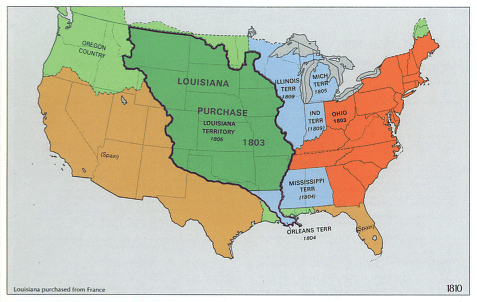
The Louisiana Purchase
1803: The French territories in Northern America including Louisiana and Missouri are ceded by Napoleon to the United States, as part of the Louisiana Purchase.
1812: Louisiana is admitted into the U.S. as a slave state.
1820: Missouri is admitted into the U.S. as a slave state, as part of the Missouri Compromise.
1823: Thomas O’Flaherty arrives in the U.S. from Ireland at the age of 18.
1844: Thomas O’Flaherty’s first wife, Catherine de Reilhe, dies in childbirth; six months later, he marries Eliza Faris.
1848: Organized by Elizabeth Cady Stanton and local Quaker women, the Seneca Falls Convention, the first major women’s rights event to be held in the U.S., begins in Seneca Falls, New York: a milestone in the history of the feminist movement in America.
1850: Katherine O’Flaherty is born on February 8, in St. Louis, Missouri.
— Susan Warner publishes the novel The Wide, Wide World.
1852: Harriet Beecher Stowe publishes the novel Uncle Tom’s Cabin.

Academy of the Sacred Heart, St. Louis, Missouri
1855: Kate is sent to school at the Sacred Heart Academy in St Louis, but returns home after her father’s death later than year; she is sent back to the school in 1857.
— Thomas O’Flaherty, Kate’s father, dies in a railway accident in November.
1859: Charles Darwin publishes On the Origin of Species.
1861-1865: Following Abraham Lincoln’s election as President of the U.S., eleven southern slave states including Louisiana secede from the Union and form the Confederacy; the American Civil War begins.

Map of New Orleans in 1845
1862: In April, New Orleans is captured by the Union Army, and Louisiana is the first Confederate state to be defeated.
1863: George, Kate’s half-brother, dies of fever while serving as a Confederate soldier.
— Victoire Charleville, Kate’s maternal great-grandmother, dies.
1865: The Ku Klux Klan, a white supremacist paramilitary organization, is created in Tennessee.
1865-1877: The Reconstruction era is marked by the passing of the first Jim Crow laws in southern states, which aim to prevent African-Americans from being wholly integrated, voting, or organizing.
1868: Kate graduates from the Sacred Heart Academy and enters into St. Louis society as a debutante.
— Louisa May Alcott publishes the novel Little Women.
1869: The National Woman Suffrage Association and the American Woman Suffrage Association are formed: they merge as the National American Woman Suffrage Association in 1890.
— Kate visits New Orleans with her mother for the first time.
— Kate completes her first short story, “Emancipation. A Life Fable”.
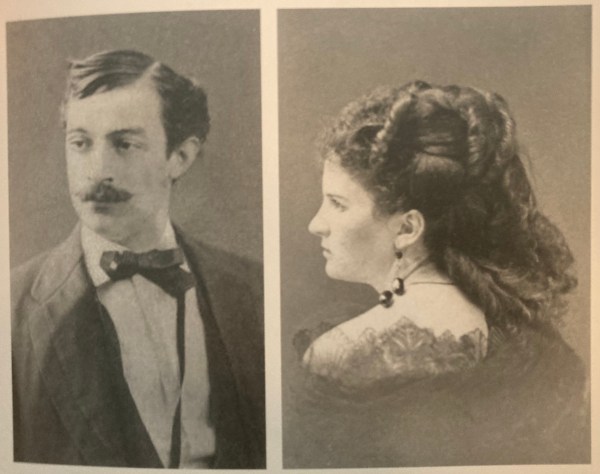
Oscar and Kate Chopin at the time of their marriage
1870: On June 9, Kate marries Oscar Chopin in St. Louis; they honeymoon in Europe, and settled as a family in New Orleans, on Magazine Street. They have six children in eight years: Jean Baptiste (1871), Oscar Charles (1873), George Francis (1874), Frederick (1876), Felix Andrew (1878), and Lélia (1879).
— In November, Oscar Chopin’s father dies.
1871: Elizabeth Stuart Phelps publishes the novel The Silent Partner.
— Charles Darwin publishes The Descent of Man, and Selection in Relation to Sex.

Edgar Degas, Le Bureau de Coton à la Nouvelle Orléans, 1873
1872: Kate strikes a friendship with the French painter Edgar Degas, whose family owns a cotton business in New Orleans.
— Victoria Claflin Woodhull, an activist for women’s rights and “free love,” runs for president of the US.
1873: Thomas O’Flaherty Jr., Kate’s elder brother, dies in a buggy accident in St. Louis.
1874: The White League, a white supremacist paramilitary organization, becomes active in Louisiana. During the “Battle of Liberty Place,” the League attacks the New Orleans police headquarters, killing 27 people; Oscar Chopin is among the rioters.
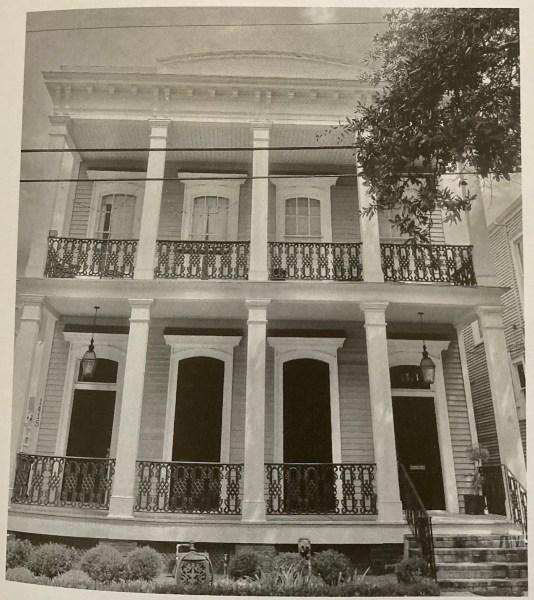
The Chopins’ last home in New Orleans, on Louisiana Avenue
1878: An epidemic of yellow fever takes the lives of 4,000 people in New Orleans.
1879: Oscar Chopin’s cotton brokerage goes bankrupt and the family must move to La Cote Joyeuse, in the village of Cloutierville, in Natchitoches Parish.
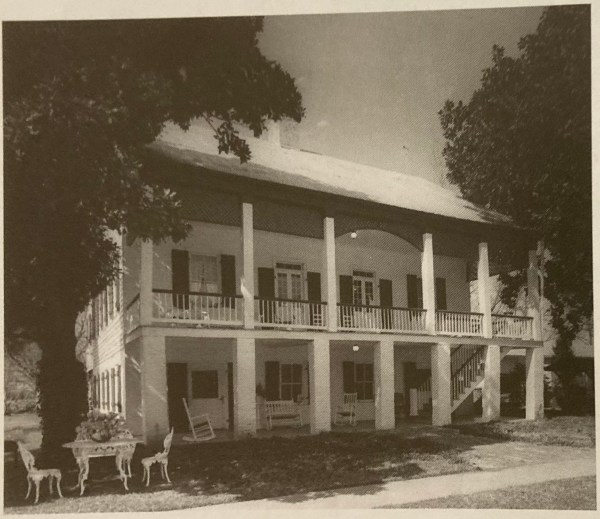
The Chopins’ house in Cloutierville
1882: Oscar Chopin dies of malaria, leaving Kate $42,000 in debt.
1884: Kate sells her Louisiana business and moves back to St. Louis with her children to be with her mother.
1885: Eliza Faris, Kate’s mother, dies.
1889: Kate publishes her first short story, “A Point at Issue!”, in the St. Louis Post-Dispatch.
1890: Kate’s first novel, At Fault, is published privately.
— Kate’s second novel, Young Dr. Gosse, is rejected by publishers and she destroys the manuscript.
— Elizabeth Cady Stanton delivers her “Solitude of Self” address.

John Genin, Surf Bathing at Grand Isle, 1885
1893: Guy de Maupassant dies of syphilis
— A hurricane strikes Grand Isle and wipes out the peninsula of Chênière Caminada, killing 2,000 people.
— The World’s Columbian Exposition is held in Chicago.
1894: Bayou Folk, Kate’s first collection of short stories, is published by Houghton Mifflin.
— Mary Eleanor Wilkins Freeman publishes the novel Pembroke.
1895: Kate publishes a translation of Maupassant’s story “Solitude”.
1896: Sarah Orne Jewett publishes the novel The Country of the Pointed Firs.

First edition of A Night in Acadie
1897: A Night in Acadie, Kate’s second collection of short stories, is published by Way & Williams.
— Athenaïse Charleville, Kate’s maternal grandmother, dies.

First edition of The Awakening
1899: The Awakening, Kate’s second novel, is published by Herbert Stone & Co. Most of the reviews are scathing.
— Kate sells her house in Cloutierville, and never returns to Louisiana after.
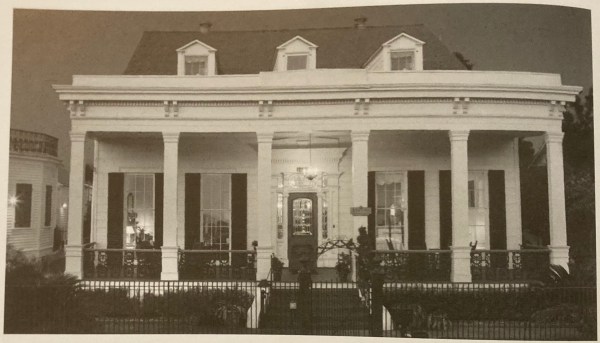

The double cottage on Esplanade Avenue likely to have served as an inspiration for the Pontelliers’ home in New Orleans
1900: A Vocation and a Voice, Kate’s third collection of short stories, is rejected by her publisher Herbert Stone & Co.
1904: The World’s Fair is held in St. Louis.
— Kate Chopin dies of a brain hemorrhage on August 22 and is buried in Calvary Cemetery in St. Louis.
1932: Daniel Rankin, a Marist priest, publishes Kate Chopin and her Creole Stories, the first full-length biography of the author.
1953: The French scholar Cyrille Arnavon publishes a translation of The Awakening, with a landmark introduction paying tribute to Chopin’s stature as a novelist.
1969: The Norwegian scholar Per Seyersted publishes The Complete Works of Kate Chopin, with a foreword by Edmund Wilson, and a comprehensive critical biography of the author.
1972: The Awakening is published in paperback for the first time, by Avon Books.
1981: Mary Lambert direct the film “Grand Isle”, a film adaptation of The Awakening starring Kelly McGillis as Edna, Jon DeVries as Leonce, and Adrian Pasdar as Robert.
1986: Robert Stone publishes Children of the Light, a novel about a production company making a film adapted from The Awakening.
 The CONDORCET