
Portrait of Jane Austen, based on one drawn by her sister Cassandra, 1873
1704 Richard ‘Beau’ Nash becomes master of ceremonies at the rising spa town of Bath.
1728 The architect John Wood, the Elder, moves to Bath and starts designing numerous streets and buildings in the city in a neo-classical style; his work is pursued by his son, John Wood, the Younger.

Print from a painting by Joseph Highmore illustrating Pamela; or, Virtue Rewarded, 1741-1743.
1740 Samuel Richardson publishes Pamela; or, Virtue Rewarded.
1748 Samuel Richardson publishes Clarissa; or, the History of a Young Lady.
1749 Henry Fielding publishes Tom Jones.
1752 Charlotte Lennox publishes The Female Quixote; or, The Adventures of Arabella.
1753 Samuel Richardson publishes The History of Sir Charles Grandison.
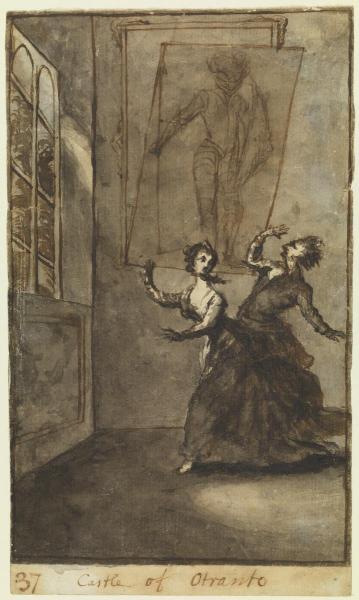
The Ghost Scene from The Castle of Otranto, by Susanna Duncombe
1764 Horace Walpole publishes The Castle of Otranto.
1771 The inventor Richard Arkwright opens the first cotton mill at Cromford, Derbyshire, marking the beginning of the Industrial Revolution.
– Bath’s Upper Assembly Rooms are completed.

The Royal Crescent in the 1780s
1774 Bath’s Royal Crescent is completed.
1775 Jane Austen is born on December 16 in Steventon, Hampshire, the seventh child of George Austen (1731-1805) and Cassandra Leigh (1739–1827).
1778 Frances Burney publishes Evelina.
1780 The Gordon riots erupt in London.
1778 Frances Burney publishes Cecilia.
1783 William Pitt the Younger becomes Britain’s prime minister at the age of 23.

The Abbey School in Reading
1785 Austen and her sister Cassandra are sent for two years to the Abbey School, a boarding school in Reading. Austen ends her formal education at age 11.
1787 Austen begins writing her juvenilia.
– Mary Wollstonecraft publishes Thoughts on the Education of Daughters.

Bath’s Pump Room Bath, by Isaac Robert Cruikshank, 1823
1789 The French Revolution breaks out.
– Austen writes a satirical epistolary novel entitled Love and Freindship.
– Bath’s Grand Pump Room is completed.
1790 The bookseller William Lane creates the Minerva Press publishing house in London.
1791 Ann Radcliffe publishes The Romance of the Forest.
1793 Louis XVI and Marie Antoinette are executed in France; the Reign of Terror begins, and France declares war on England.
– Austen starts to write the novel Lady Susan, which will be published posthumously in 1871.

Engraving illustrating Emily’s discovery of a body in The Mysteries of Udolpho, 1806
1794 Ann Radcliffe publishes The Mysteries of Udolpho.
— Habeas Corpus is suspended in Britain.
1795 The Seditious Meetings Act and Treasonable Practices Act pass in Britain.
– The Board of Agriculture is created, accelerating the pace of enclosures across the country.
– Austen writes “Elinor and Marianne,” a first version of Sense and Sensibility.

Caricature of a couple reading The Monk in the W.C., 1802.
1796 Austen is romantically involved with Tom Lefroy.
– Austen writes a novel called “First Impressions,” a first version of Pride and Prejudice; Austen’s father fails to have it published by Thomas Cadell.
– Matthew Lewis publishes The Monk.
– Frances Burney publishes Camilla.
– Maria Edgeworth publishes The Parent’s Assistant, her first collection of short stories, which includes “Simple Susan.”
1797 Ann Radcliffe publishes The Italian.
– Austen visits Bath for the first time; she stays with a wealthy uncle and aunt, the Leigh-Perrots.
1798 Austen starts to write an early version of Northanger Abbey with the working title “Susan.”
– Austen visits Bath a second time; she stays at Queen Square with her brother Edward (Austen) Knight.
1799 The Newspaper Publication Act attempts to control all criminal and seditious writings.
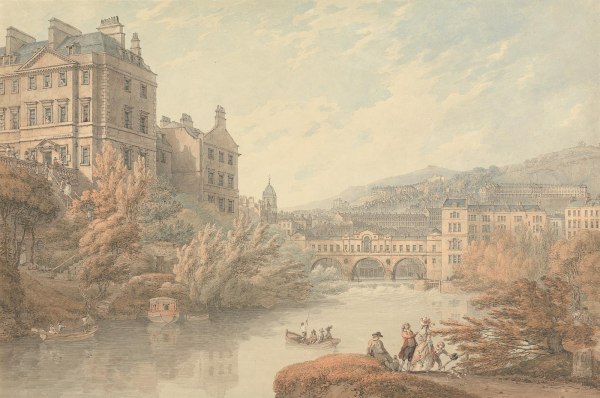
View of Bath from Spring Gardens, by Thomas Hearne, 1790
1801 George Austen retires from his ministry in Steventon and moves the family to Bath.
– Maria Edgeworth publishes Belinda.
1802 Austen accepts Harris Bigg-Wither’s proposal of marriage, but changes her mind the next day.
1803 “Susan” is sold to the publisher Crosby & Co, for £10, but he does not publish it.
– Britain declares war on Napoleon.
1804 Austen starts to write a novel entitled The Watsons, but is unable to finish it.
1805 George Austen dies.
1807 Austen, her mother and her sister Cassandra move to Southampton.
– Austen attempts to take back the manuscript of “Susan” from Crosby & Co. but the publisher refuses.

1809 Austen’s brother Edward accommodates her, her mother and her sister in a large cottage in Chawton, Hampshire; this becomes Austen’s home for the rest of her life.
– Susan, a popular novel by an anonymous author is published.
1811 Sense and Sensibility is published anonymously.
– Luddite riots erupt against industrialization in Nottinghamshire, Lancashire, and Yorkshire.
– George, Prince of Wales, becomes Regent due to the illness of his father George III.
1813 Pride and Prejudice is published anonymously.
– Eaton Stannard Barrett publishes The Heroine.
1814 Mansfield Park is published anonymously.
1815 The Prince Regent asks Austen to dedicate her next novel to him.
– France’s defeat at the battle of Waterloo marks the end of the Napoleonic Wars.
– Austen starts a new novel called “The Elliots,” which will only be published posthumously under the title Persuasion.
– Henry’s bank fails, leaving the whole family in a precarious state.
– Austen starts to suffer from a kidney disease, probably Addison’s.
– In December, Emma is published anonymously, with a dedication to the Prince Regent.
1816 Austen and her brother Henry buy “Susan” back from Crosby, and she starts revising it.

First edition of Northanger Abbey and Persuasion, published in 1817
1817 Austen starts a new novel, “The Brothers,” but is never able to complete it: it is published posthumously in 1925 under the title Sanditon.
– In May, Cassandra and Henry take Austen to Winchester to receive treatment; she dies there on 18 July, at the age of 41, and is buried in the cathedral.
– In December, Northanger Abbey and Persuasion are published, with a “Biographical Notice” by Austen’s brother Henry, officially identifying her as the author of her novels
1818 Mary Shelley publishes Frankenstein.
1843 Cassandra destroys almost all of Austen’s 3,000 letters.
1870 Austen’s nephew, James Edward Austen-Leigh, publishes a biography of the novelist entitled A Memoir of Jane Austen.
 The CONDORCET