1796 Mary Robinson publishes Sappho and Phaon.
1798 W. Wordsworth and S.T. Coleridge publish the Lyrical Ballads.
1806 Elizabeth Barrett Moulton-Barrett is born on March 6 in Coxhoe Hall, County Durham, the first child of Edward Barrett Moulton-Barrett and Mary Graham Clarke.
1807 Edward (‘Bro’), EBB’s first and favourite brother, is born.
– The Slave Trade Act prohibits the slave trade in the British Empire, though it does not yet make the purchase and ownership of slaves illegal.
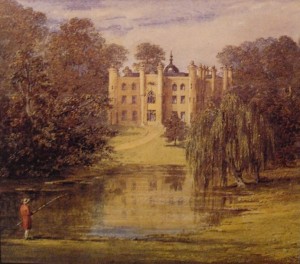
Hope End in the early 19th century.
1809 The Barrett family move to Hope End, in Ledbury, Herefordshire.
1812 EBB completes her first poem, “On the Cruelty of Forcement to Man,” a protest against impressment.
– On May 7, Robert Browning is born.
1817 EBB is allowed to attend lessons with the tutor preparing her brother Edward to enter the Charterhouse public school.
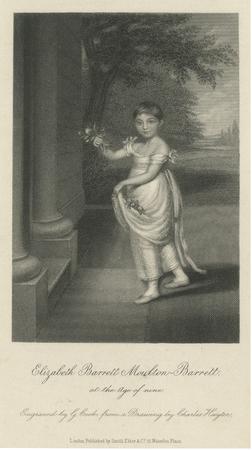
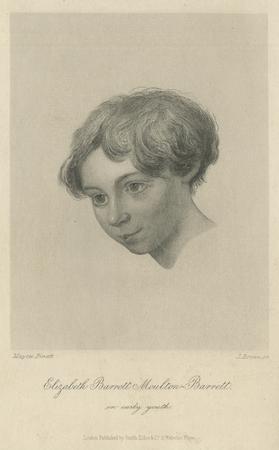
Portraits of EBB as a child at Hope End.
1819 On May 24, Victoria becomes Queen of the United Kingdom of Great Britain and Ireland.
1820 EBB completes The Battle of Marathon, an epic poem inspired by the battle between the Athenian and Persian forces in 490 B.C.; EBB’s father, to whom it is dedicated, publishes the poem privately.
1821 The Greek war of independence begins.
– In May, EBB publishes Stanzas Excited by Reflections on the Present State of Greece in “New Monthly Magazine”, in tribute to Greece’s independence.
– Letitia Elizabeth Landon publishes her first book of poetry, The Fate of Adelaide.
1824 EBB publishes Stanzas on the Death of Lord Byron in the “Globe and Traveller” magazine.
1826 EBB publishes her first collection of verse, An Essay on Mind, with Other Poems.
– Felicia Hemans publishes the poems Casabianca and The Homes of England.
1828 Mary, EBB’s mother, dies.
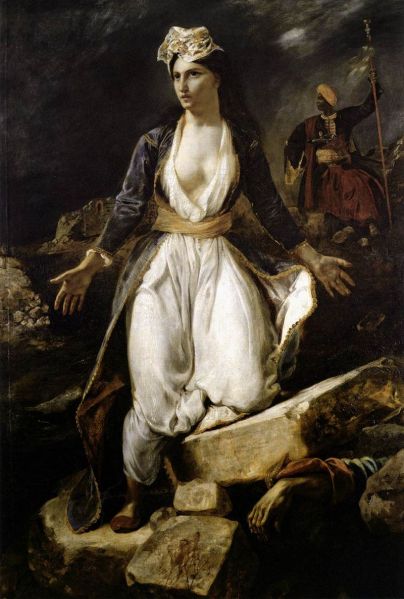
Eugène Delacroix, La Grèce sur les ruines de Missolonghi, 1826.
1830 After nine years of war, Greece becomes an independent state under the London Protocol.
– Alfred Tennyson publishes his first collection, Poems Chiefly Lyrical.
1832 A slave insurrection begins in the West Indies.
1833 The Slavery Abolition Act makes the purchase or ownership of slaves illegal within the British Empire with the exception of India; Edward Barrett Moulton-Barrett’s business interests in Jamaica collapse and the Barretts are forced to leave Hope End and settle in Devon.
– EBB publishes a translation of Aeschylus’ Prometheus Bound.
– Robert Browning anonymously publishes Pauline, a Fragment of a Confession, his first poem.
1835 Robert Browning publishes Paracelsus and gains access to the English literary world; EBB reads Browning’s work for the first time.
1836 Through John Kenyon, EBB makes the acquaintance of William Wordsworth and of Mary Russell Mitford, who becomes her closest friend.
1837 Samuel Barrett, EBB’s uncle and a former MP, dies and leaves EBB a handsome income.
1838 EBB publishes her first collection of poems under her own name, The Seraphim and Other Poems.
– The Barretts settle at 50 Wimpole Street, Marylebone, London, but EBB’s deteriorating health forces to stay in Torquay, Devonshire until 1841.
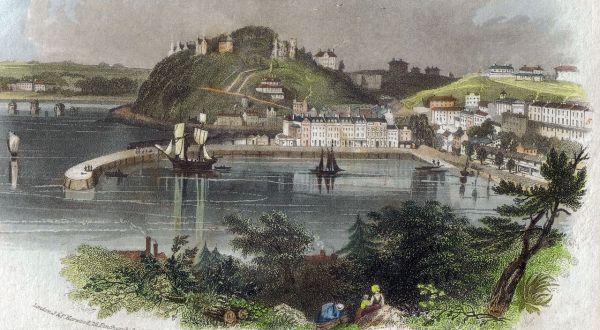
Torquay in 1842.
1840 On February 10, Queen Victoria and Prince Albert are married; five days later, EBB publishes The Crowned and Wedded Queen in the “Athenaeum” magazine to celebrate the marriage.
– In February, EBB’s brother Samuel dies of a fever in Jamaica.
– In July, EBB’s brother Edward drowns in a sailing accident in Torquay; EBB enters a period of quasi permanent seclusion in her room.
1841 Robert Browning publishes the first of the eight instalments of his collection of poems, Bells and Pomegranates; the poems are treated coldly by reviewers.
– Mary Russell Mitford offers EBB a cocker spaniel named Flush
1842 The Children’s Employment Commission publishes its report into the working conditions in British mines and factories.
1843 EBB publishes the poem The Cry of the Children in “Blackwood’s Magazine” to denounce child labour and raise support for a Ten Hours Bill.
– EBB publishes the poem Catarina to Camoëns in “Graham’s Magazine”.
– Flush is stolen and ransomed.
1844 EBB publishes her two-volume collection of Poems, which includes The Cry of the Children, Lady Geraldine’s Courtship and Catarina to Camoëns.
– Flush is stolen and ransomed again.
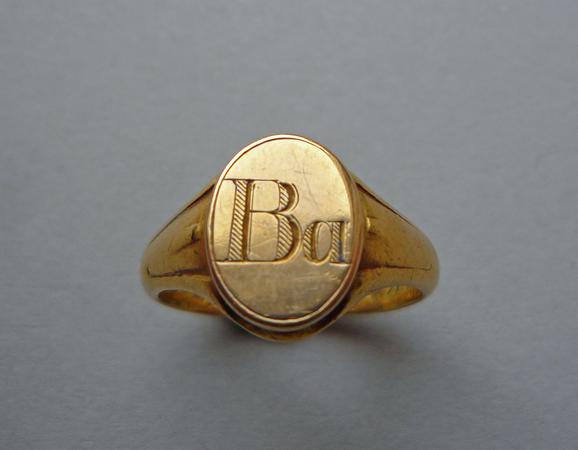
Gold ring given by EBB to RB in November 1845, containing a lock of her hair.
1845 On January 10, Robert Browning writes his first letter to EBB; she soon starts writing the poems that will be collected in Sonnets from the Portuguese.
– On May 20, EBB and Browning meet for the first time
– In the “Broadway Journal”, Edgar Allan Poe praises EBB’s poetic inspiration as “the highest – we can conceive of nothing more august” and dedicates his 1845 collection The Raven and Other Poems to her.
1846 Flush is stolen and ransomed yet again.
– On September 12, EBB and Robert Browning are married in secret at St Marylebone Parish Church, London, and leave for Florence, Italy.
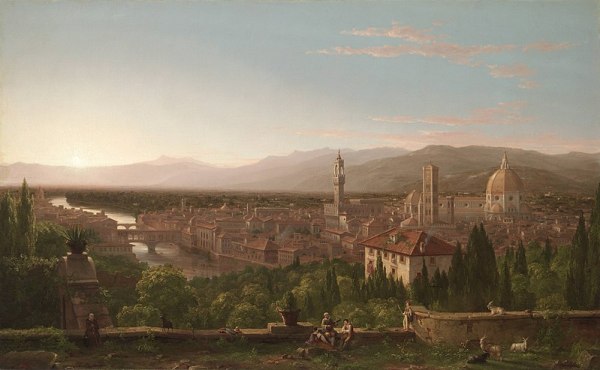
Thomas Cole, View of Florence, 1837.
1847 Parliament passes the Factories Act, which restricts the working hours of women and children.
1848 In January, revolts erupt in Sicily against the Austrian empire, sparking off more than two decades of conflict until the 1871 Risorgimento.
– The Brownings settle in Casa Guidi, in Florence.
– EBB publishes The Runaway Slave at Pilgrim’s Point in Boston’s abolitionist journal “The Liberty Bell”.
1849 On March 9, the Brownings’ only son, Robert Wiedeman Barrett Browning (“Pen”) is born.
– EBB shows to Browning the sonnets she has been writing about their relationship; he urges her to have them published.
1850 EBB publishes a revised edition of her Poems that includes Sonnets from the Portuguese, a sequence of 44 poems she has written since her first exchanges of letters with Browning.
– William Wordsworth dies on April 23; EBB and Leigh Hunt are shortlisted to succeed him as poet laureate, but the position goes to Alfred Tennyson.
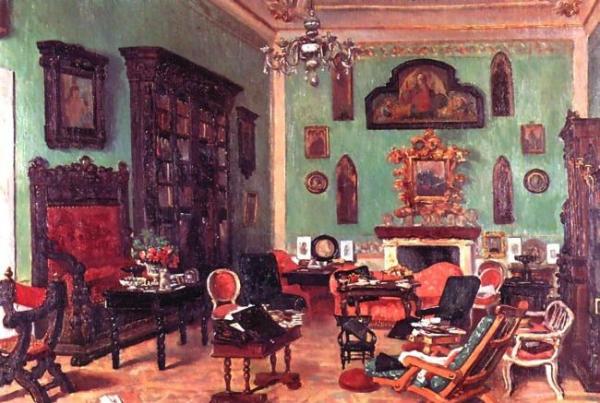
The Brownings’ drawing room in Casa Guidi in 1861.
1851 EBB publishes Casa Guidi Windows.
– The Brownings visit the Great Exhibition, held at the Crystal Palace in Hyde Park, London.
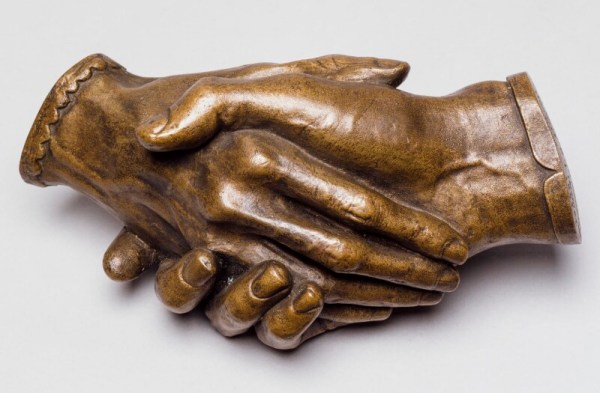
/ Bronze cast of EBB & RB’s clasped hands. By Harriet G. Hosmer, 1853.
1854 Flush dies.
1855 Robert Browning publishes his two-volume Men and Women.
1856 John Kenyan dies and leaves a handsome fortune to the Brownings.
1857 EBB publishes Aurora Leigh.
– On April 17, Edward Moulton-Barrett, EBB’s father, dies.
– EBB’s health deteriorates: the Brownings move to Siena and then Rome.
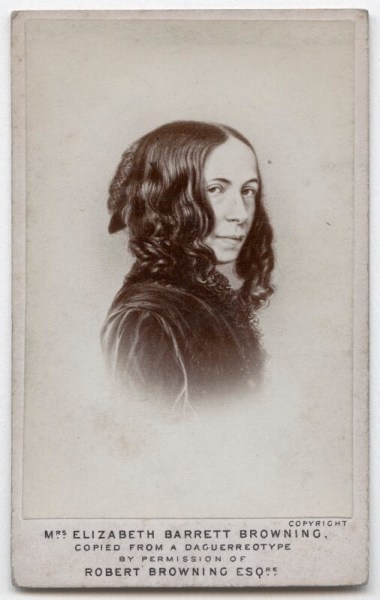
EBB in 1858.
1859 Charles Darwin publishes On the Origin of Species.
– John Stuart Mill publishes On Liberty.
– Robert Browning is invited to dine with the Prince of Wales in Rome.
1860 EBB publishes Poems before Congress, a collection of political poems.
– Nathaniel Hawthorne publishes The Marble Faun, whose Donatello is modelled on Robert Browning.
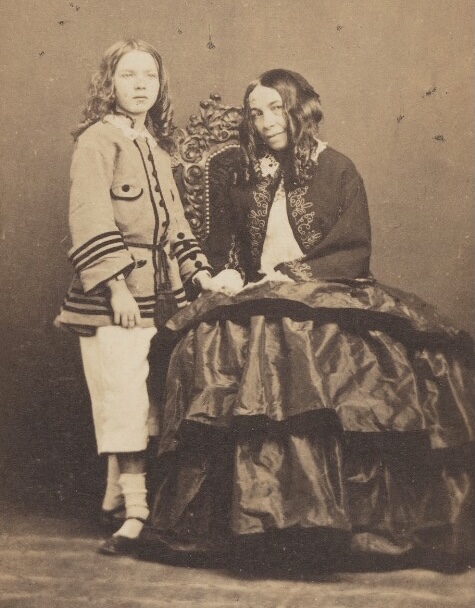
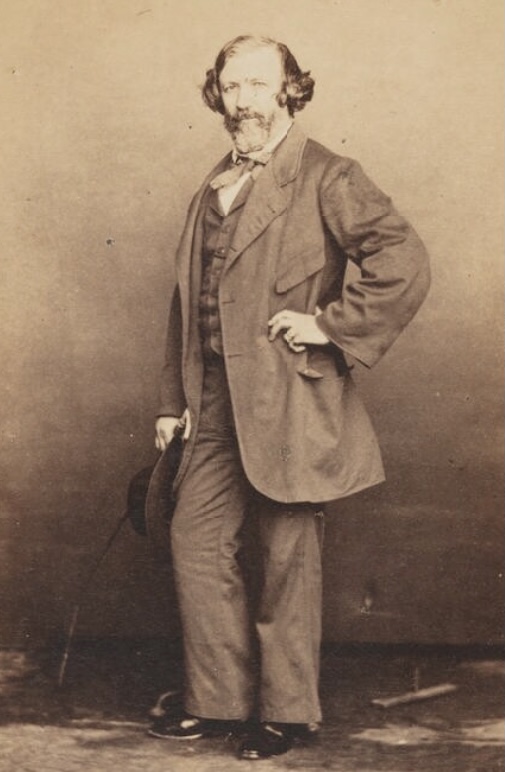
EBB, Robert Browning and Pen in 1860.
1861 On April 12, the American Civil War begins.
– On June 6, Camillo Cavour, the “father of the Italian nation”, dies in Turin.
– On June 29, EBB dies and is buried on July 1 in the English protestant cemetery of Florence.
1862 Robert Browning returns to London with his and EBB’s son, Pen.
– EBB’s Last Poems are published posthumously.
– Emily Dickinson writes her poem I think I was enchanted, paying tribute to EBB for having helped her grow from a “sombre Girl” into a poet.
1863 EBB’s The Greek Christian Poets and the English Poets is published posthumously.
1864 Robert Browning publishes Dramatis Personae.
1865 Passed by the U.S. Congress on January 31, 1865, the 13th Amendment to the American Constitution abolishes slavery.
– On May 9, 1865, the American Civil War ends.
1868 Robert Browning publishes The Ring and the Book.
1871 After 50 years of rebellion and conflict, the Italian unification is complete: Rome becomes the capital of the Kingdom of Italy.
1889 On December 12, Robert Browning dies in his son’s home in Venice and is buried in Poets’ Corner in Westminster Abbey.
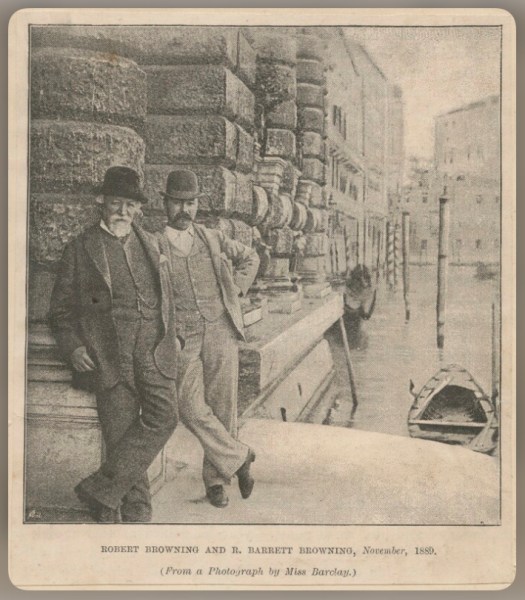
Robert Browning with his son Pen in Venice shortly before his death.
1899 The Letters of Robert Browning and Elizabeth Barrett Browning (1845-1846) are published.
1892 Alfred Tennyson dies.
1901 Queen Victoria dies and is succeeded by her son Edward VII.
1912 “Pen” dies in Asolo, Italy.
1933 Virginia Woolf publishes Flush: A Biography.
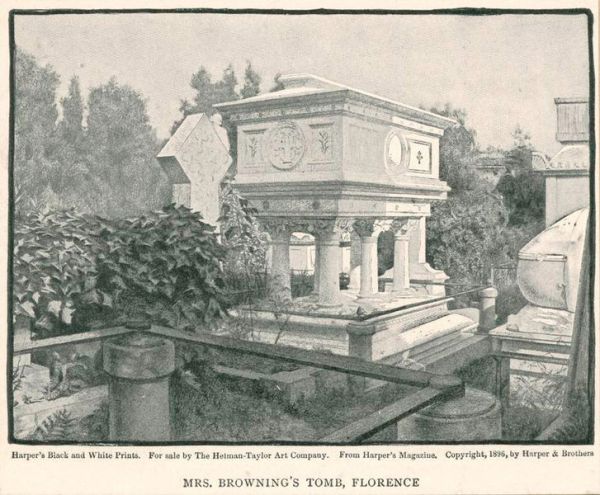
EBB’s tomb at the Cimitero degli Inglesi in Florence, 1896.

