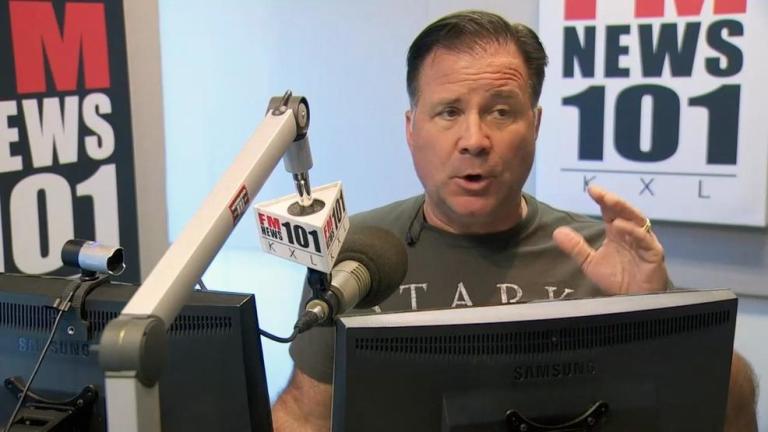
Lars Larson, host of The Lars Larson show on KXL radio
In the Trump era, immigration debate grows more heated over what words to use
By David Nakamura, The Washington Post, January 21, 2018
Lars Larson, a conservative radio host in Portland, Ore., who supports President Trump, uses the phrase “illegal aliens” on his nationally syndicated talk show to describe immigrants living in the country unlawfully. “I think it’s a way to define a problem,” Larson said. “We’re a nation of laws.” Cecilia Muñoz, a longtime immigrant rights advocate who served as President Barack Obama’s domestic policy adviser, calls those words “pejorative” and prefers alternatives such as “undocumented immigrants.” “Aliens, in the public mind, are not a good thing,” Muñoz said.
Their disagreement over how to describe an estimated population of 11 million people might seem like minor semantics in the tempestuous, decades-long debate over how to overhaul the nation’s immigration system. But people on both sides say the yawning gap in language has come to symbolize the inability of Congress and the general public to forge consensus.
Though Trump’s use of a vulgarity in a recent immigration meeting at the White House drew widespread condemnation, more mundane terms have been weaponized in pursuit of political advantage. On the right, Trump and his allies have warned of the dangers of “chain migration” and railed against “amnesty” for lawbreakers. Their choice of words suggests that immigrants are taking advantage of the US and are a drain on society. On the left, advocates have defended a tradition of “family reunification” and cast undocumented immigrants who arrived as children as “dreamers” and “kids” in need of special care. Their rhetoric paints immigrants as strivers seeking a chance at success.
“Who controls the parameters around language really has a lot of power in the debate,” said Roberto Gonzales, a professor at Harvard who specializes in immigration. “How do you frame an issue in a way that sways public opinion?” Although disagreements over immigration terminology predate Trump’s presidency, Gonzales said, the president’s willingness to use extreme rhetoric in the name of undermining political correctness has exacerbated the problem and raised the stakes. Gonzales pointed to Trump’s campaign against “chain migration” in the wake of a terrorist attack in New York in the fall in which the suspect, Sayfullo Habibullaevic Saipov, an immigrant from Uzbekistan, is charged with striking and killing eight people while driving a truck on a bike path. The president falsely claimed that Saipov, a permanent legal resident who is not a citizen, had helped two dozen foreign-born relatives immigrate to the US. In fact, there is no evidence he brought a single family member.
Jose Antonio Vargas, chief executive of Define American, a media advocacy group that focuses on immigration coverage, said conservatives have deliberately “created this entire linguistic parallel reality that is framed by the language they use.” Vargas pointed to outlets such as Breitbart News, which supports Trump and — until this month — was overseen by his former White House chief strategist, Stephen K. Bannon. Breitbart published recent stories with headlines such as “Illegal Aliens Escalate Amnesty Demands” and “Anchor Baby Population in U.S. Exceeds One Year of American Births.”
Define American has run a campaign, “Words Matter,” that asks news organizations to commit to dropping what Vargas calls “dehumanizing” phrases, such as “illegal immigrant.” Although some major outlets, including the Associated Press, have complied, Vargas said progress has been slow. “The right has been so good at using language as a weapon,” said Vargas, a former Post reporter who came out publicly in a 2011 New York Times article as an unauthorized immigrant from the Philippines.
Immigration hard-liners accuse advocacy groups of trying to discredit terms that have been considered mainstream for decades. The Department of Homeland Security, for example, continues to use the phrases “illegal alien” and “criminal alien” in reports, news releases and tweets. In 2014, after Congress failed to approve a comprehensive immigration bill, Obama used his executive authority to announce a deferred action program to shield up to 4 million undocumented parents of U.S. citizens from deportation by granting them renewable three-year work permits. In making his announcement, Obama said the program was not “amnesty.” His critics scoffed. “Any time a politician says something is not really amnesty, what everyone hears is that this is an amnesty,” said Mark Krikorian, executive director of the Center for Immigration Studies, which advocates lower immigration levels. “It would be, politically, so much better for them to just say, ‘Look, folks, I don’t like it either, but we have a tax amnesty, we have a parking ticket amnesty, and sometimes we have to do it.’ ”
Larson, the radio host, said immigrant advocates are “lying to the public to try to make something sound good that is not. I don’t say a bank robber is making undocumented withdrawals.”

