
Sean Keating, An Allegory, 1924.
3,500 BC The Neolithic peoples of the Boyne Valley in the north of Ireland build a complex of chamber tombs, standing stones and enclosures over a period of hundreds of years. This includes the unique archaeological site of Newgrange, in County Meath.
500 BC The Celts settle in Ireland during the Iron Age. Celtic influence in society, culture and art begins to take hold. The Irish Gaelic language originates from the languages spoken by the Celts, as in Scotland and on the Isle of Man.
300 BC The Clonycavan Man, one of the well-preserved bog bodies discovered in March 2003 in County Meath, is killed, possibly as part of a ritual sacrifice.
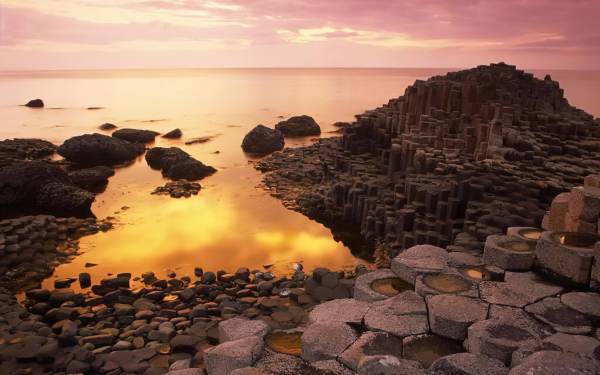
The Giants’ Causeway.
432 St Patrick, one of Ireland’s three patron saints (with St Columba and St Brigid), brings Christianity to Ireland.
563 The Irish abbot Columba creates a monastery on the Scottish island of Iona, marking the start of a Golden Age of Irish monastic influence in the British Isles. The Book of Kells, an illuminated manuscript of the New Testament now held at Trinity College, Dublin, is believed to have been crafted by monks at the Iona monastery circa 800.
795 The first Viking raids occur in the north of Ireland in Rathlin Island and Inishmurray.
852 Viking chiefs Ivar Beinlaus and Olaf the White land in Dublin Bay and establish a fortress there. Dublin becomes the Vikings’ stronghold in Ireland for two centuries.
1014 The Viking forces and their ally, the King of Leinster, are defeated by the armies of Brian Boru, the High King of Ireland, at the Battle of Clontarf. This marks the beginning of the decline of Viking power in Ireland.
1167 Having been deposed by Ruaidrí Ua Conchobair, King of Connacht, Dermot MacMurrough, the former King of Leinster, seeks support from Henry II of England to reclaim his crown. In 1171, Henry II lands at Waterford and declares his youngest son, John Lackland, Lord of Ireland. In 1175, the Treaty of Windsor consolidates English influence in Ireland.
1216 King Henry III of England issues the Great Charter of Ireland which secures rights for Anglo-Norman lords on the island.
1366 The Statutes of Kilkenny ban intermarriages between the Irish and the Anglo-Normans and prohibit the Anglo-Normans from adopting Irish customs and names.
1542 Henry VIII forces the Irish parliament to pass the Crown of Ireland Act, which establishes a Kingdom of Ireland to be ruled by him and his successors.
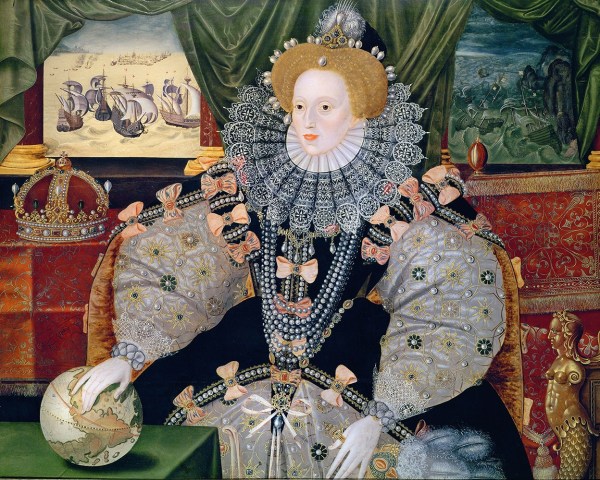
Elizabeth I, The Armada Portrait, ca. 1588
1570 Pope Pius V issues a papal bull that declares Elizabeth I a heretic and releases her subjects from any allegiance to her. In Ireland, appeals are issued to the Pope and the King of Spain for military assistance to protect the Catholic faith and preserve Catholic landowners’ property. This precipitates a backlash against Irish Catholics, are increasingly subjugated through a policy of plantation. The policy accelerates in 1610, under James I, when Scottish Presbyterians are encouraged to move to Ulster and take possession of newly confiscated land.
1649 Oliver Cromwell, leader of the newly formed Commonwealth, invades Ireland with an expeditionary force and crushes the Irish rebellion that began in 1641. Towns are sacked, and tens of thousands of rebels and civilians are massacred indiscriminately, notably in the town of Drogheda; some 50,000 more are sold as indentured servants and often sent to the American colonies. In 1652, the Act of Settlement of Ireland passed by Cromwell’s Parliament then bars Catholics from most public offices and confiscates large amounts of their land, much of which is given to Protestant settlers.
1688 The British Parliament invites William of Orange, a Protestant prince from the Netherlands, to rule England and Scotland, instead of James II, the Catholic king, who is deposed and flees to Ireland.
1690 On July 1, the forces of the deposed King James II are defeated by the armies of King William III of Orange, known as Orangemen, at the Battle of the Boyne, a river in the northeast of Ireland. This victory and the one at the Battle of Aughrim in 1691 are later commemorated by Orangists every July 12 (“the Twelfth”).
1695 Passed by the Irish Parliament, the Education Act is the first in a series of Penal Laws that set up systemic discrimination against Irish Catholics, forbidding them to vote, get elected, teach, join the army, buy or inherit land; additional bans are imposed on Irish music, language and literature. These laws are gradually repealed between 1771 and 1829, but the Protestant ascendancy in Ireland has been secured for good.
1762 Agrarian unrest affects many parts of the Irish countryside. This leads to the emergence of secret organizations amongst the Irish peasantry, such as the ‘Whiteboys’. These groups, although largely made up of Catholics, did not overtly campaign on political issues as such but instead concentrated on agrarian grievances. These include the enclosure of common land, the spread of livestock at the expense of tillage and the payment of a tithe to the Church of Ireland.
1782 Thanks to a political campaign led by the Irish MP Henry Grattan, Westminster concedes the principle of ‘legislative independence’ to the Irish parliament. A further series of Relief Acts are enacted, restoring further property rights to Irish Catholics.
1791 In Belfast the Society of United Irishmen is established. The new organization inspired by the ideal of the French Revolution and led mostly by radical Presbyterians sets out to end English control over Irish affairs. In 1794, the authorities move to suppress the United Irishmen and in response the organization turns into a secret society and commits itself to launching an armed rebellion to remove English control over Ireland. Leading members of the United Irishmen, such as the Protestant barrister Wolfe Tone, leave Ireland in search of military assistance for their plans.

Benjamin West, The Battle of the Boyne, 1778.
1795 In September, the Orange Order is established to commemorate the victory of William of Orange at the Battle of the Boyne in 1690. The next year, it organizes its first parade on 12 July (the ‘twelfth’).
1796 A French fleet of thirty-five ships with Wolfe Tone on board try to land in Ireland at Bantry Bay but are prevented from doing so by bad weather. Alarmed by the threat of an armed uprising the authorities in Ireland impose martial law, combined with harsh anti-insurgency measures across the Irish countryside.
1798 The United Irishmen plan for a national uprising for May but the plans are thwarted when most of its leadership is arrested. In August, a small French force under General Humbert lands in the west of Ireland in County Mayo. It gains some early military victories but an attempt to march on Dublin to attract new support fails and Humbert is defeated at Ballinamuck, County Longford. In October, another French invasion fleet is defeated off the coast of Donegal and Wolfe Tone is captured. On 19 November, Tone commits suicide, becoming a martyr of the nationalist cause.
1800 In response to the recent rebellions in Ireland, the English authorities decide that stability can only be restored through a union between Great Britain and Ireland. Legislation is drawn up to make this possible and includes the decision to seek the abolition of the Irish parliament.The Act of Union creates the United Kingdom of Great Britain and Ireland, governed through parliament in London. It takes effect on January 1, 1801.
1824 Under the leadership of Daniel O’Connell, a Catholic lawyer, the Catholic Association develops into a mass movement throughout Ireland demanding the removal of the political restrictions placed on Catholics in the UK.
1829 The Catholic Relief Actallows Irish Catholics to sit in parliament and to hold most senior civil and legal positions. The next year, Daniel O’Connell becomes an MP.
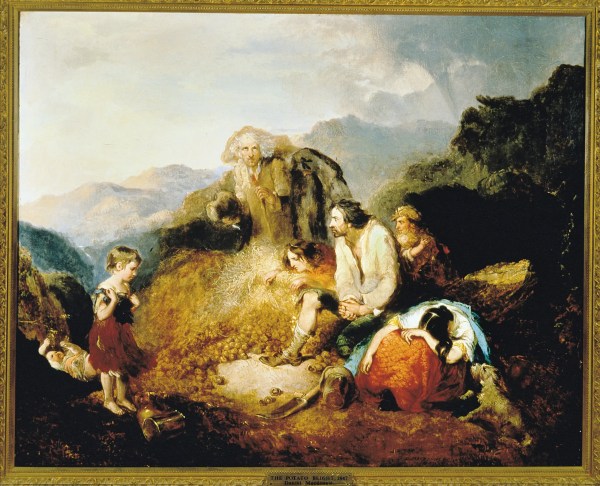
Daniel Macdonald, An Irish Peasant Family Discovering the Blight of Their Store, 1847.
1845 In August and September, a severe blight in the potato crop occurs across Ireland. This has far-reaching implications as huge numbers of the population are heavily dependent on the crop as their main food supply. To the problem of starvation is added the outbreak of epidemics such as typhoid and cholera, and several poor grain harvests in succession. The British government refuses to make emergency imports of corn and meal, and delivers little relief to the poor. In less than five years, an estimated 1m Irish people die because of the famine and another million emigrate: between 1841 and 1851, the whole population on the island is down from 8.1m to 6.5m.
1848 Born in the early 1840s, Young Ireland is a radical political movement that gradually promotes violent action to defend the nationalist cause. Inspired by the outbreaks of popular revolutions across Europe, it makes plans for a rising in Ireland in 1848. The authorities however have prior knowledge of their plans and when the rebellion finally occurs in late July, it quickly ends in failure. The leading members of Young Ireland who have not already fled to America are arrested and convicted of treason. But their death sentences are later commuted and instead they are transported to penal colonies in Australia.
1858 James Stephens, a Young Ireland leader who fled to America in 1848 and returned to Ireland in 1856, founds the Irish Republican Brotherhood (IRB), a secret revolutionary group. The IRB is committed to removing British influence in Ireland by means of an armed insurrection. In America, its sympathizers form the Fenian Brotherhood and soon the term ‘Fenian’ is applied to describe both organizations.
1869 The Church of Ireland (which is Anglican and unpopular among nationalists) is disestablished on the island.
1875 Charles Stewart Parnell, a Protestant landlord and future chairman of the Irish Parliamentary Party, becomes an MP in Westminster and becomes the champion of Irish self-government, known as Home Rule. He eventually convinces the British Prime Minister William Gladstone, a Liberal, to introduce a bill in Parliament in 1886.
1879-1882 An economic downturn and poor weather conditions result in a series of bad harvests in many parts of Ireland. Consequently, many tenants are unable to pay their rent and are faced with the threat of eviction. The growing unrest that this produces in the Irish countryside becomes known as the ‘Land War’. At a mass meeting to protest at the situation at Irishtown, County Mayo, the political activist Michael Davitt pledges to lead a fight to gain better rights for Irish tenants, focusing on three main demands: fair rent, fixity of tenure and freedom of sale (these become known as the three ‘Fs’). To further his campaign Davitt establishes the Irish National League (INL) and persuades Charles Stewart Parnell to become its first President. The next year, the INL advocates a new strategy based on the principle that it should ostracize anyone suspected of not fully supporting or cooperating with its cause. The tactic itself is first applied in County Mayo on a local land agent called Captain Hugh Cunningham Boycott and is soon simply referred to as ‘boycotting’.
1884 The Gaelic Athletic Association (GAA) is founded to promote sporting pastimes with a distinctive Irish background, notably Gaelic football and hurling.
1886 William Gladstone supports a vote on Irish Home Rule that would include a separate parliament and government to be set up in Dublin which would have control over all Irish affairs except defense issues, foreign relations, trade and customs.In the Commons, his party splits between supporters of Home Rule and Unionists, the vote fails, and the Conservatives, who oppose Home Rule, return to power.
1890 Charles Parnell’s affair with Kitty O’Shea becomes public. His political career collapses and he dies the next year.
1893 Having returned to power, Gladstone’s Liberals introduce a second Home Rule bill; the bill has a majority in the Commons, but it is rejected by the House of Lords. In 1894, Gladstone retires from political life and in 1895, the Conservatives win a significant majority in Parliament, which they keep for more than ten years, taking Home Rule off the table.

The Abbey Theatre.
1904 William Butler Yeats and Lady Gregory cofound the Abbey Theatre in Dublin, which becomes the epicenter of the Celtic Twilight.
1905 In November, Arthur Griffith, a Dublin journalist, creates the political party Sinn Fein, meaning ‘we ourselves’ in Gaelic. Its aim is to free Ireland from British rule and gain independence for the whole of Ireland.
1912 Introduced by Lloyd George, the Liberal Prime Minister, the Home Rule Act passes at last in Parliament, but the outbreak of World War I in August 1914 delays implementation.
1913 Protestant militants in Ulster form the Ulster Volunteer Force, an armed militia, and warn that they will resist militarily any attempt to introduce Home Rule in Ireland. In Dublin, supporters of Home Rule form their own militia, called the Irish Volunteers.
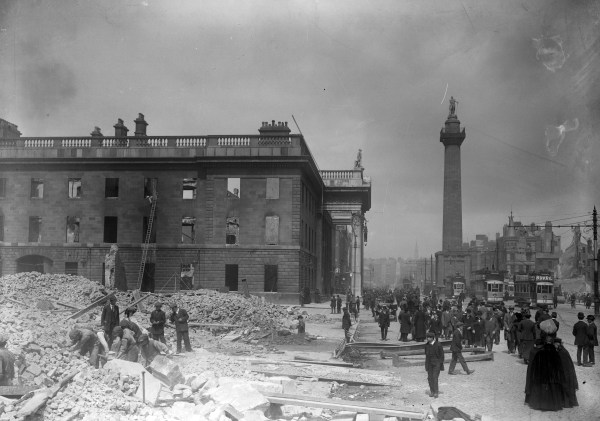
The shell of the General Post Office after the Easter Rising.
1916 Taking advantage of the fact that Britain is stuck in the war against Germany, an armed insurrection of 1,200 Irish nationalists attempts to overthrow the British administration in Dublin over Easter weekend, seizing the General Post Office and proclaiming an independent Irish republic. The rising is crushed by the 20,000 British troops, who execute 15 of its leaders, including Patrick Pearse and James Connoly. The insurrection becomes known as the Easter Rising. The executions lead to a rise in support for Sinn Féin across the island.
1919 Led by Éamonn De Valera, the president of Sinn Fein, the nationalist movement sets up a Dublin assembly, the Dáil Éireann, which proclaims Irish independence. A brutal three-year war between the nationalist armed forces – the Irish Republican Army (IRA), led by Michael Collins – and British troops follows. On 21 November 1920, the IRA kills 11 Englishmen suspected of being intelligence agents. “Black and Tans” (former British soldiers serving as reinforcements in the Royal Irish Constabulary) take revenge the same afternoon, attacking spectators at a Gaelic football match in Croke Park, Dublin, killing 12 and wounding 60. This becomes known as Bloody Sunday. The Irish War of Independence ends with a ceasefire in July 1921.
1921 In December 1921, the Anglo-Irish Treaty establishes the Irish Free State, an independent dominion of the British crown of 26 counties, including 3 counties of the province of Ulster (Cavan, Donegal, Monaghan), with full internal self-government rights in Dublin, partitioned from the 6 other counties in Ulster (Antrim, Armagh, Down, Fermanagh, Londonderry, Tyrone) which remain part of the UK and retain their own assembly (the Stormont) in Belfast.
1922 The Dublin parliament ratifies the Anglo-Irish Treaty. Yet, opponents of the treaty like De Valera, who refuse to let Ireland be partitioned, take up arms against former IRA comrades and a civil war ensues. Michael Collins is killed in an ambush just before a truce is declared. The civil war officially ends in May 1923.
1926 De Valera founds the Fianna Fail party, which will dominate Irish politics in the next decades. Defenders of the Anglo-Irish Treaty, on the other hand, later found the Fine Gael party, Fianna Fail’s main rival in modern Irish politics.
1937 Irish voters approve a new constitution that proclaims Éire (Irish for Ireland) as a sovereign, independent, democratic state.
1949 Eire becomes the Republic of Ireland, with a president instead of the British King, and leaves Commonwealth.
1956 The Irish Republican Army (IRA) begins what it calls a “Campaign of Resistance to British Occupation,” also known as the “Border Campaign”. The campaign ends in 1962 because of lack of support.
1966 Rioting breaks out in Belfast as Loyalists hold counterdemonstrations to oppose commemorations of the 1916 Easter Rising. The same year, the Ulster Volunteer Force is created as a loyalist paramilitary group and starts carrying out terrorist actions.
1967 On 1 February, the Northern Ireland Civil Rights Association (NICRA) is formed. Based on the US civil rights movement that fought for equality for African Americans, it opposes the discriminations endured by Catholics in Northern Ireland.
1968 On 5 October, a civil rights march in Derry is halted by the RUC with batons and water cannons. Rioting follows. The march is considered to mark the beginning of the Troubles.

The Battle of the Bogside.
1969 The 12 August loyalist parade passing through the nationalist Bogside ghetto of Derry sparks rioting. The incident becomes known as the Battle of the Bogside. Two days later, the British Army enters Derry. At first the troops are welcomed by the population, but sectarian violence worsens. In December the same year, the IRA is rebooted in Dublin. Serving as the paramilitary arm of Sinn Fein, its renewed goal is to remove Northern Ireland from the UK and create a worker’s republic encompassing all of Ireland. Just a few weeks later, however, a split occurs between the “Official” IRA and the “Provisional” IRA, the latter advocating more violent action and rejecting political participation. Soon enough, the Provisional IRA (or “Provos”) becomes the most powerful branch.
1971 Free circulation between Northern Ireland and the Republic is suspended; military checkpoints are set up along the border and will remain all through the Troubles. In August, the British government attempts to crack down on nationalist violence by introducing internment without trial. Between 1971 and 1975, nearly 2,000 people, a vast majority of them Catholics, are held without trial on suspicion of involvement in terrorism. These arbitrary arrests only increase local support for the IRA. The same year, Ian Paisley forms the Democratic Unionist Party, which becomes the intransigent wing of Ulster Unionism. The Ulster Defense Association, the second main loyalist paramilitary group after the UVF, is also created.
1972 On 30 January, a protest against internment in Derry is fired upon by British troops. 13 people are shot dead and another one dies later. Troops claim they were fired upon first; this claim is debunked by the Saville report in 2010. Thousands of people sign up to the IRA in the days that follow. In February, the British embassy in Dublin is burnt. In March, the British government suspends the Northern Ireland parliament and introduces direct rule from Westminster. As a whole, 497 people are killed in Northern Ireland in 1972, making it the worst year during the whole of the Troubles.
1973 The Republic of Irelandand the UK join the European Economic Community: while violence in Northern Ireland intensifies, relations between both countries are strained.
1974 In November, 21 people are killed when the IRA bombs two pubs in Birmingham. The British government responds by introducing the Prevention of Terrorism Act, which allows suspects to be held without charge for up to 7 days. In December, a bomb explodes at the House of Commons, injuring 11 people. Meanwhile, loyalist terrorist actions kill 33 in Ireland the same year. In December, the Irish National Liberation Army (INLA) is created, becoming the second main republican paramilitary group after the IRA.
1979 In August, Lord Mountbatten, Royal Navy admiral and uncle of Prince Philip, is assassinated by the IRA.

IRA patrol in Belfast in the 1980s.
1981 In March, Bobby Sands, an IRA prisoner at the Maze prison in Northern Ireland, begins a hunger strike to protest conditions of imprisonment for political inmates. He is elected to the UK Parliament during his hunger strike but eventually dies in May after refusing food for 66 days. Around 100,000 people attend his funeral. Nine other Republicans die on hunger strike between May 12 and August 20, 1981, including Heaney’s neighbor Francis Hughes, from Bellaghy. The ten men becomes martyrs of the nationalist cause and symbols on the Thatcher government’s intransigence.
1984 The IRA bombs Grand Hotel in Brighton during the Conservative Party conference, killing 5 people and injuring 34 others. The Prime Minister herself was a target. The same year, Gerry Adams become leader of Sinn Fein.
1985 The Anglo-Irish Agreement gives the Republic of Ireland a consultative role in the government of Northern Ireland.

Derry murals in the 1990s. (c) https://lalunemauve.fr/irlande-du-nord-derry-peintures-murales/
1991 The IRA launches mortar bombs at 10 Downing Street.
1993 In a statement on 15 December – the Downing Street Declaration – the new British prime minister, John Major, and the Irish Taoiseach, Albert Reynolds, agree in principle on talks on the future of Northern Ireland. Any party that “renounces violence” is invited to take part, opening the way for Sinn Féin if it can prove the IRA is committed to decommissioning (i.e., surrendering and destroying) its weapons.
1994 On 31 August, the IRA declares a ceasefire in Northern Ireland, a gesture followed a month later by Protestant paramilitaries. The first formal talks between the British government and Sinn Féin begin in December.
1995 After decades of economic stagnation and poverty, the Republic of Ireland enters the “Celtic Tiger” period, a time of unprecedented economic growth.
1996 On 9 February, the IRA declares an end to its ceasefire after the Major government insists on decommissioning weapons as a condition of talks. Moments later, the IRA explodes a bomb at Canary Wharf, killing 2 people and causing millions of pounds worth of damage.
1997 In July, the IRA announces a new ceasefire. Tony Blair, now British prime minister, announces that decommissioning will take place in parallel with talks. The U.S. Senator George Mitchell, who is presiding over the talks, sets a deadline of 9 April for the parties to reach an agreement.

Front cover of the Good Friday Agreement with the signatures of all the major participants.
1998 On April 10, a peace deal is officialized. The deal, known as the Good Friday agreement, includes the restoration of a devolved assembly at Stormont and guarantees a cross-community power-sharing local government and a role for the Republic of Ireland in the affairs of the north. The deal is approved in referenda staged in Northern Ireland (by 71.12%) and in the Irish republic (by 94.4%). On 15 August, the Real IRA, a splinter groups, kills 26 people and injures 200 more with a bomb planted in Omagh, in Northern Ireland. In October, John Hume, leader of the moderate nationalist party SDLP, and David Trimble, the leader of the Ulster Unionists, are jointly awarded the Nobel Peace Prize. The same year, Trimble becomes First Minister of the newly convened Northern Ireland Assembly, but between 2001 and 2006, devolution is suspended repeatedly due to the IRA’s reluctance to decommission its arms.
2002 The euro replaces the Irish punt as national currency.
2005 In July, the IRA finally announces a formal end to armed conflict and orders units to dump all their weapons.
2007 In March, the Northen Ireland Assembly elections are held. Ian Paisley’s DUP wins the majority; Sinn Fein comes second. Paisley agrees with Gerry Adams, the leader of Sinn Fein, to form a power-sharing government with Irish nationalists, with him as First Minister and Sinn Fein’s Martin McGuinness (a former IRA commander) as his deputy. The next year, Paisley steps down as first minister and is replaced by Peter Robinson, the DUP’s new leader.
2009 In March, dissident republican paramilitaries shoot 2 British soldiers dead outside their barracks near Antrim. The same month a police officer is also shot dead in Craigavon. Various dissident republican terrorist groups claim both killings, including the Real IRA, notorious for the Omagh bombing in 1998. Sinn Fein political leaders denounce them as traitors.
2010 38 years after Bloody Sunday, an investigation launched by Tony Blair in 1998 concludes that, though they were not a premeditated state conspiracy, the shootings of January 1972 were “unjustified” and had been covered up. Blair’s Conservative successor at Number 10, David Cameron apologizes on behalf of the British state.

President of the Irish Republic Mary McAleese, Queen Elizabeth II and GAA President Christy Cooney at Croke Park, Dublin, the site of the 1920 massacre, in 2011.
2011 In March, policing and justice powers are transferred from London to Belfast. In May, Queen Elizabeth pays official visit to Ireland, the first by a British monarch since independence.
2014 President Michael D. Higgins goes on an official visit to Britain, the first by an Irish head of state.
2016 In June, a majority of 52% of British people vote to leave the European Union, but in Northern Ireland, a majority of 56% of voters choose Remain. This stirs frustrations in the province, as well as fears that the return of a hard border between Northern Ireland and the Republic after Brexit will revive sectarian violence. The Northern Ireland Protocol (NIP) of the Brexit withdrawal agreement which comes into effect on January 1, 2021, temporarily resolves the problem by creating the equivalent of a border between Britain and Northern Ireland along the Irish Sea. The Protocol is then adjusted by the Windsor Framework in March 2023. But the dual situation of Northern Ireland, both outside the E.U. and organically connected to a country within is intractable.
2022 For the first time in history, Sinn Fein wins the Northern Ireland Assembly election, with a short majority of 29%. The party’s vice-president, Michelle O’Neill, becomes First Minister of the power-sharing government. This comes two years after Sinn Fein also won the popular vote in the Irish general election in the Republic of Ireland for the first time in its history. Sinn Fein’s rise on both sides of the border as well as the peculiar circumstances of Brexit make the prospect of reunification more plausible than ever
 The CONDORCET