
Tennessee Williams in the 1950s
1898 Konstantin Stanislavski founds the Moscow Art Theatre. The same year, the company performs Anton Chekhov’s play The Seagull, with Stanislavski playing Trigorin and Vsevolod Meyerhold playing Konstantin.
1909 Rose Isabel Williams, Williams’s elder sister, is born.
1911 On March 26, 1911, Thomas Lanier Williams III is born in Columbus, Mississippi.
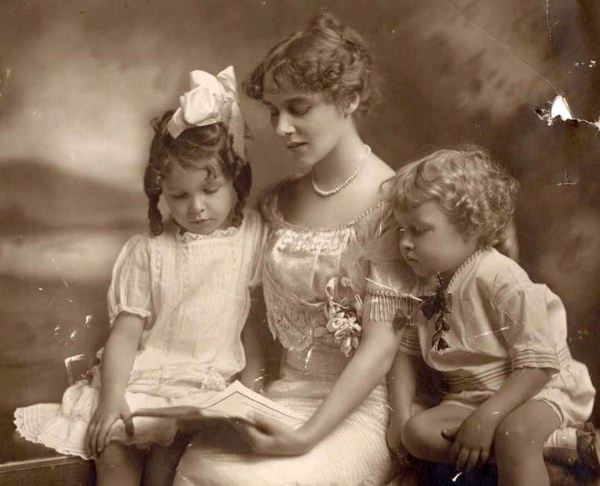
Edwina Williams, Rose Williams, and Thomas Lanier Williams in 1915
1916 Williams contracts diphteria, which leaves him paralyzed from the waist down for almost two years.
1918 Williams’s father is promoted to a job at the home office of the International Shoe Company in St. Louis, Missouri; the family moves there the next year.
1919 Walter Dakin Williams, Williams’s younger brother, is born.
1925-9 Williams attends Soldan High School, then transfers to University High School.
1927 Williams wins third prize for an essay entitled “Can a Good Wife Be a Good Sport?” and published in “Smart Set” magazine.
1928 Williams’s publishes his first short story “The Vengeance of Nitocris” in “Weird Tales” magazine.
— Williams’s maternal grandfather Reverend Dakin takes him on a trip to Europe.
1929 In October, the Wall Street Crash sparks off the Great Depression.
1929-31 Williams studies liberal arts and journalism at the University of Missouri at Columbia; disappointed with his grades, his father pulls him out after two years and forces him to work at the International Shoe Company and study typing in night classes.

Williams’s annotated copy of The Collected Poems of Hart Crane
1930 Williams completes his first play, a 12-page one act play entitled Beauty Is the Word.
— Hart Crane publishes the poem The Bridge.
1931 Eugene O’Neill’s play Mourning Becomes Electra premieres on Broadway.
— The Group Theatre is formed in New York City by Harold Clurman, Cheryl Crawford and Lee Strasberg.
1932 In November, Franklin Delano Roosevelt is elected President; the New Deal begins.
— Hart Crane drowns himself in the Gulf of Mexico.
1935 Produced by the Group Theatre, Clifford Odets’s play Waiting for Lefty premieres on Broadway.

Foto-Life of Tennessee Williams, 1930s
1935 Williams suffers a nervous breakdown and recuperates at his grandparents’ home in Memphis, Tennessee; he completes another one-act play, Cairo, Shanghai, Bombay!, which is the first one to be produced at a local community theater. Williams then enrolls at Washington University in St. Louis, where he completes and produces two more plays with a group of local amateur actors, the Mummers. The same year, Williams’s mother separates from his father.
1937 Williams transfers to the University of Iowa and graduates with a B.A. in English.
— Rose is subjected to a botched lobotomy and remains incapacitated the rest of her life.
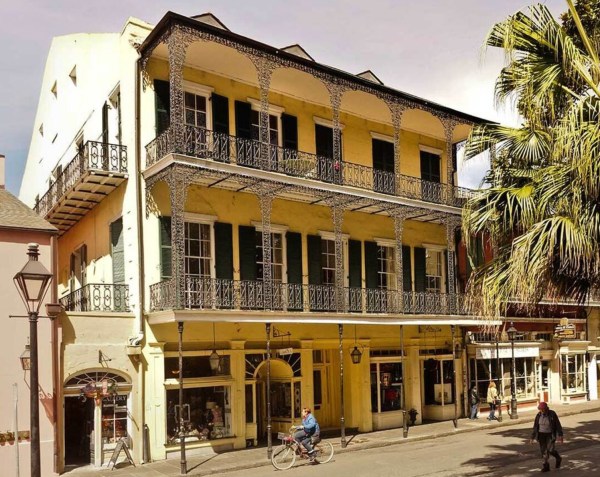
431 Royal Street, Williams’s first residence in New Orleans
1938 Williams moves to New Orleans, Louisiana, and starts living in the French Quarter; he has his first homosexual relationships there.
— Konstantin Stanislavski publishes his acting manual, An Actor’s Work.
— Thornton Wilder’s Our Town opens on Broadway.

Tennessee Williams, Self-portrait, 1939
1939 Williams submits three short plays gathered under the title American Blues to a Group Theatre contest: he is rewarded with a cheque for $100 and is put in contact with Audrey Wood, a theatrical agent from New York. The same year, he is awarded a $1,000 grant from the Rockefeller Foundation. This is also when he starts using “Tennessee” as a pen name.
— The German theatre director Erwin Piscator, the foremost exponent of epic theatre along with Bertolt Brecht, emigrates to the U.S. and creates the Dramatic Workshop at the New School for Social Research in New York City.
— Directed by Victor Fleming and produced by Metro-Goldwyn-Mayer, the musical The Wizard of Oz is released; adapted from Frank Baum’s children’s fantasy novel published in 1900, it takes place during the Great Depression and stars Judy Garland.
— Also directed by Victor Fleming and produced by Metro-Goldwyn-Mayer, the film adaptation of Gone with the Wind, Margaret Mitchell’s best-selling novel published in 1936, is released: it stars Vivien Leigh and Clark Gable.
1940 Battle of Angels, Williams’ first commercially produced play, premieres in Boston, Massachusetts, but is poorly received and never makes it to Broadway.
1940-3 Williams studies with the theatre historian and critic John Gassner at the Dramatic Workshop of the New School for Social Research in New York City; he familiarizes himself with Erwin Piscator’s ideas about expressionism and epic theatre of.
1941 On December 7, the Japanese air force attacks the American naval base at Pearl Harbor in Honolulu, Hawaii; the U.S. enters WW2 alongside the allied forces.
— Bertolt Brecht emigrates to the U.S.

Cover page of Williams’s Gentleman Caller script, 1943
1943 Williams signs a six-month contract as a scriptwriter with MGM and moves to Santa Monica, Ca.; he writes the script of The Gentleman Caller, but it is rejected by the studio. The same year, Williams also writes the short story “Portrait of a Girl in Glass”.
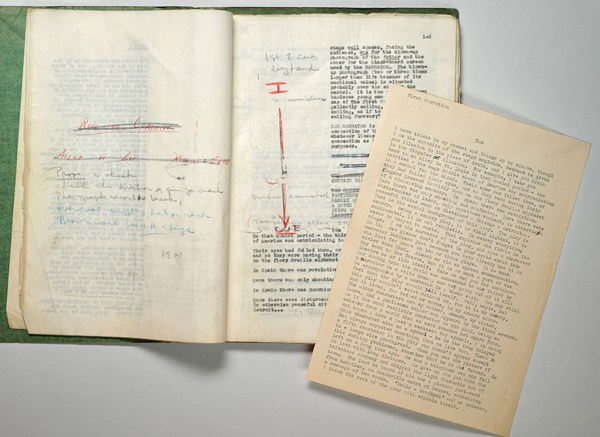
The Glass Menagerie, typed playscript annotated by Margo Jones and others
1944 On December 26, 1944, The Glass Menagerie premieres at the Civic Theatre in Chicago. The production is co-directed by Eddie Dowling and Margo Jones. Dowling plays Tom Wingfield, Laurette Taylor plays Amanda Wingfield, Julie Haydon plays Laura, and Anthony Ross plays Jim O’Connor. The music is composed by Paul Bowles.
— Jean-Paul Sartre’s Huis clos premieres at the Theâtre du Vieux-Colombier in Paris.

Anthony Ross, Laurette Taylor, Eddie Dowling and Julie Haydon in the Broadway production of The Glass Menagerie in 1945
1945 On March 31, The Glass Menagerie opens on Broadway, at the Playhouse Theatre, and runs for 563 performances, before moving to the Royal Theatre for one month. The play wins the New York Drama Critics’ Award and the Academy Award in Literature.
1946 Williams moves to Mexico to work on A Streetcar Named Desire.
— Laurette Taylor dies of illness.
1947 Directed by Elia Kazan, A Streetcar Named Desire opens on Broadway; Jessica Tandy plays Blanche DuBois, Marlon Brando plays Stanley Kowalsky, Kim Hunter plays Stella and Karl Malden plays Mitch. Williams receives the Pulitzer Prize for Drama.
— Eliza Kazan, Cheryl Crawford and Robert Lewis found the Actors Studio in NYC.

Thomas Hart Benson: Poker Night (from A Streetcar Named Desire), 1948
1948 The Glass Menagerie opens in London at the Theatre Royal Haymarket in a production directed by John Gielgud. The same year, Williams’s play Summer and Smoke premieres on Broadway; it is directed by Margo Jones. Williams also publishes the short story collection entitled One Arm and Other Stories, which includes “Portrait of a Girl in Glass”.
1949 Arthur Miller’s play Death of Salesman, directed by Elia Kazan, premieres on Broadway.
1950 Williams’s first novel, The Roman Spring of Mrs. Stone, is published. The same year, a film adaptation of The Glass Menagerie is released; directed by Irving Rapper, it stars Gertrude Lawrence as Amanda, Jane Wyman as Laura, Arthur Kennedy as Tom, and Kirk Douglas as Jim O’Connor. Williams is credited for co-writing the screenplay but disavows the film.
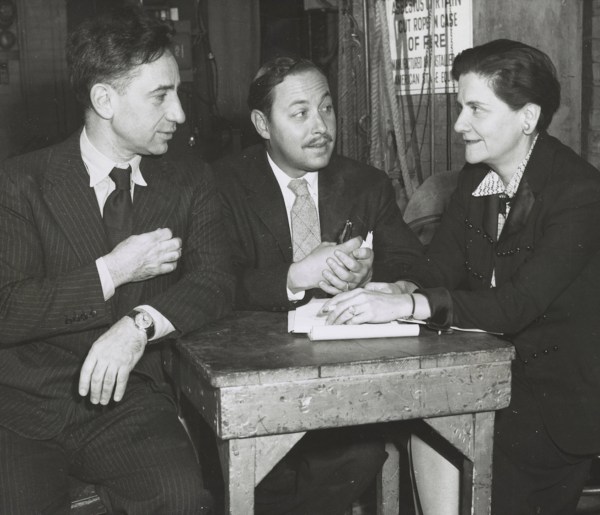
Tennesse Williams, with Elia Kazan and Cheryl Crawford
1951 A radio adaptation of The Glass Menagerie is performed on Theatre Guild on the Air, with Helen Hayes reprising her role in the Gielgud production as Amanda, Montgomery Clift as Tom, Kathryn Baird as Laura and Karl Malden as Jim. The same year, Williams’s next play, The Rose Tattoo, premieres on Broadway, directed by Cheryl Crawford; Williams is rewarded with a Tony Award for the best play of the year. Meanwhile, Elia Kazan’s film adaptation of A Streetcar Named Desire is released; Vivien Leigh replaces Jessica Tandy in the role of Blanche DuBois.

Williams with Elia Kazan and Vivien Leigh on the film set of A Streetcar Named Desire
1953 Directed by Elia Kazan, Williams’s next play, Camino Real, premieres on Broadway.
— Eugene O’Neill dies.
1955 Directed by Elia Kazan, Williams’s next play, Cat on a Hot Tin Roof (1955), premieres on Broadway, with Ben Gazzara in the role of Brick. Williams is rewarded with a second Pulitzer Prize for Drama and a second New York Drama Critics’ Circle award.
— Reverend Walter Dakin, Williams’s maternal grandfather, dies.
1956 Elia Kazan’s film Baby Doll is released; the film is based on a screenplay by Tennessee Williams and stars Carroll Baker, Eli Wallach and Karl Malden.
— Eugene O’Neill’s posthumous play Long Day’s Journey into Night premieres on Broadway.
1957 Williams’s next play, Orpheus Descending, opens on Broadway. The same year, he starts psychoanalysis with Dr. L. Kubie, but breaks it off one year later.
— Cornelius Coffin Williams, Williams’s father, dies.
1958 Williams’s one-act play Suddenly Last Summer premieres Off-Broadway.
— Richard Brooks’s film adaptation of Cat on a Hot Tin Roof is released; it stars Paul Newman as Brick, Elizabeth Taylor as Maggie the Cat, and Burl Ives as Big Daddy.
1959 Directed by Elia Kazan, Williams’s next play, Sweet Bird of Youth, premieres on Broadway; it stars Paul Newman and Geraldine Page.
— Joseph Mankiewicz’s film adaptation of Suddenly, Last Summer is released. The screenplay is co-written by Tennessee Williams and Gore Vidal, and the film stars Elizabeth Taylor as Catharine Holly, Katharine Hepburn as Violet Venable, and Montgomery Clift as Dr. John Cukrowicz.
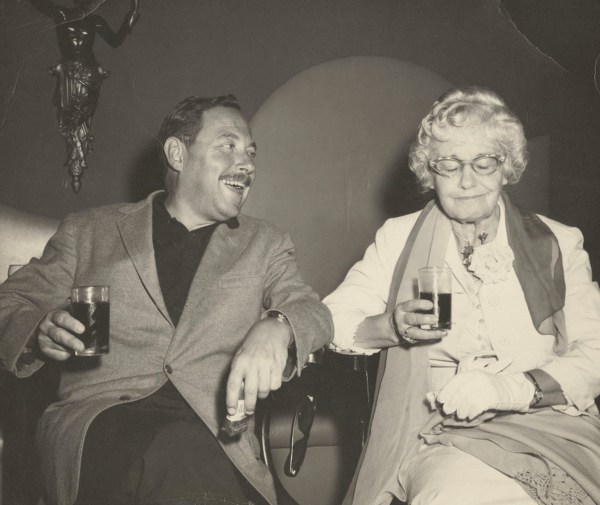
Williams with his mother Edwina
1960 Adapted from Williams’s play Orpheus Descending, Sidney Lumet’s film The Fugitive Kind is released: it stars Marlon Brando, Anna Magnani and Joanne Woodward.
1961 Williams’s play The Night of the Iguana premieres on Broadway; it stars Patrick O’Neal as Reverend T. Lawrence Shannon and Bette Davis as Maxine Faulk.
— Williams’s novel The Roman Spring of Mrs. Stone is adapted into a feature film directed by José Quintero; it stars Vivien Leigh and Warren Beatty.
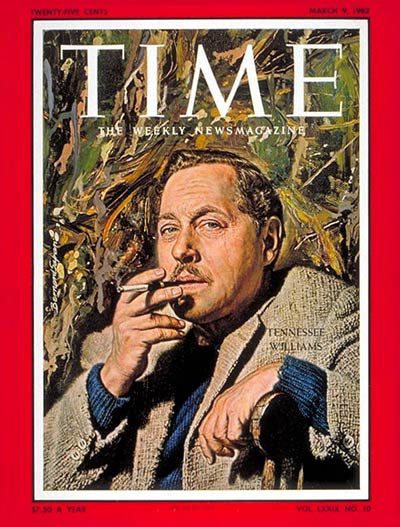
Time magazine, March 9, 1962
1962 Williams appears on the cover of Time magazine as “America’s Greatest Living Playwright.”
1963 Frank Merlo, Williams’s partner for 15 years, dies of cancer; Williams falls into depression.
1964 Williams becomes a patient of Dr. Max Jacobson (“Dr. Feelgood”), who prescribes him a mix of amphetamines, which he mixes with a regime of alcohol and barbiturates.
— The Glass Menagerie is recorded in an LP, starring Montgomery Clift as Tom, Jessica Tandy as Amanda, Julie Harris as Laura, and David Wayne as Jim.
— John Huston’s film adaptation of The Night of the Iguana is released; it stars Richard Burton as Reverend T. Lawrence Shannon, Ava Gardner as Maxine Faulk, Deborah Kerr as Hannah Jelkes, and Sue Lyon as Charlotte.
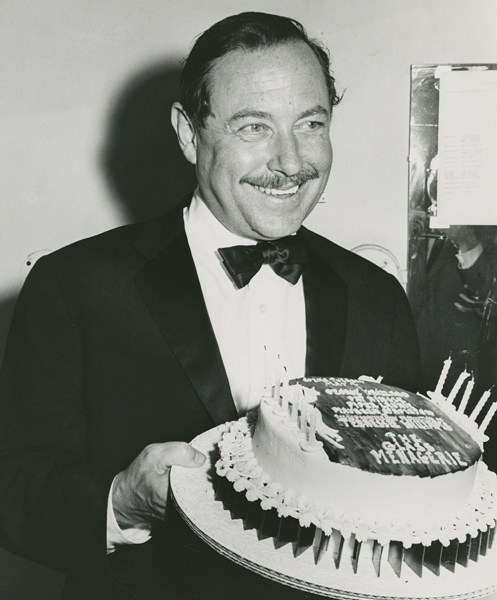
Williams on the 20th Anniversary of The Glass Menagerie, New York, 4 May 1965
1966 CBS produces a TV drama adapted from The Glass Menagerie. Directed by Michael Elliott, the film stars Shirley Booth as Amanda, Barbara Loden as Laura, Hal Holbrook as Tom and Pat Hingle as Jim. The film uses the original music composed by Paul Bowles.
1969 Williams converts to Roman Catholicism. He is awarded the American Academy of Arts and Letters gold medal for drama. The same year, he commits himself into the psychiatric ward of Barnes Hospital in St. Louis.
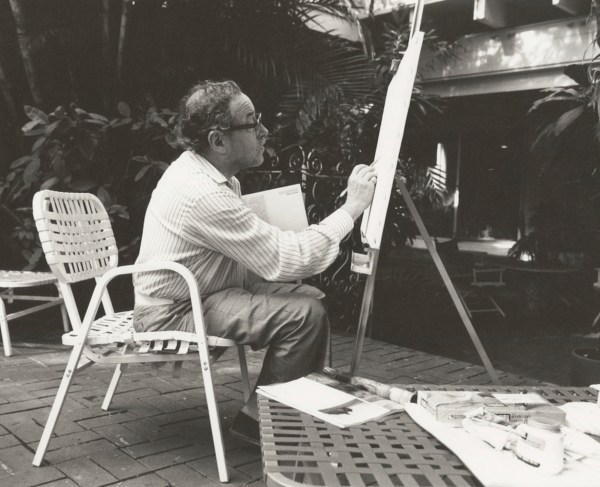
Williams painting in Key West, Florida, in the early 1970s
1973 ABC produces a TV drama adapted from The Glass Menagerie. Directed by Anthony Harvey, the film stars Katharine Hepburn as Amanda, Sam Waterston as Tom, Joanna Miles as Laura, and Michael Moriarty as Jim. The music is by John Barry.
1975 Williams publishes his Memoirs, in which he opens up about his homosexuality and his use of drugs. The same year, he publishes his second novel, Moise and the World of Reason.

Williams with actress Charlotte Rampling at the 1976 Cannes Film Festival
1976 Williams serves as president of the jury at the Cannes Film Festival. The same year, he is initiated as life member of the American Academy of Arts and Letters.
1980 Edwina, Williams’s mother, dies at the age of 95.
1982 Williams’s last play, A House Not Meant to Stand, premieres in Chicago and runs for only 40 performances.
1983 On February 24, Williams is found dead in his suite at the Hotel Elysée in New York; he is buried in St. Louis, Missouri, next to his mother.
1987 A second film adaptation of The Glass Menagerie is released; it is directed by Paul Newman, and stars John Malkovitch as Tom, Joanne Woodward as Amanda, Karen Allen as Laura, and James Naughton as Jim. The music is by Henry Mancini.
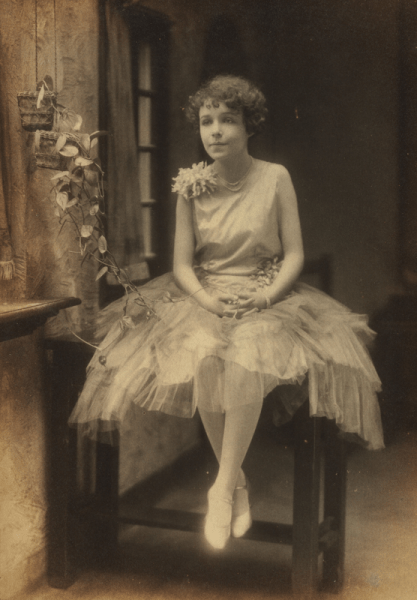
Rose Williams in her early teens
1996 Rose Isabel Williams, Williams’s sister, dies in a mental institution in New York state.
 The CONDORCET