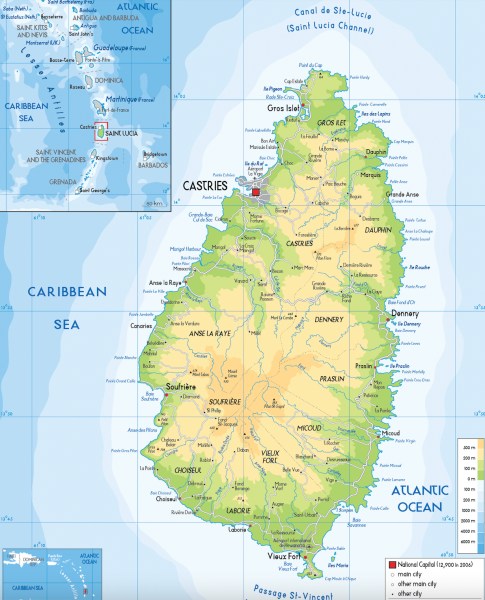
Saint Lucia: a brief historical timeline
200-400s: Arawak Indians from northern South America populate the island of Saint Lucia, then known as Iouanalao, meaning “Island of the Iguanas”.
800s: Carib Indians take over the island, now known as “Hewanorra,” also meaning “Land of the Iguanas”.
1501: Saint Lucia is sighted by Christopher Columbus during his fourth voyage in the region; later that year, a globe in the Vatican shows the island as Santa Lucia.
1550s: French pirates led by François “Jambe de Bois” Leclerc use Saint Lucia as a base to attack passing Spanish ships.
1600s: The Dutch establish a fortified base at Vieux Port.
1605: English colonists start a settlement on Saint Lucia but are soon forced to flee by the local Caribs.
1639: British settlers attempt to take over Saint Lucia but are wiped out by the local Caribs.
1651: From their headquarters in Martinique, the French establish a new colony on St Lucia, purchasing land from the locals.
1660: The French sign a treaty with the indigenous Carib people; the British send troops from Barbados to take back the island but ultimately fail, and Saint Lucia becomes a dependency of Martinique. Fighting between the French and the British lasts until 1814, the island changing hands a total of 14 times in the interval.
1746: Soufrière becomes the first major French settlement on the island; by then, the island has a population of 3455, including 2573 slaves. By 1780, 11 more settlements and a large number of sugar plantations have been established; the population reaches 19,230, including 16,000 slaves.
1778: During the American Revolutionary War, the British briefly occupy the island again after their victory during the Battle of Cul de Sac.
1782: The British fleet, led by Admiral Sir George Rodney, defeat the French at the Battle of the Saintes, off the coast of Saint Lucia, forcing the French and the Spanish to abandon their invasion of Jamaica. This remains the biggest English victory over the French during the American Revolutionary war.
1814: France cedes Saint Lucia to Britain following the Treaty of Paris; Britain proclaims the island a crown colony and brings in African slaves to work on the sugar cane plantations.
1834: Slavery is abolished; there were more than 13,000 black slaves on the island by then, against 2,600 free blacks and 2,300 whites.
1838-85: Saint Lucia is incorporated into the British Windward Islands administration, administered by the governor of Barbados.
1871-1956: Saint Lucia becomes a member of the Leeward Islands Federation.
1924: A new constitution grants Saint Lucia representative government.
1936: Saint Lucia is given a constitution providing for a majority of elected representatives in the legislative council.
1942: During the Battle of the Caribbean, a German U-boat attacks and sinks two British ships in Castries harbor.
1951: Saint Lucia is granted universal adult suffrage.
1957: Bananas exceed sugar as Saint Lucia’s major export crop.
1958-62: Saint Lucia becomes a member of the Federation of the West Indies, a short-lived semi-autonomous dependency of the UK; the federation collapses after Jamaica withdraws from it.
1964: Saint Lucia ceases sugar cane production.
1967: Saint Lucia becomes fully self-governing in internal affairs, with Britain remaining in charge of external matters and defense.
1979: Saint Lucia becomes independent and joins the Commonwealth; Queen Elizabeth remains the country’s official monarch. In the decades that follow, government is held alternately by the conservative-leaning United Workers Party (UWP) and the St Lucia Labour Party (SLP).
1980: Hurricane Allen wipes out the local banana crop.
1993: Fall in the price of bananas leads to unrest and strikes by farmers and agricultural workers.
2002: Tropical Storm Lili destroys about half of the banana crop in Saint Lucia. In some places entire plantations are wiped out.
2003: Parliament amends constitution to replace oath of allegiance to British monarch with pledge of loyalty to St Lucians.
2004: Volcanic twin peaks – the Gros and Petit Pitons – are declared a UNESCO world heritage site.
2013: Saint Lucia joins the Bolivarian Alliance for the Peoples of Our America
2014: Saint Lucia says it is planning to switch from the Privy Council in London to the Caribbean Court of Justice as its final court of appeal.
 The CONDORCET