
Nathaniel Hawthorne, by Charles Osgood, 1841.
1517: Martin Luther publishes his Ninety-five Theses.
1536: John Calvin publishes his Institutes of the Christian Religion.
1553: Persecution of Protestants begin in England under Mary I.
1603: James I becomes King of England and Scotland.
1620: The Pilgrim Fathers, led by William Bradford, arrive at Plymouth Rock.
1623: William Blackstone arrives in Massachusetts.
1625: James I dies in March 1625 and is succeeded by his son Charles I.
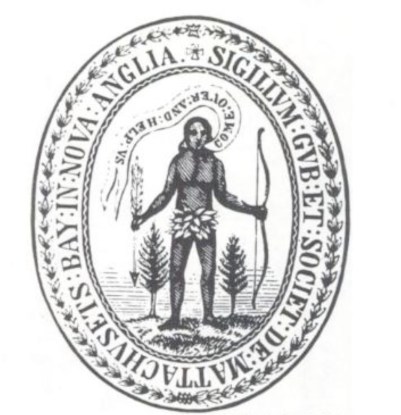
The 1629 seal of the Massachusetts Bay Colony
1629: The Massachusetts Bay Company is granted a royal charter.
1630: On June 12, the Arbella lands in Salem, Massachusetts: among the passengers, there are John Winthrop, John Wilson, Richard Bellingham, as well as William Hathorne, Nathaniel Hawthorne’s great-great-great grandfather.
– In August, John Winthrop is elected Governor of the colony of Massachusetts.
– The Puritans dissolve the colony of Merrymount and banish Thomas Morton.
1634: The Pequot War begins between English colonists and the Pequot natives: hundreds of Indians are killed and hundreds more are sold into slavery between 1634 and 1638.
– Ann Hutchinson migrates to Massachusetts with her family.
1635: William Blackstone leaves Boston for Rhode Island.
1636: Roger Williams leaves Boston and founds the Providence Plantations.
1638: Ann Hutchinson is excommunicated and is forced to leave for Rhode Island.
1641: The Body of Liberties protects all inhabitants in Massachusetts from arbitrary justice and guarantees their right to a fair trial; it also bans torture, notably on the rack, as well as all punishments deemed “inhumane, barbarous and cruel”.
1642: The First English Civil War begins, ending in 1646.
– In May, the Governor of the Massachusetts Bay Colony, Richard Bellingham, is replaced by John Winthrop – i.e., just before the story of The Scarlet Letter begins.
– That same year, an obscure legal case involving a widow’s sow leads to a constitutional crisis in the Colony: the General Court eventually turns into a bicameral legislature, separating the council of assistants from the house of deputies.
1643: Ann Hutchinson and her family are killed by Indians in New Netherland (today’s The Bronx).

North American colonies in the 17th and 18th centuries.
1644: Mary Latham and James Britton are executed, the only two executions for adultery in the history of the colony of Massachusetts.
1648: The Second English Civil War begins.
1649: Charles I is executed and England becomes a Commonwealth.
1651: In York, Mary Batchellor is found guilty of adultery, and receives 40 strokes and has the letter A branded on her forehead.
1653: Oliver Cromwell becomes Lord Protector of the Commonwealth until his death in 1658.
1656: Ann Hibbins, Governor Bellingham’s sister-in-law, is hanged for witchcraft.
1658: The official penalty for adultery in Massachusetts includes whipping and the sewing of the letters AD on the culprit’s garments on their arm or in their back.
1660: The English monarchy is restored; Charles II is crowned.
– The three ‘Boston martyrs’, including Mary Dyer, are executed
1667: John Milton publishes Paradise Lost.
1678: John Bunyan publishes The Pilgrim’s Progress.
1682: Mary Rowlandson publishes her ‘Narrative of Captivity and Restoration.’
1685: The dominion of New England is formed.
1691: A new Royal Charter is granted to the colony of Massachusetts, which puts an end to the control of government by the Puritan religious leaders.
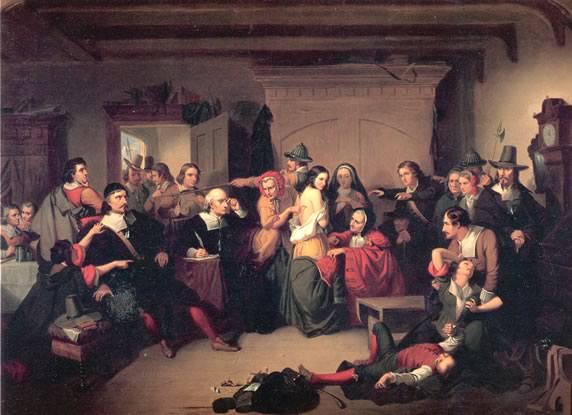
Examination of a Witch, Tompkins Harrison Matteson 1853.
1692: John Hathorne, Nathaniel Hawthorne’s great-great grandfather, and his fellow magistrates sentence the Salem ‘witches’ to death.
1764: Horace Walpole publishes The Castle of Otranto.
1796: Matthew Gregory Lewis publishes The Monk.
1804: Nathaniel Hawthorne is born on July 4.
1808: Hawthorne’s father dies of yellow fever in Suriname, New Guinea.
1809: With his mother and two sisters, Hawthorne moves into the home of his maternal grandparents.
1821: Hawthorne goes to Bowdoin College, in Brunswick, Maine: he becomes friends with poet Henry Wadsworth Longfellow and future President Franklin Pierce.
1822: Jean-François Champollion deciphers the Rosetta stone.
1825: Hawthorne graduates from college and returns to Salem to live with his mother; he will spend the next dozen years in relative isolation, concentrating on reading and writing.
1828: Hawthorne publishes his first novel Fanshawe, anonymously and at his own expense; he will later attempt to destroy every copy he can find.
1830: Hawthorne begins to publish sketches and tales anonymously, using a pseudonym.
1834: George Bancroft publishes his History of the United States.
– The Whig lawyer Rufus Choate delivers a speech on “The Importance of Illustrating New England History by a Series of Romances like the Waverley Novels”.
1836: Ralph Waldo Emerson publishes his essay Nature.
1837: Hawthorne publishes the collection of short stories Twice-Told Tales, which includes ‘Endicott and the Red Cross,’ ‘The Minister’s Black Veil’ and ‘The Maypole of Merrymount.’
– Emerson delivers his speech entitled ‘The American Scholar’ at Harvard.
1839: Hawthorne and Sophia Peabody are engaged; he works as a measurer of salt and coal at the Boston customs house until 1841.

1850 drawing of Brook Farm.
1841: In April, Hawthorne joins the Brook Farm farming community in West Roxbury, MA, but withdraws after a mere eight weeks.
1842: Hawthorne and Sophia Peabody are married and move to the Old Manse in Concord, MA: their neighbours include Emerson, Henry D. Thoreau, the feminist intellectual Margaret Fuller and A. Bronson Alcott (the father of Louisa May Alcott).
1844: Hawthorne’s daughter Una is born.
1845: Margaret Fuller publishes Women in the 19thcentury.
– That same year, James K. Polk, a Democrat, is elected president of the US, and Hawthorne is offered a position as surveyor at the Salem customs house, until his dismissal in 1849.
– Texas is annexed by the US, and John O’Sullivan coins the phrase ‘Manifest Destiny.’

The Salem custom house in the 1940s.
1846: Hawthorne publishes Mosses from an Old Manse, a collection of previously published stories, including ‘The Birthmark.’
– Hawthorne’s son, Julian, is born.
1848: Zachary Taylor, a Whig, is elected president of the US: Hawthorne is dismissed from his position at the Salem customs house the next year.
1850: On March 16, Hawthorne publishes The Scarlet Letter, and he and his family move to Lenox, MA, where he becomes friends with Herman Melville.
– California joins the Union.
– The US Congress passes the Fugitive Slave laws.

The Scarlet Letter, Hugues Merle, 1861
1851: Hawthorne publishes The House of the Seven Gables and The Snow-Image and Other Twice-Told Tales, a collection that includes the eponymous story, ‘Main Street’ and ‘Ethan Brand.’
– Hawthorne’s second daughter, Rose, is born.
– Herman Melville publishes Moby Dick.
1852: Hawthorne publishes The Blithedale Romance, two works for children (A Wonder-Book for Girls and Boys and Tanglewood Tales) and a campaign biography of Franklin Pierce, A Life of Pierce.
1853: Hawthorne is appointed consul in Liverpool, England until 1857.
– Melville publishes his short story ‘Bartleby, the Scrivener.’
1854: Henry D. Thoreau publishes Walden; or Life in the Woods.
1855: The Californian Gold Rush begins.
1857: Hawthorne and his family live in Italy, in Rome and then Florence.
1860: Hawthorne publishes his last work of fiction, The Marble Faun, inspired from his years in Italy. That same year he returns to Concord, where he spends the rest of his life.
1861: The Civil War begins.
1863: Hawthorne publishes Our Old Home, a series of essays on England and Anglo-American relations.
1864: Hawthorne dies on May 19 in Plymouth, NH; he is buried at Sleepy Hollow Cemetery, Concord, MA.
– Later the same year, the first collected edition of Hawthorne’s works is published by Ticknor & Fields.
1879: Henry James publishes a biographical essay on Hawthorne.
1939: Harvard scholar Perry Miller publishes The New England Mind: The Seventeenth Century, the first of his classic studies on American Puritanism.
1953: Arthur Miller publishes The Crucible.
1985: Margaret Atwood publishes The Handmaid’s Tale.
2000: Philip Roth publishes The Human Stain.
 The CONDORCET