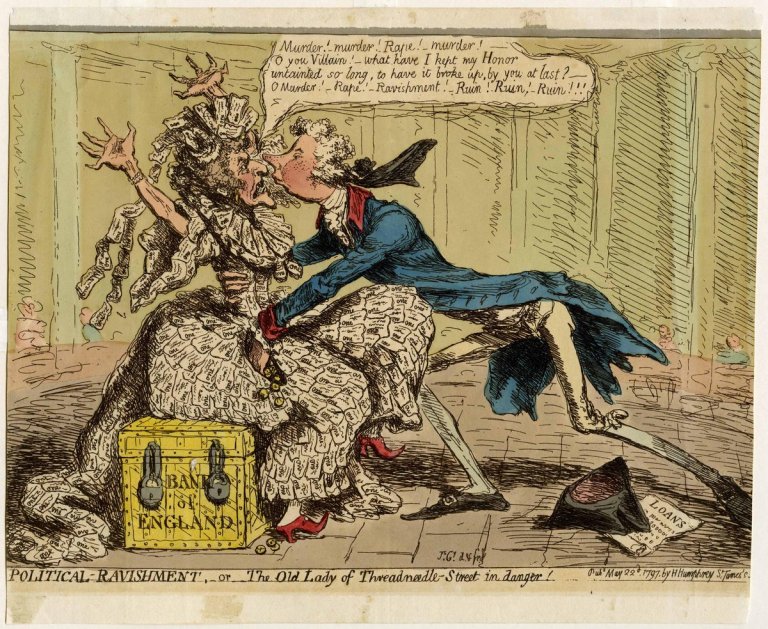
‘Political-ravishment, or the old lady of Threadneedle-street in danger!’ A political cartoon by James Gillray (1797)
1158: Henry II introduces the pound sterling, struck from silver, in the kingdom of England.
1536: Following the Act of Supremacy, Henry VIII becomes the head of the Church of England and dissolves monasteries in England: goldsmiths across the country accumulate stocks of gold and modernize their operations into banks
1571: Thomas Gresham founds the Royal Exchange in the City of London.
1672: C. Hoare & Company is founded, becoming the first and still the oldest private bank in the United Kingdom.
1690: Two goldsmiths create Barclay’s, the first of what would come to be known as the Big Four (Barclay’s, HSBC, Lloyds and The Royal Bank of Scotland).
1694: The Bank of England is founded, setting up its first offices in Walbrook.
1695: The Bank of Scotland is founded.
1707: Following the Treaty of Union between England and Scotland, the pound sterling becomes the currency of Great Britain.
1720: The South Sea Bubble crisis leads a number of small banks to bankruptcy, forcing them to ask the Bank of England for its support.
1734: The Bank of England moves to its iconic location in Threadneedle Street.
1762: Francis Baring founds the Barings Bank.
1765: Industrialists Sampson Lloyd and John Taylor found the Lloyds Bank in Birmingham.
1797-1821: the Napoleonic wars force the government to suspend the gold standard and allow the pound to “float”.
1797: James Gillray publishes his first cartoons featuring “The Old Lady of Threadneedle Street”.
1811: Nathan M. Rothschild creates the bank Rothschild & Sons, which specializes in government bonds.
1844: The Bank Charter Act gives the Bank of England a quasi monopoly on the issuance of banknotes in the United Kingdom.
1855: The Bank of England’s banknotes are no longer hand-written but are fully printed.
1865: Thomas Sutherland creates the Hong Kong and Shanghai Banking Corporation (HSBC) in Hong Kong, notably to fund opium trading.
1866: The Bank of England allows Overend Gurney, the country’s largest discount house, to go bankrupt.
1890: The Bank of England bails out Barings, London’s oldest merchant bank.
1931: The UK abandons the gold standard.
1946: The Labour government nationalises the Bank of England, allowing the Chancellor of the Exchequer (then Hugh Dalton) to directly steer the country’s monetary policy.
1960: For the first time, a British monarch appears on a Bank of England banknote.
1971: On 15 February, or “Decimal Day”, Britain decimalises the pound sterling.
1972: in November, replacing the old Royal Exchange, the new 96-metre-high Stock Exchange Tower is inaugurated by Queen Elizabeth II.
1973: Gordon Richardson becomes Governor of the Bank of England for 2 terms of five years.
— The collapse of London and County Securities causes a bank run, as well as the “secondary banking crisis,” which forces the Bank of England to bail out around 30 small lending banks and assist some 30 others.
1979: The Banking Act extends the Bank of England’s regulatory powers over lenders and provides protections for depositors.
— In May, the Conservative party led by Margaret Thatcher wins a landslide victory in the general election, pledging to privatise and deregulate the British economy.
1981: The reserve requirement for banks to hold a minimum proportion of their deposits as reserves at the Bank of England are abolished.
— In June, the 183m, 47-storey Natwest Tower, the first British skyscraper (named after the National Westminster Bank) is inaugurated by Queen Elizabeth.
1983: Robin Leigh-Pemberton becomes Governor of the Bank of England for 2 terms.
1984: The Financial Times and the London Stock Exchange create the FTSE 100 Index (a.k.a. “Footsie 100”).
— In October, Johnson Matthey Bankers (JMB) threatens to go bankrupt, due to bad debts, forcing the Bank of England to transfer £100 million of capital to it.
1986: On 27 October, the so-called “Big Bang” of the UK’s financial sector is enforced.
— In November, the Financial Services Act sets up a certain number of light regulations on the UK’s new financial system.
1991: The fraud-ridden Bank of Credit & Commerce International collapses, leading the Bank of England to close its 25 branches.
1992: On Wednesday, 16 September (a.k.a., “Black Wednesday”), the pound sterling suddenly loses 15% of its value, forcing Britain to withdraw from the European Exchange Rate Mechanism, the mechanism designed in the late 1970s to stabilize European currencies in preparation for the introduction of the euro.
1993: Edward George becomes Governor of the Bank of England for two terms of five years.
1995: Due to losses of $1.5 billion entailed by poor speculative investments by the rogue trader Nick Leeson, the Barings Bank goes bankrupt: invoking moral hazard, the Governor of the Bank of England refuses to bail it out, preferring instead to use it as an example to other banks.
1997: In May, Labour wins the general election by a landslide: Tony Blair becomes Prime Minister and Gordon Brown becomes Chancellor of the Exchequer
1998: The Bank of England Act makes the Bank of England an independent organization again.
2001: The Bank of England’s power to regulate financial institutions is transferred to the Financial Services Authority.
2002: The Bank of England sells its banknote printing operations to De La Rue.
2003: Mervyn King becomes Governor of the Bank of England for two terms of five years.
2004: Norman Foster’s 180-meter-high 30 St Mary Axe (a.k.a. the “Gherkin”) is inaugurated in the City of London.
2004: The London Stock Exchange moves to smaller headquarters in Paternoster Square.
2007: In June, Gordon Brown replaces Tony Blair as Prime Minister.
— On 14 September, Northern Rock’s losses force it to ask for an emergency loan from the Bank of England, prompting the first bank run in the UK for 150 years.
2008: On January 1, Mark Carney becomes Governor of the Bank of Canada for five years.
— In February, Parliament passes the Banking Special Provisions Act, which allows the government to nationalize British banks under emergency circumstances. This leads the government to nationalize Northern Rock on February 17.
— On September 15, Lehman Brothers goes bankrupt: in London, the bank’s 5,000 staff find their offices closed.
— On September 17, the Halifax Bank of Scotland is bought out by Lloyds TSB.
— On September 29, the government nationalises Bradford & Bingley before it goes bankrupt.
— On October 6, the worst day of the financial crisis, £90 billion are wiped off the value of Britain’s companies in the City.
— On October 8, the government bails out HBOS and the Royal Bank of Scotland. That same day, it freezes the assets of the subsidiaries of Iceland’s three largest banks – Glitnir, Kaupthing, and Landsbank – where many British customers have deposits and investments. That same day, the Bank of England coordinates with Federal Reserve and the European Central Bank to cut their interest rates by 0.5%.
2009: In March, the Bank of England announces that it will be pursuing a policy of quantitative easing (QE) in the foreseeable future, with some £200 billion of funds.
— In April, the Chancellor of the Exchequer, Alistair Darling, announces the biggest budget deficit in British history, at £175 billion.
2010: In May, the Conservative party wins the general election on a platform of austerity measures, but must form a Coalition government with the Liberal-Democrats for lack of an absolute majority in Parliament. David Cameron becomes Prime Minister and George Osborne becomes Chancellor of the Exchequer.
— In December, the Basel Committee on Banking Supervision publishes the recommendations emanating from the Third Basel Accord.
2011: The Financial Stability Board is created as part of the Basel Accord: Mark Carney becomes chairman
— In October, the Stock Exchange is one of the main targets for the protesters of Occupy London.
2012: In December, the Financial Services Act gives back to the Bank of England most of its powers of oversight, along with the Prudential Regulation Authority and the independent Financial Conduct Authority
2013: The Financial Services Act implements a series of regulations designed to reduce risks: retail banking is “ring-fenced” to protect consumers and banks are required to retain certain amounts of capital to act as buffer against market instability.
— The FSA is abolished and the Bank of England’s Prudential Committee is created in order to enforce risk oversight in the British banking system.
— Mark Carney becomes Governor of the Bank of England for one term of five years, which will be extended to eight years in 2018.
2014: In January, the office of Deputy Governor is added to the executive structure of the Bank of England.
— The Bank of England starts carrying out stress tests, to check whether British banks are resilient enough to overcome a sudden economic downturn.
2015: In May, the Conservative party wins the general election with an absolute majority. David Cameron and George Osborne remain Prime Minister and Chancellor of the Exchequer respectively.
2016: On June 23, 52% of British voters vote to leave the European Union.
— In July, David Cameron and George Osborne resign; Theresa May becomes Prime Minister
— The Bank of England sets up the Senior Managers and Certification Regime (SM&CR), which requires financial institutions to allocate clear roles and responsibilities to senior individuals like the CEO and Chair, making it easier to establish accountability if things go wrong.
— RBS fails the Bank of England’s annual stress tests, and is forced it to cut its costs and its exposure to risky assets.
2017: In November, the BoE raises its interest rate from 0.25% to 0.5%, the first increase in over a decade, in order to counter a surge in inflation of more than 3% and the risks of uncontrollable wage rises due to the low unemployment numbers.
2018: In August, the BoE raises its interest rate from 0.5% to 0.75%, which was expected to lead to other increases, but the Bank suspends its decision when inflation falls and because of the uncertainties surrounding Brexit and the unstable global context.
— In September, the British government announces that Mark Carney has agreed to stay on as Governor of the Bank of England until January 2020 in order to see through the turbulence of the Brexit process.
— In December, the Bank of England announces that the 7 biggest British banks will have to set up « living wills » by the end of 2020.
2019: As part of the Basel accord, large UK banks must separate core retail banking services from their riskier investment and international banking activities.
— In May, panic surges surrounding the solvency of Metro Bank, an up and coming bank founded in 2010 by US entrepreneur Vernon Hill, with people coming to some of its 67 branches in London and the south-east, asking to pull their money out and empty their safe deposit boxes. In January, it had been discovered that some £900m of its loans had been wrongly classified as less risky than they actually were, which led to investigation by the Financial Conduct Authority and the Prudential Regulation Authority.
— In August, the BoE reports that the UK has one in three chances of plunging into recession in 2020, following its departure from the EU.
— In December, the Chancellor of the Exchequer, Sajid Javid, announces that Andrew Bailey will be appointed Governor of the BoE and take over in March 2020.
 The CONDORCET