
WALL STREET IN 1911
– 1775: the Continental Congress and insurgent states start issuing bills called “Continentals”.
– 1788: Article I, Section 8 of the US Constitution gives Congress the power “to coin money”.
– 1791: the First Bank of the United States becomes the country’s first central bank until 1811.
– 1792: the Coinage Act establishes the US dollar as the official unit of currency of the country; that same year, the Buttonwood Agreement formalizes the association of New York’s biggest traders on Wall Street.
– 1817: the New York Stock & Exchange Board rents a room at 40 Wall Street.
– 1818: the Second Bank of the United States is created until 1838, when Congress fails to renew its charter.
– 1884: Charles H. Dow starts tracking stocks exchanged on Wall Street: his numbers soon become the benchmark for analysing the stock market, the origin of the Dow Jones Industrial Average (DJIA).
– 1903: the New York Stock Exchange opens its iconic building at 18 Broad Street.
– 1907: starting in October, the bankers’ panic (a.k.a. Knickerbocker crisis) sparks off losses of nearly 50% on the New York Stock Exchange, numerous runs on banks and bankruptcies.
– 1913: the Federal Reserve Act creates the US Federal Reserve system.
– 1920: on September 16, 1920, a bomb explodes on Wall Street, across the offices of the Morgan Bank, killing 38 people and injuring 143 others: the perpetrators are never identified but are believed to be socialist and/or anarchist terrorists, which contributes to the Red Scare.
– 1928: the Federal Reserve raises its interest rate from 3.5% to 5% to slow markets.
– 1929: on September 3, the Dow Jones reaches a historic 381 points.
–> on October 29 (Black Tuesday), 16 million shares are sold in panic and the Dow loses 25%
– 1930: the Smoot-Hawley Tariff Act raises tariffs on imports, sparking off a trade war and turning the financial crisis into a Great Depression.
– 1932: Franklin Delano Roosevelt defeats incumbent Herbert Hoover: the New Deal begins.
– 1933: on March 14: the Federal Reserve refuses to act as lender of last resort and closes its doors.
–> the Glass-Steagall Act (or Banking Act)separates commercial and investment banks, and banks receiving consumer deposits are forbidden to engage in risky activity; the law also creates the Federal Deposit Insurance Corporation (FDIC) to insure consumers’ deposits (to the level of $2,500 at first).
–> the US quits the gold standard
– 1935: the Banking Act clarifies the functions of the Federal Reserve Board of Governors and creates the Federal Open Market Committee; regional Federal Reserve banks are given the right to make loans to member banks; the FDIC is made permanent.
– 1950: the Federal Deposit Insurance Act allows the government, the Fed and other regulators to assist insolvent banks through loans or the direct acquisition of its assets until it recovers from its distress
– 1951: the Federal Reserve-Treasury Department Accord restores independence to the Fed after years of submissions to the executive branch.
– 1971: the Nixon shock: President Nixon put an end to the convertibility of the dollar in gold: the American currency becomes fiat money.
– NASDAQ, the first and largest electronic stock market, is created on Wall Street
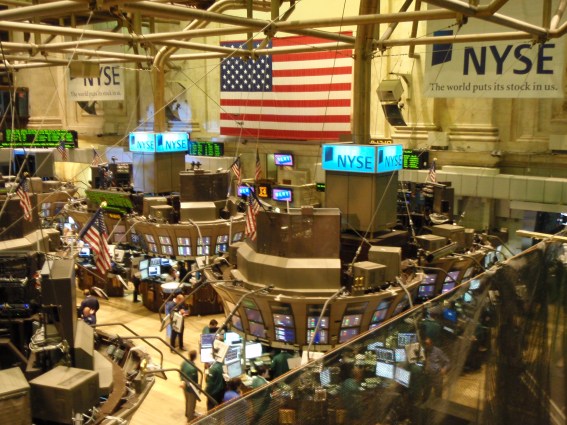
THE NEW YORK STOCK EXCHANGE’S BIG BOARD FLOOR
– 1975: the SEC puts an end to the NYSE’s “Rule 394,” which required most stock transactions to take place on the Big Board’s floor, freeing up trading for electronic methods.
– 1976: banks are allowed to buy and sell stocks on the NYSE, and not just stockbrokers.
– 1977: the Federal Reserve Reform Act tasks the Fed not just with controlling inflation but with the goal “to promote maximum employment, production, and price stability”. The act also requires quarterly reports to Congress.
– 1978: the International Banking Act requires foreign banks to apply for charters and approvals from the Fed to operate in the US.
–> the Full Employment and Balanced Growth (a.k.a., Humphrey-Hawkins Full Employment Act) confirms the Fed’s mandate to maintain long-term growth and minimize inflation; it instructs the Board of Governors to transmit a Monetary Policy report to Congress twice a year, and requires the Chairman to connect the Fed’s monetary policy with the President’s economic policy.
– 1979: in July, President Carter nominates Paul Volcker as Chairman of the Federal Reserve.
– 1980: the Depository Institutions Deregulation and Monetary Control Act gives the Fed greater control over non-member banks andcompels all banks to abide by its rules.
– 1982: the Reagan administration and Congress deregulate savings and loan companies.
– 1983: after his first term, Paul Volcker is re-nominated by President Reagan as Chairman of the Fed.
– 1984: Continental Illinois, the seventh largest American commercial bank, is saved from bankruptcy by the US Treasury and the Federal Reserve: it becomes the classic example of “too big to fail”.
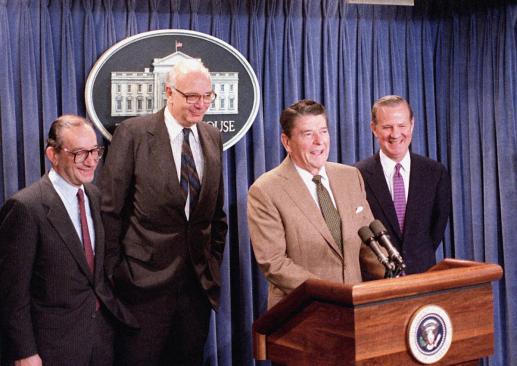
PRESIDENT REAGAN ANNOUNCES PAUL VOLCKER’S REPLACEMENT BY ALAN GREENSPAN AS CHAIRMAN OF THE FED
– 1987: in June, Alan Greenspan is nominated by President Reagan as Chairman of the Fed.
–> on October 19, 1987 (“Black Monday”), stock markets around the world crash, the Dow Jones Industrial Average falling 508 points (i.e., by 22%).
– 1988: a committee of central bankers and supervisors start to meet in Basel to negotiate international rules on the banking industry
– 1990-1992: the bursting of a housing bubble leads to a crisis of the banking industry and a credit crunch
– 1998: Citicorp and Travelers merge into Citigroup, the largest financial company in the world.
–> in October, the failure of the LCTM hedge fund sparks off panic.
– 1999: in November, the Financial Services Modernization Act (or Gramm-Leach-Bliley Act, often also dubbed the “Citigroup Relief Act”)repeals the Glass-Steagall Act, removing the barriers between investment banks, commercial banks and insurance companies.
– 2000: the Commodities Futures Modernization Act exempts derivatives from market regulations.
– 2000-2002: the dot-com bubble bursts: following years of excessive speculation, the market value of a vast majority of Internet-based companies (notably companies tracked on the Nasdaq index) peaks and crashes between March 2000 and October 2002.
– 2001: following the terrorist attacks of 9/11, the Fed initiates a series of interest rate cuts, eventually bringing it down to 1% in 2004.
– 2004: Alan Greenspan is re-nominated by President George W. Bush for an unprecedented fifth term as Chairman of the Fed.
–> The SEC authorizes banks to increase their leverage ratios more freely.
– 2005: the IMF’s Chief Economist Raghuram Rajan warns world leaders about the excessive reliance of the financial system on short-term profit, disproportionate incentives and bonuses, and the lack of penalties when bankers and brokers make mistakes.
– 2006: in January, President George W. Bush nominates Ben Bernanke to replace Alan Greenspan as Chairman of the Fed.

LEHMAN BROTHERS EMPLOYEES LEAVING THEIR OFFICES ON 15 SEPTEMBER 2018
– 2008: January: Countrywide Financial Corporation, the largest mortgage lender in the US is bought out by Bank of America.
–> March 14: the investment bank Bear Stearns is rescued from bankruptcy by JP Morgan Chase for just $1.2 billion, while the Federal Reserve absorbs $29 billion of its troubled assets.
–> September 7: the US Treasury announces a conservatorship of Fannie Mae (Federal National Mortgage Association) and Freddie Mac (Federal Home Loan Mortgage Corporation), America’s biggest mortgage agencies facing bankruptcy
–> September 14: facing bankruptcy, the investment bank Merril Lynch is sold to Bank of America
–> September 15 (Meltdown Monday): the investment bank Lehman Brothers files for bankruptcy
–> September 16: the Reserve Primary Fund, one of the U.S.’s major money-market funds, announces that it will “break the buck,” i.e., that it will be unable to pay its investors any more than 97 cents on the dollar. The announcement sparks off a stampede out of money-market funds.
–> September 17: American International Group (AIG), the country’s biggest insurer, is saved from bankruptcy by the US Treasury and the Fed.
–> September 25: Washington Mutual (WaMu), the country’s largest commercial bank, fails and is sold to JP Morgan Chase.
–> October 1: Wachovia Corp is sold to Wells Fargo.
–> October 3: the Emergency Economic Stabilization Act becomes law: to remedy the subprime mortgage crisis, the law authorizes the Treasury Secretary to create the $700 billion Troubled Asset Relief Program (a.k.a. TARP) to purchase distressed assets and supply cash to banks.
–> October 10: after a meeting of finance ministers and central bank governors in Washington, DC, G7 leaders agree to a five point plan of action to stabilize financial markets and restore the flow of credit to support economic growth.
–> November: the Federal Reserve lowers its interest rate to 0-0.25%.
– 2009: January: President Obama’s first piece of legislation, the American Recovery and Reinvestment Act (ARRA) passes a stimulus package of $831 billion to jump start the economy.
–> January: the bailout of the US’s car-making industry begins, until December 2014, for a total cost of $80 billion: in March 2009, the Obama administration is even forced to take over GM and Chrysler.
–> the US joins other G20 countries to create the Financial Stability Board (FSB) to promote and monitor global financial stability through reform, standards and regulation.
– 2010:Ben Bernanke is appointed for a second term as Chairman of the Federal Reserve
–> on January 21, President Obama officially endorses the Volcker rule and announces his intention to put an end to the ‘too big to fail’ mentality pervading the financial sector.
–> the Dodd-Frank Wall Street Reform and Consumer Protection Act imposes tighter regulations on American banks, adding oversight, transparency, and monitoring of risk. Certain institutions are made to prepare resolution plans (a.k.a. ‘living wills’) that must be submitted to the Fed. The powers of supervision of the Fed itself are extended to a greater variety of companies. A new position is created in the Board of Governors: the Vice Chairman for Supervision. The law also includes the Volcker rule, a return to some of the principles of the Glass-Steagall Act of 1933.
–> the Tax Relief, Unemployment Insurance Reauthorization, and Job Creation Act, a second major stimulus plan of $850 billion after ARRA is passed, with payroll, income, and AMT tax cuts along with an extension of unemployment benefits
– 2014: Janet Yellen becomes the first Chair of the Federal Reserve.
– 2015: in December, the Fed raises its interest rate for the first time since 2006.
– 2017: On June 8, the Republican-led House passes the Financial CHOICE Act, which intends to roll back most of the regulations implemented by Dodd–Frank, but the bill dies in the Senate.
– 2018: in January, Randal Quarles, the Fed’s Vice-Chairman for Bank Supervision suggests that existing banking sector regulations are too tough, and could be relaxed in order to promote commercial bank lending, investment, and stock market trading. The next month, however,he appears to deny that the Fed intends to relax regulations at all.
–> in February, Jerome Powell becomes Chairman of the Federal Reserve.
–> in March, the Federal Reserve raises its interest rate, rousing vocal criticism from President Trump.
–> on May 24, President Trump signs into law a bipartisan bill immediately easing financial regulations and reducing oversight for banks with assets below $100 billion (up from $50 billion), and then for all those with assets below $250 billion by the end of 2019: such banks will no longer have to undergo stress tests or submit “living wills:” proponents of the bill argue the legislation will lift burdens unnecessarily put on small and medium-sized lenders and boost economic growth; some opponents have criticized the bill for opening taxpayers to more liability if the financial system collapses.
 The CONDORCET