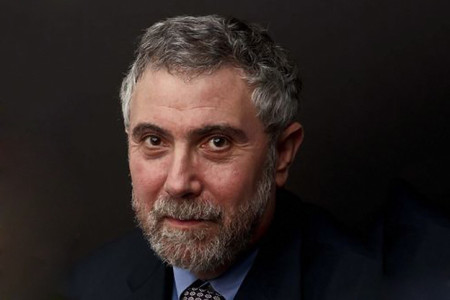
Economics professor and New York Times opinion columnist Paul Krugman
The 2018 Financial Crisis as Seen from the Top (Adapted)
By Paul Krugman, The New York Times, April 16, 2019
For a few months in 2008 and 2009 many people feared that the world economy was on the verge of collapse. Financial markets were virtually frozen. The real economy was in free fall. Over the winter America was losing 700,000 jobs a month, while world trade and industrial output were falling as fast as they did in the first year of the Great Depression. In the end, however, the worst didn’t happen. What saved us? There were multiple factors. But one element was that key public officials didn’t stand aside while the world burned. Instead, they acted, not always soon enough, not always forcefully enough, not always wisely, but pretty effectively all the same.
Firefighting: the Financial Crisis and its Lessons is a brief account of that crucial moment by three of the most important actors. Ben S. Bernanke was the chairman of the Federal Reserve Board. Henry M. Paulson Jr. was George W. Bush’s Treasury secretary. Timothy F. Geithner was president of the Federal Reserve Bank of New York – another key position in the Fed system – then became Paulson’s successor under Barack Obama.
There are a number of forms a book by central players in a historic episode can take. Firefighting could have been a juicy tell-all; it could have been an exercise in boasting about how its authors saved the world; it could have been a litany of excuses, explaining why none of what went wrong was the authors’ fault. The truth is that there’s a little bit of each of these elements, but not much, considering.
What Bernanke et al. – I’m going to call them BGP for short – have given us, instead, is a primer on why the crisis was possible; a ticktock on how the crisis and the financial rescue unfolded; and a very scary warning about the future.
Fundamentally, BGP argue, what happened in 2008 was a “classic financial panic,” of the kind that has happened again and again since the dawn of modern banking. So why didn’t people see it coming? Part of it was hubris: “Serious economists were arguing that financial innovations like derivatives had made crises a thing of the past.” The reality was that financial innovation made things worse, not better. Most of the leverage in U.S. finance had moved to “shadow banks” that, unlike conventional ones, were unregulated and lacked a financial safety net. A few Cassandras warned about the risks, but like the original Cassandra, they went unheeded. And BGP, to their credit, acknowledge their own failures to recognize the danger, including Bernanke’s notorious declaration that problems in subprime lending were “contained.”
Then it all fell apart. Most of the book is concerned with the desperate efforts of BGP and other officials to prop up financial dominoes before they toppled and collapsed the whole system. Sometimes these efforts fell short. In a section that will no doubt cause a lot of controversy, BGP argue that there was nothing they could legally have done to prevent the bankruptcy of Lehman Brothers, the event that nearly broke the world. Was this true? I’m not enough of a lawyer to tell.
Still, by the late spring of 2009 the storm seemed to have passed. Recovery was slow, but at this point we were back to an economy with low unemployment and seemingly stable financial markets.
But should we be worried about another crisis? Yes, the authors say, in a final chapter that is downright scary. Banking, they argue, is actually less risky than it was, thanks to reforms that, while far short of what should have been done, have nonetheless led to safer practices. But crises will still happen, and when they do, the firefighting abilities of policymakers will have been gravely compromised. Interest rates are too low for cutting them further to do much good. Fiscal stimulus will be much harder to sell given high levels of debt. In other words, it’s hard to imagine BGP’s modern successors carrying out the kind of rescue operation the authors managed a decade ago. And it’s not even clear whether they would try, or have any idea what they’re doing. The authors are too nice to say this, but today’s top economic officials seem to be systematically drawn from the ranks of those who got everything wrong during the crisis. The failure of Bear Stearns was the first indication of how much trouble we were in; Donald Trump has just chosen David Malpass, Bear’s chief economist at the time, to head the World Bank. Larry Kudlow, now the administration’s top economist, ridiculed “bubbleheads” who claimed that housing prices were out of whack, then praised Paulson for refusing to bail out Lehman, just hours before financial markets went into full meltdown.
In other words, we seem to have learned the wrong lessons from our brush with disaster. As a result, when the next crisis comes, it’s likely to play out even worse than the last one.
SUMMARY
In 2008, the collapse of the financial industry, in the US and then all around the world, sparked off a recession unprecedented since the Great Depression. This collapse was crystallized by the bankruptcy and disappearance of the iconic investment bank Lehman Brothers on the infamous Meltdown Monday of 15 September. More than ten years later, politicians, historians and economists still disagree on the reasons and responsibilities that led to this disaster; they also disagree on the way decision-makers – notably policymakers and central bank chairmen and governors – handled the crisis itself. These debates were revived by the wealth of surveys, editorials and Op-eds published for the tenth anniversary of the financial meltdown, but also particularly publications such as the one that is the main subject in this opinion column published in The New York Times, on April 16, 2019, and entitled “The 2018 Financial Crisis as Seen from the Top” – books written by the key public figures who were in office when the crisis broke, in this case Ben Bernanke (chairman of the Fed between 2006 and 2014), Hank Paulson (Treasury Secretary from 2006 to 2008) and Tim Geithner (President of the New York Federal Reserve from 2003 to 2008, then Treasury Secretary until 2013), the three co-authors of a collective memoir Firefighting: the Financial Crisis and its Lessons. Written by Paul Krugman, a scholar, Nobel Prize laureate in Economics (in 2008) and liberal-leaning columnist for The New York Times,the text, is in effect a book review (though as we shall see, it is sometimes hard to make the difference between what Krugman conveys from the book and his own viewpoint), and a rather laudatory one too, that goes back to the origins and circumstances of the crisis, summarizes and analyses the gist of the three authors’ viewpoint on it and on the part they played in it, as well as, ultimately, a wake-up call about the lessons that public officials have failed to draw from it and the ominous signs that it is soon to repeat itself.
Indeed, as I have just suggested, the tone that Paul Krugman sets very early in his review is a rather laudatory one, insisting, first, that the people in charge in 2008, including the three authors of the book, reacted reasonably well to the crisis, or at least prevented the Great Recession from degenerating into a crisis similar to or even worse than the Depression of the 1930s, which had been precipitated by the Wall Street Crash of 1929. (Borrowed from the title of the book itself, the running metaphor he uses for these policymakers’ action, expressing both their bravery and the extreme, last resort circumstances they find themselves in, is firefighting.) His opinion on the nature and viewpoint of the book is just as reasonably positive, avoiding as it does the pitfalls of self-serving revisionism or sensationalism that are often typical of such books by former policymakers (what Krugman calls juicy tell-alls, in one of the many colloquialisms that are typical of his writing style). In fact he repeatedly pays tribute to their humility and ability to recognize the mistakes they made, notably their failure to anticipate the looming threats of the subprime mortgage bubble.
His review is structured along the three main themes in the book, which he has found most interesting: the three authors’ analysis of the origins of the 2008 crisis, their narrative of the circumstances of the crisis and the solutions that were enforced to stem it (the largest part in the book, Krugman points out), and finally the alarm they sound about the crises that still threaten the American financial system.
Krugman’s review of the first main theme – the origins on the crisis – focuses on how and why the crisis was not prevented. The main culprit, it seems, is what he refers to as hubris, i.e., the blind sense of self-certainty that prevailed in the financial system that it was now protected from crises by some of its evolutions, notably derivatives, which in fact had made it even more hazardous than before given the absence of oversight on such financial products.
Krugman’s review of the second main theme – the narrative of the crisis – is fairly brief, other than a mention to the chaotic, snowball effect that characterized the crisis, the fairly effective action that was taken to resolve it, and a surprisingly brief reference to the three author’s infamously controversial decision not to bail out Lehman Brothers in September 2008, accompanied by an even more surprisingly non-committal remark on Krugman’s part about this decision. (A subject that I will return to in my commentary).
The longest part of Krugman’s review, in fact, is dedicated to the book’s ominous warnings about the future of the financial system. The greatest risks, the authors argue, have less to do with a system lacking oversight, since useful regulatory measures were taken since 2008, but the lack of leeway that policymakers will have to stem future crises, notably because of how low interest rates are (thus not allowing the Fed to use this lever to dramatically add to the money supply if need be) and how in debt the US already is (thus making it even more difficult for future administrations to resort to the bailouts and stimulus packages that were critical in 2008-2009).
Eventually, Krugman adds a further, more politicized reason for concern, which, he emphasizes, is not in the book: what he perceives as the ideological blindness and incompetence of those in charge, notably around President Trump. His very last words casting a very gloomy note about future crises.
 The CONDORCET