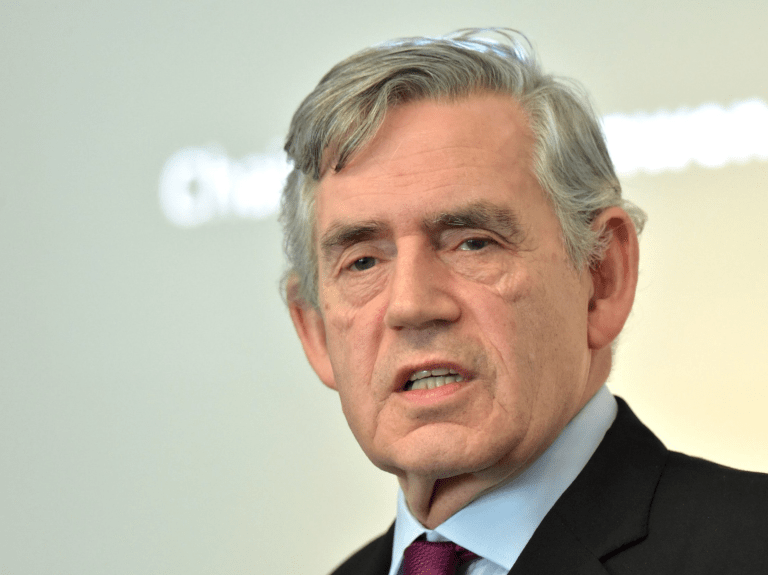
Former Prime Minister and Chancellor of the Exchequer Gordon Brown
‘The world is sleepwalking into a financial crisis’ says Gordon Brown
By Larry Elliott, The Guardian, 12 September 2018
Britain’s leader during the period when the collapse of the US investment bank Lehman Brothers put every major bank at risk, said that after a decade of stagnation the global economy was now moving into a decade of vulnerability. Speaking to the Guardian at his home in Scotland, Brown delivered a scathing analysis of how the big problems of 2009 remained unresolved and said that much tougher action was needed to prevent wrongdoing by bankers.
Brown was instrumental in creating the G20 – a body made of the world’s leading developed and developing nations – but said the cooperation that helped avoid a second Great Depression had been replaced by a world in which countries had retreated into nationalism.
“We are in danger of sleepwalking into a future crisis,” Brown said when asked to assess the risks of a repeat of 2008. “There is going to have to be a severe awakening to the escalation of risks, but we are in a leaderless world.”
The former prime minister, who lost the 2010 election following Britain’s longest and deepest recession of the post-war era, said there was less scope to reduce interest rates than was the case a decade ago, no evidence that financial ministries would be allowed to cut taxes or increase public spending, and no guarantee that China would be as active in providing stimulus.
After taking over from Tony Blair as Prime Minister in June 2007, Brown had only a short honeymoon before the first signs of trouble emerged later in the summer. He said the global economy still lacked an early warning system and a system for monitoring financial flows so that it was possible to tell what had been lent to whom and on what terms.
Brown admitted that Labour should have been tougher on the City in the boom years leading up to the crisis. “Yes, we did not know what was going on in some of the institutions, some of it illegal, and which was being covered up.” But he insisted that the mood at the time was for even greater deregulation of the City. “I was being criticised for being too tough in terms of regulation and tax.”
Since the crisis, banks have been forced to hold more capital to protect them against possible losses, and a system of bonus clawbacks has been introduced to dissuade bankers from taking too many risks. But Brown said action against financial malpractice had not been tough enough and that banks would expect to be bailed out again in the event of a future crisis. “The penalties for wrong-doing have not been increased sufficiently. The fear that bankers will be imprisoned for bad behaviour is not there. There has not been a strong enough message sent out that government won’t rescue institutions that haven’t put their houses in order.”
The crisis of 2008 had its roots in the US housing market, with the losses sustained on subprime mortgages cascading through the global financial system in the months leading up to the collapse of Lehmans. Brown said there would be a different cause next time. “It is very difficult to say what will trigger the next crisis but we are at the latter end of the economic cycle where people take greater risks. There are problems in emerging markets. In an interconnected world there is an escalation of risks.”
Recalling the freezing up of the financial markets a decade ago, Brown said governments had sought to compensate for the lack of trust between banks by cooperating more closely. “In the next crisis a breakdown of trust in the financial sector would be mirrored by breakdown in trust between governments. There wouldn’t be the same willingness to cooperate but rather a tendency to blame each other for what’s gone wrong. Countries have retreated into nationalist silos and that has brought us protectionism and populism. Problems that are global as well as national and local are not being addressed. Countries are at war with each other on trade, climate change and nuclear proliferation.”
Brown was scathing about the austerity policies pursued by the coalition government that came to power after he lost the 2010 election. “Austerity was based on an analysis that what had caused the global recession was the high level of public debt rather than the reckless action of the financial sector. Nobody who has looked at it seriously would come to that conclusion but the Conservatives dined out on it for five years. The country got back to growth quickly but couldn’t sustain it because of over-rapid fiscal consolidation. The country was out of recession in 2009 but back in it by 2011. Why? The withdrawal of government support cost us jobs and prosperity but also cost us our ability to cut the deficit in the long term.”
 The CONDORCET