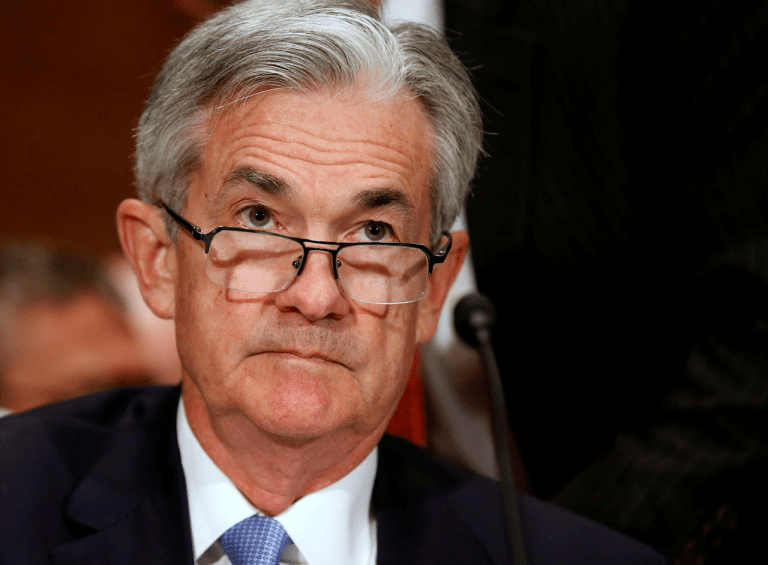
Jerome Powell, Chair of the Federal Reserve
The Economy Is Strong and Inflation Is Low. That’s What Worries the Fed
By Jeanna Smialek, The New York Times, May 21, 2019
America’s job market is booming and the economy is strong, but that combination is not raising prices the way it used to. Biscuit Head, a North Carolina restaurant chain, would be charging more if the previous economic relationships held up. At 3.3%, unemployment in Asheville, N.C., home to three of Biscuit Head’s four locations, clocks in below the national average, and business is brisk. The owners, Carolyn and Jason Roy, have been lifting wages and offering new benefits as they seek to attract and retain staff. Yet they haven’t raised prices on their giant buttermilk biscuits all that much. The stable pricing is sustainable partly because the Roys have gotten less picky about whom they hire. “It used to be that you’d look at résumés, and some things were an automatic disqualifier,” Ms. Roy said. “Now there’s really no disqualifier. Anyone who comes in, we’ll interview them.”
Across the US, a similar cocktail seems to be keeping inflation at bay. Employers are reluctant to charge more, unsure how consumers will react, and they’ve found an untapped supply of workers. It’s partly great news. More Americans are getting jobs than policymakers once thought possible, and wages and prices aren’t spinning out of control the way history would predict.
But it is posing a big challenge for the Federal Reserve. Stubbornly low inflation is raising questions about whether the central bank can achieve one of its primary goals — to keep prices growing slowly and steadily. By keeping interest rates low, it could also hinder the central bank’s ability to steer the economy should another downturn occur.
Inflation rose a scant 1.6% last year, well short of the central bank’s 2% target. The Fed’s policymakers are worried about the continuing sluggishness, and President Trump has repeatedly cited low inflation as a reason for the central bank to start cutting interest rates. “We are doing very well at 3.2% GDP, but with our wonderfully low inflation, we could be setting major records &, at the same time, make our National Debt start to look small!” Mr. Trump said in a recent tweet.
The Fed, for its part, is wrestling with how to respond to persistently low inflation amid what appears to be the weakening of a foundational economic relationship. Unemployment is at its lowest level since 1969, which should spur higher wages as companies compete for workers. Climbing labor costs should eventually get passed along to customers, driving inflation up. Instead, it is moderating.
The Fed’s chairman, Jerome H. Powell, has called weak inflation “one of the major challenges of our time.” In part to address it, he has led the Fed to embark on a yearlong review of its communications, tools and strategy. A major goal is determining what is reining in price gains and what can drive inflation back to the Fed’s target in a sustainable way.
Extra labor supply is one obvious culprit. Since 2016 at least some Fed officials have declared the labor market “at or near full employment.” But the job market keeps surprising them. Prime-age workers are hanging on to their positions for longer. That has provided an unexpected source of new employees, enabling brisk hiring to persist without a run-up in wages and prices. Average hourly earnings have shown progress without rocketing up. Beyond slack in the labor force and expectations, forces like technology and globalization may be restraining pricing power. Consumers with Amazon and Yelp in their pockets can easily avoid overpaying.
Regardless of its cause, the dilemma has a global flavor. Low inflation plagues central banks from Japan and New Zealand to the eurozone, threatening serious fallout. Falling inflation raises the risk that economies will slip into outright deflation if growth weakens, making downturns worse as consumers hoard their cash, knowing that prices will be lower tomorrow. It also means policymakers will have less room to ease policy come next recession.
If price increases get stuck in low gear permanently, consequences could reverberate from the Fed in Washington to the dining scene in Asheville. In inflation’s absence, Ms. Roy from Biscuit Head is seeing her fellow restaurateurs make tough choices. They can’t charge enough to cover higher wages, because their competitors are holding prices fairly steady. That leads to understaffing, and has caused some owners to give up the game altogether. “If you’re perceived as being too expensive, people aren’t going to want to come,” Ms. Roy said. “It really is a balancing act.”
 The CONDORCET