Though President Trump called the 2018 midterm elections a ‘tremendous success’ for himself and the Republican Party, the results are proving otherwise.
In the House of Representatives, the Republicans lost their majority following a significant swing of at least 35 seats in favor of the Democrats: votes are still being counted or re-counted in some districts, but the Democrats are likely to eventually reach an approximate 245 vs. 190 majority.
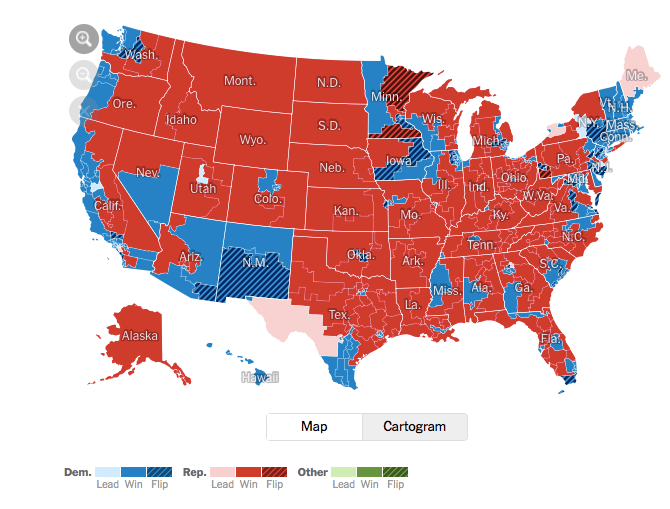
The 2018 House of Representatives election results
The new House will be the most feminized in American history, with 107 Congresswomen, 85 of them Democrats, including new figures like Alexandria Ocasio-Cortez (D – New York), who will become, at 29, the youngest Congresswoman in history; Rashida Tlaib (D – Michigan) and Ilhan Omar (D – Minnesota), who will be the first Muslim Congresswomen; and Sharice Davids (D – Kansas) and Deb Haaland (D – New Mexico), the first Native American Congresswomen. Moreover, the next Speaker of the House is expected to be Nancy Pelosi, the Democratic Congresswoman from California.
The Democrats’ victory means that they will hold the keys to the country’s coffers, that they can now block most of the Trump administration’s agenda if necessary (though not the nominations of high-ranking officials, the power of confirmation being held by Senators), present legislation of their own, as well as protect special prosecutor Robert Mueller’s investigation into the Trump campaign’s suspected collusion with Russia in 2016 and launch investigations of their own against the president. Also worrying for President Trump and the Republicans, the Democrats made significant gains in crucial states for the 2020 election, notably ‘Rust Belt’ states (Michigan, Minnesota, Wisconsin, Pennsylvania, etc.), which Donald Trump had won in 2016, but even in Texas, whose demographic evolution threatens sooner or later to turn blue.
In the US Senate, the Republicans were able to hold on to their majority, and even increase it from 51 vs. 49 to 52 vs. 48 or 53 vs. 47 (depending on the recount currently taking place in Florida). The result is slightly misleading, however, insofar as a disproportionate number of Democratic incumbents were finding themselves in weak positions, notably in conservative states, which they had been able to conquer by riding the coat-tails of President Obama during the 2012 election. Altogether, Democratic candidates still won far more votes than their Republican opponents: 48 million vs. 34 million.
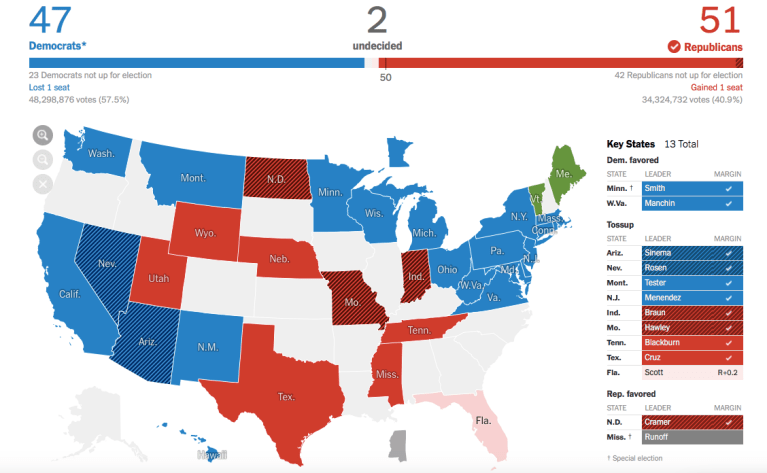

THE 2018 SENATE MAP
At state level, the Democrats have gained significant ground too: they have gained control in 7 legislative chambers (the State Senates in Colorado, Connecticut, Maine, New York and New Hampshire; the Houses in Minnesota and New Hampshire too), improving their ratio from 28 vs. 72 to 35 vs. 65, and also won 7 governorships while losing only 1, improving their ratio from 17 vs. 33 to 23 vs. 27.

THE 2018 ELECTIONS FOR GOVERNOR
This means that Democrats will be able to pass progressive legislation (raising minimum wages, improving health care and welfare, protecting women’s rights, passing eco-friendly laws, strengthening gun control, protecting voting rights, increasing spending on education, etc.) in far more numerous states in the years to come, even it they are prevented from doing so by a divided government in Washington, DC.
Just as importantly perhaps, today’s more even share of Democratic-led and Republican-led legislatures means a more level playing field for future elections. Indeed, state legislatures will be in charge of redrawing congressional districts after the 2020 census. With their landslide victories in the 2010 state-level elections, Republicans had been able to gerrymander a number of districts in ways that still keep Democrats at a political disadvantage. But now the Democrats will have the power to undo some of the harm or at least give themselves more of a say in how districts are drawn.
Finally, 155 statewide ballot measures were also organized across 37 states in the country. Here is a selection of the results of these referenda on a variety of topics:
- in Colorado, a proposition to allow an independent committee to take care of redistricting rather than the state legislature was adopted by 71% of voters. Similar propositions were adopted in Michigan and Utah by 61% and 51% of voters respectively.
- In Florida, a proposition to give the right to vote to felons not convicted of murder or a sexual offense was adopted by 63% of voters.
- in Arkansas a proposition requiring ID with a photo to vote was adopted by 79% voters. A similar proposition was adopted in North Carolina by 55% of voters.
- in Alabama, a proposition authorizing the display of the Ten Commandments on public grounds was adopted by 71% of voters.
- in Massachusetts, a proposition to ban gender identity discrimination (i.e., requiring any place with separate for men and women to allow full access for a person based on their gender equality) was adopted by 70% of voters.
- in Alabama, a proposition recognizing ‘fetal rights’ was adopted by 59% of voters. In West Virginia, a proposition restricting public funding for abortion was adopted by 51% of voters. Conversely, in Oregon, a proposition to prohibit using public funds for abortion or health plans covering abortion was rejected by 64% of voters.
- in Washington, a proposal to implement restrictions on the purchase and ownership of firearms including raising the minimum age to purchase a gun to 21, background checks, waiting periods and storage requirements, was adopted by 60% of voters.
- in California, a proposition to repeal 2017 taxes on gas was rejected by 52% of voters.
- in Nevada, a proposition to require electric utilities to acquire 50% of their electricity from renewable resources by 2030 was adopted by 58% of voters. A similar proposition was rejected in Arizona by 70% of voters.
- in North Carolina, a proposition to create a constitutional right to hunt, fish, and harvest wildlife was adopted by 57% of voters.
- in Idaho, a proposition to expand Medicaid coverage was adopted by 61%. Similar initiatives were adopted in Nebraska and Utah by 53% and 54% of voters respectively. In Montana, however, a similar initiative was rejected by 54% of voters.
- in Michigan, a proposition to legalize the recreational production and consumption of marijuana was adopted by 56% of voters. In Utah and Missouri, propositions to allow the use of medical marijuana were adopted by 53% and 65% of voters respectively.
- in Nevada, a proposition to repeal the ‘pink tax’, i.e., the 1955 tax on feminine hygiene products was adopted by 56% of voters.
- in Oregon, a proposition to repeal sanctuary state laws was rejected by 62% of voters.
- in Missouri, a proposition to increase the state’s minimum wage to €12 was adopted by 61% of voters. In Arkansas, a similar initiative to increase the state’s minimum wage to €11 was adopted by 68% of voters.
 The CONDORCET