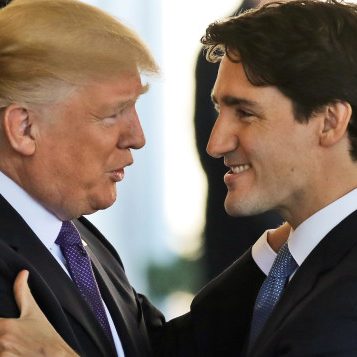
Lexington: America and Canada, divided by a common border
The Economist, April 22, 2017
A MILE of water divides the American village of Morristown from its Canadian neighbour, Brockville. Their economies were once closely linked, with small factories on each bank of the St Lawrence river producing patent medicines such as Dr Morse’s Indian Root Pills and Dr Williams’ Pink Pills for Pale People. Old folk remember winters when the river froze, and trees jammed into the ice marked a path to Canada. Both towns are conservative. The elected town supervisor of Morristown, Frank Putnam, a Republican, is especially exercised by welfare spending in his county, a struggling tract of upstate New York sustained by dairy farms, summer tourism and two state prisons.
Now a debate with worldwide resonance has revealed differences between the two settlements. In common with cities across Canada, Brockville has volunteered to host Syrian refugees. Residents, church groups and civic leaders are raising about $25,000 in private funds to sponsor each family for a year. Across the St Lawrence, by contrast, Mr Putnam is sure that the cost of receiving refugees would cause “alarm” in Morristown. He supports President Donald Trump’s attempts to halt refugee arrivals from Syria and impose “extreme vetting” on other travellers. Mr Trump wants a “time-out” to fine-tune security, says Mr Putnam, in private life a salesman for Cowsmopolitan, a magazine for dairy farmers.
Brockville is in southernmost Canada, a busily affluent region, Morristown in northernmost New York, an area in long-term decline. These diverging economic fortunes give people “a different outlook”, suggests Mr Putnam. Morristown is not invariably hostile to outsiders, he insists: nearby farms employ Central Americans in jobs that locals shun. But many resent being taxed to pay for welfare for less assiduous folk. The terror attacks of September 2001 also left a mark. Canada has been “pretty unscathed” by terrorism, he says, whereas America is “a little gun-shy.”
Yet attitudes to refugees seem too visceral to be explained by economics or recent history alone. An hour down the road from Morristown, in Watertown, reverberations continue from a council meeting last October at which speakers outlined an economic and moral case for welcoming refugees. The council member behind that discussion, Teresa Macaluso, has been accused in local blogs of wanting to import terrorists. At the next meeting, a local shouted about Muslims raping women and beheading people.
The counties around Morristown and Watertown voted decisively for Mr Trump. “People believe in Trump’s rhetoric that refugees are bad,” Ms Macaluso sighs. Ms Macaluso, a retired nurse, is braced for a backlash at her next election in November. If she loses, “So be it,” she says.
Ms Macaluso has allies. The Roman Catholic diocese that covers Morristown and Watertown has called for compassionate immigration laws and is about to twin with a Maronite diocese in Latakia, Syria, offering support to Christians trying to survive there.
Father Steven Murray, pastor of Holy Family Church, argues that Canada has always been more open. Go back to the 19th and early 20th centuries, when upstate New York boomed and, he says: “We didn’t want the Irish here, then they didn’t want the Italians here.”
Brockville’s mayor, David Henderson, agrees that security has changed the river: he remembers windsurfing to America as a teenager to buy illicit beers. He also suspects that a big terror attack could shake the broad consensus that has seen over 40,000 Syrians welcomed to Canada since November 2015. Even now, perhaps a fifth of his residents are “uncomfortable” with refugees: he works hard to deal with concerns and rumours. But, crucially, his city of 22,000 people, 95% of them whites of European descent, knows that without new families it will shrink.
Canadians are relatively trusting of the state, adds Jacqueline Schoemaker Holmes, head of “Refugees for Brockville”, an umbrella group for private sponsors. A poll in March found that 41% of Canadians think that recent flows of asylum-seekers across the snowy border from America will make their country less safe—a trend that may threaten the vocally pro-refugee stance taken by the prime minister, Justin Trudeau. But to a striking degree, Ms Schoemaker Holmes suggests, Canadians have “faith in their government” to ensure that refugees are given a haven and are properly vetted. Americans seem more “individualistic”.
 The CONDORCET