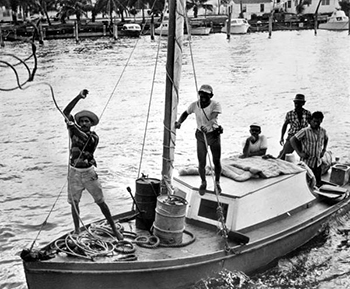
Cuban refugees arriving in Miami, Florida (1962)
The Immigration Debate We Need
Op-Ed by George Borjas, The New York Times, February 27, 2017
The first month of the Trump administration has already changed the direction of the immigration debate, with many more changes coming soon. So far, executive orders and deportations dominate the discussion. But the fight over how many refugees to admit or how best to vet those refugees obscures what the debate is really about.
Changes in social policy do not make everyone better off, and immigration policy is no exception. I am a refugee, having fled Cuba as a child in 1962. Not only do I have great sympathy for the immigrant’s desire to build a better life, I am also living proof that immigration policy can benefit some people enormously.
But I am also an economist, and am very much aware of the many trade-offs involved. Inevitably, immigration does not improve everyone’s well-being. There are winners and losers, and we will need to choose among difficult options. The improved lives of the immigrants come at a price. How much of a price are the American people willing to pay, and exactly who will pay it?
This tension permeates the debate over immigration’s effect on the labor market. Those who want more immigration claim that immigrants do jobs that native-born Americans do not want to do. But we all know that the price of gas goes down when the supply of oil goes up. The laws of supply and demand do not evaporate when we talk about the price of labor rather than the price of gas.
Over the past 30 years, a large fraction of immigrants, nearly a third, were high school dropouts, so the incumbent low-skill work force formed the core group of Americans who paid the price for the influx of millions of workers. Their wages fell as much as 6%. Those low-skill Americans included many native-born blacks and Hispanics, as well as earlier waves of immigrants.
But somebody’s lower wage is somebody else’s higher profit. The increase in the profitability of many employers enlarged the economic pie accruing to the entire native population by about $50 billion. So, as proponents of more immigration point out, immigration can increase the aggregate wealth of Americans. But they don’t point out the trade-off involved: Workers in jobs sought by immigrants lose out.
Moreover, immigrant families, mostly because of their relatively low incomes and higher frequency of participating in government programs like subsidized health care, are a fiscal burden.
The immigration debate will also have to address the long-term impact on American society, raising the freighted issue of immigrant assimilation. In recent decades, there has been a noticeable slowdown in the rate at which the economic status of immigrants improves over time. In the 1970s, the typical immigrant could expect a substantial improvement relative to natives over his or her lifetime. Today, the economic progress of the typical immigrant is much more stagnant.
Part of the slowdown is related to the growth of ethnic enclaves. New immigrants who find few ethnic compatriots get value from acquiring skills that allow more social and economic exchanges, such as becoming proficient in English. But new immigrants who find a large and welcoming community of their countrymen have less need to acquire those skills; they already have a large audience that values whatever they brought with them. Put bluntly, mass migration discourages assimilation.
The trade-offs become even more difficult when we think about the long-term integration of the children and grandchildren of today’s immigrants. Many look back at the melting pot in 20th-century America and assume that history will repeat itself. That’s probably wishful thinking. That melting pot operated in a particular economic, social and political context, and it is doubtful that those conditions can be reproduced today.
Similarly, the ideological climate that encouraged assimilation back then, neatly encapsulated by our motto “E pluribus unum” (Out of many, one), is dead and gone. A recent University of California directive shows the radical shift. The university’s employees were advised to avoid using phrases that can lead to “microaggressions” toward students and one another. One example is the statement “America is a melting pot,” which apparently sends a message to the recipient that they have to “assimilate to the dominant culture.”
We, Americans, need to confront the trade-off between short-term economic gains and the long-term costs of a large, unassimilated minority. This is a first step toward a more sensible immigration policy. We also need some general principles, combining common sense and compassion.
No matter where one stands in the ideological divide, President Trump has already answered the fundamental question guiding the design of a more rational policy. In his speech at the Republican National Convention, he described how he would pick among the available choices: “We are going to be considerate and compassionate to everyone,” he said. “But my greatest compassion will be for our own struggling citizens.” He added, “We are going to have an immigration system that works, but one that works for the American people.”
Many of my colleagues in the academic community — and many of the elite opinion-makers in the news media — recoil when they hear that immigration should serve the interests of Americans. Their reaction is to label such thinking as racist and xenophobic, and to marginalize anyone who agrees.
But those accusations of racism reflect their effort to avoid a serious discussion of the trade-offs. The coming debate would be far more honest and politically transparent if we demanded a simple answer from those who disagree with “America First” proposals: Who are you rooting for?
George Borjas is a professor of economics and social policy at the Harvard Kennedy School and the author of, most recently, « We Wanted Workers: Unraveling the Immigration Narrative.”
 The CONDORCET