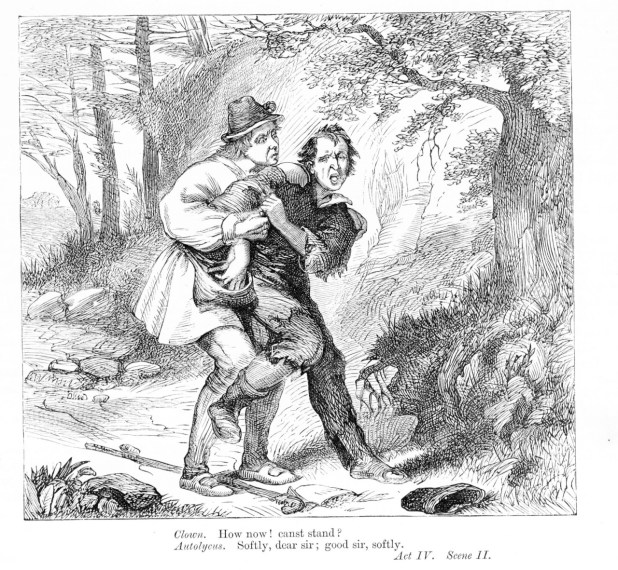
Illustration by HC Selous, published in « The Plays of William Shakespeare » (1868)
Act IV, Scene 3 is the first main scene in the play to actually represent Bohemia’s pastoral setting (the previous one, between Polixenes and Camillo, taking place at the King’s court), and it is particularly significant that it should be such a farcical one, marking the play’s complete shift from the wintry and the tragic to a rejuvenating sense of playful light-heartedness.
The scene first focuses on the character of Autolycus who enters the stage singing a bawdy ballad (the first of the six songs that he sings in the whole play), a cheerful celebration of his lubricious, mischievous, happy-go-lucky self. A former servant of Prince Florizel’s who was dismissed because of some wrongdoing, he became a wanderer, a thief and a confidence man that delights in preying on the gullible. On cue, the perfect prey enters the stage: the Clown – whom we had last seen 16 years before, as he and his father were discovering the infant that would become his foster sister, i.e., Perdita – walks in, doing his best to calculate the money he has made from the shearing of his sheep, and going through the shopping list young Perdita has given him for the upcoming feast. Autolycus does not miss this golden opportunity: making him believe that he has been beaten and robbed by a thief, Autolycus tricks the Clown into assisting him to his feet and picks his pocket. [1]

Autolycus, played by Richard McCabe, enters the stage hanging from a bunch of balloons, in the RSC’s 1992 production directed by Adrian Noble.
Along with the Clown himself and, most of all, Paulina, Autolycus is one of the very few characters in the play that were not already part of Robert Greene’s romance Pandosto (1588), but are Shakespeare’s invention. The character is a barely realistic one. He enters the stage, out of the blue, as it were, and his actions are far from being central to the plot. Still, a great deal of the play’s comic force is generated by him, through him, a catalyst, so to speak for the Bohemian scenes’ playful tone, which stands in sharp contrast with the pathos and morbidity that prevail in the first half.
The character of Autolycus is partly a social type, inspired from the London rogues that roamed the city in Shakespeare’s time. But the contrast between Autolycus and the Clown is topical on two other levels. On one level, the former comes out as the embodiment of the cynical, corrupt townsman and (fallen) courtier vs. the gentle, innocent country folk. And yet the scene’s insistence on his precarious status as a wanderer (ll.17-21) vs. the abundant profit the Clown makes out of the sheep business somewhat reverses the power relationship between the two, pitting Autolycus as something of a champion of the poor, downtrodden folk vs. the emergent rural bourgeoisie. [2]
Most of all Autolycus is a literary type the Elizabethan audience, particularly the groundlings, were well acquainted with, a type associated to the buffoonish, slapstick humour of the Commedia dell’arte [3], in this case the set scene of the “simple cheat” involving a trickster and his slow-witted victim. Autolycus evokes the Harlequin figure, the witty, mischievous and lustful servant/adventurer, with his signature chequered costume (symbolizing his protean, kaleidoscopic self), who divides his time between duping his social superiors (or masquerading as them) and pursuing the favours of females like the beautiful Columbina.
Finally, the character of Autolycus should also be interpreted in light of Shakespeare’s rich gallery of Fools (i.e., characters of lower extraction endowed with a falsely innocuous ability to outwit characters of higher social standing and speak truth to power, like the jesters of medieval courts), including the characters of The Fool in King Lear, the Gravedigger in Hamlet, Touchstone in As Like You It, Fasltaff in Henry IV, Puck in A Midsummer Night’s Dream, Feste in Twelfth Night, a majority of whom were written for Robert Armin, the King’s Men’s foremost comic actor.
From a functional perspective, the playful, self-reflexive quality of the character of Autolycus is emphasized by the very fact that he begins his life on stage through a soliloquy, which allows him to immediately create a bond of complicity with the audience. This bond strengthens more and more as his role is written so that he may constantly play to the audience, constantly breaking the « fourth wall, » as it were, at the other characters’ expense. In this scene, the exchanges between Autolycus and the Clown rely on a series of dramatically ironic mechanisms that culminate with the naive Clown offering his tormentor money he does not realize he no longer has (ll.77-78) which said tormentor must, of course, refuse, lest his guardian angel should realize his pocket has been emptied… [4] Adding insult to injury, he eventually warns the Clown about the thief that he pretends has beaten and robbed him, a man whom he portrays as no other than himself.

Autolycus, played as a faux-hippie by Derek Smith, dances with Mopsa (Susan Sheers) and Dorcas (Lisa Harrow) in Act IV Scene 4 in the RSC’s 1969 production directed by Trevor Nunn
From a symbolical perspective, Autolycus is to be interpreted as the rumbustious embodiment of the life principle associated to Bohemia. He is a Satyr-like creature of the flesh, of pleasure and appetite, whose ballad is the manifesto of his carefree, libidinous approach to existence, his indifference to morality, guilt, remorse, retribution or even the afterlife. (ll.29-30) This subversive, if not sacrilegious dimension in the scene is heightened by how much the scene reads as a parody of the parable of the Good Samaritan (See: Luke 10:25-37), just as Autolycus himself eventually pokes fun at the parable of the Prodigal Son (Luke: 15-11: 32). (ll.94-95) The sense of freedom that emanates from the character is also conveyed by the very genre of the ballad that he performs on stage, the abundant bird imagery that he resorts to, the playful representation of sexuality that he is championing – as opposed to Leontes’ symbolical, if not physical emasculation in the first half of the play, as well as the jealous, morbid, flesh-hating diatribes that the King carries on launching into.

Ethan Hawke as Autolycus in Sam Mendes’s ‘Bridge Projet’ production at the Old Vic in 2009.
The wandering minstrel Autolycus is reminiscent of such illustrious popular bards, adventurers and thieves as the French poet François Villon, but, as many critics have suggested, he even comes out as an image of the dramatist Shakespeare himself. [5] At the very least, Autolycus’s characterization as a « con man » makes him the quintessential Shakespearean actor/artist, a conjurer of fictional identities, a master of illusion, a teller of tales. [6] Again, it is no coincidence that he and Paulina are Shakespeare’s main contributions to Robert Greene’s story, for both allow him to dramatize some of his most cherished meta-fictional themes: the subtle, ambiguous boundaries between truth and appearance, and the demiurgic power of art.
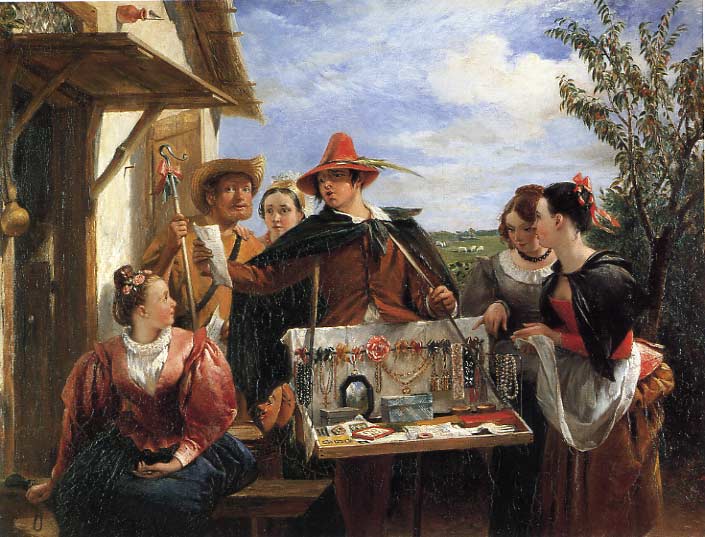
Charles Robert Leslie, Autolycus (1836) (inspired from the character’s arrival at the feast, disguised as a peddler, in Act IV, Scene 4)
[1] This is just the first of the three times Autolycus will succeed in swindling the Clown in the play, each time under a different guise and identity.
[2] Bear in mind that, in medieval and early modern England, the Whitsun feasts (around which the play’s Bohemian scenes revolve) included rustic performances, May-games, as well as Robin Hood plays, which is echoed both by Autolycus’s roguishness and the carnivalesque, anti-authoritarian atmosphere which prevails in the whole of Act IV Scene 4.
[3] The Commedia dell’arte is the popular repertory of the 16th century professional troupes of travelling actors in Italy, whose basic plots, improvisation, mimes, and stock characters influenced the evolution of modern comedy all across Europe. These stock characters include the trickster Harlequin, as well as the two other wily servants Brighella and Pulcinella, the clown Scaramouche, the more melancholy Pierrot, the beautiful Columbine, the greedy old Pantaloon, the foolish old Il Dottore, the braggadocio Il Capitano, etc.
[4] In the 1999 RSC production, the actor (Ian Hughes) overplays the role of Autolycus with great comical exuberance, gesticulating, shrieking, constantly changing the pitch of his voice, and, not content with picking the Clown’s pockets, going so far as to nick his jacket and trousers (without the Clown being aware of it, of course).
[5] The British poet Louis MacNeice (in « Autolycus, » 1947) and the American poet WH Auden (in « Forty Years On, » 1968) themselves wrote poems making this suggestion.
[6] Remember that, in Greek mythology, Autolycus is the son of Mercury, the god of thieves, the messenger of the gods, but also the god of eloquence and inventor of the lyre, who gifts Apollo (to whom Florizel will be associated in the next scene) with his very first one.
 The CONDORCET