—
Evangelicals Ignore G.O.P. by Embracing Syrian Refugees
By Richard Fausset and Alan Blinder, The New York Times, September 6, 2016
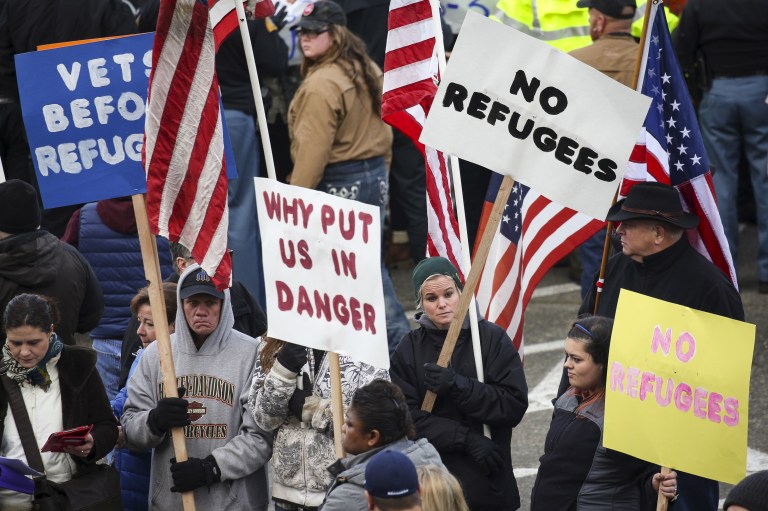
William Stocks, a white, Alabama-born, Republican-leaning member of the local Southern Baptist Church, arrived at the tiny apartment of a Syrian refugee family on a Wednesday night after work, eager to teach yet another improvised English lesson. Mr. Stocks, aged 23, recently moved to Georgia from Alabama, states where the governors are, like him, Southern Baptists, but are also among the more than 30 Republican governors who have publicly resisted the federal government’s plan to resettle refugees from Syria, fearing that these refugees might bring terrorism to their states. To Mr. Stocks, such questions belonged in the realm of politics and he had not come that evening for political reasons. Rather, he said, he had come as a follower of Christ.
Indeed, at a time when conservative politicians, many with ties to Christian groups, have aggressively sought to keep Syrian newcomers out, it is such conservative people of faith who serve as an indispensable support system. Here in Marietta, Georgia, the English lesson began around the donated kitchen table of Anwar and Daleen, two of the 10,000 Syrian refugees who have arrived in the US in the past year. Anwar and Daleen are Syrian Muslims who fled the bombings of their hometown, Tafas, in November 2012. They first crossed into Jordan, and, eventually, to this suburban sanctuary, where they settled in May in an apartment with their two children; a third child was born in August. Here, thousands of miles from civil war, they were still so fearful of reprisals against family members in Syria that they declined to be identified by their full names.
Speaking through an interpreter, Anwar, 33, and Daleen, 27, said they were aware of the politicians who oppose the arrival of Syrians. They mentioned Donald. J. Trump, the Republican presidential nominee, who has proposed barring all Muslims from entering the US. But their closest interactions with Americans have been largely with members of the Baptist Church, most of whom Republicans, like Mr. Stocks, who outfitted their tiny apartment, showed them how to navigate the grocery stores and even steered Anwar through the health care system as he prepares for heart surgery. “I have been here for four months,” Anwar said, “and I have seen nothing except goodness.” Of the politicians, he said he was not afraid: “I fear only God,” he said.
10,000 Syrian refugees had arrived by last month, which fulfilled a goal for the 2016 fiscal year that President Obama announced last September. Though they are a small fraction of the millions who have fled Syria, the concern among many conservative voters that the refugees could incubate domestic terrorism remains potent. Gov. Robert J. Bentley of Alabama and Gov. Greg Abbott of Texas have filed lawsuits challenging the Obama administration’s refugee policy. The Rev. Franklin Graham, a son of the Rev. Billy Graham, has said that he agreed with Mr. Trump’s idea of a ban on immigration by Muslims. In an interview last week, Graham said that he remained concerned about gaps in the screening process for refugees. “We’re not just leaving them on the side of the road, but we also care for this country and the people of this nation,” Mr. Graham said. “We have to put America first.”
His stance is at odds with some influential Christians, including the leaders of the Southern Baptist Churches. In June, they approved a resolution to “encourage families to welcome refugees into their churches and homes as a means to demonstrate to the nations that our God longs for every tribe, tongue and nation to be welcomed at his throne.” Officials at the NGOs that resettle refugees say members of the Mormon Church have also been helpful in resettling refugees in states like Utah, Texas and Arizona. Mormons historically tend to favor Republicans, but some polls in the spring showed Hillary Clinton, the Democratic candidate, tied with Mr. Trump in Utah, a state Democrats have not won since 1964. Mr. Trump’s position on Muslims may be a factor. In December, soon after Mr. Trump announced his idea for a Muslim ban, the Mormon Church issued a statement reasserting its commitment to religious liberty. On Monday, the church, responding to what it called “the global refugee crisis,” donated $2 million to groups that help resettle refugees.
In Marietta, Mr. Stocks has made some strides in the three months he has been teaching Anwar and Daleen, even though he has little experience as a teacher. (He is a project manager in construction.) On Wednesday, the couple wrote out the months of the year, recited their birthdays and responded to simple questions about their children. A yellow sticky note on the wall said “wall.” One on a door said “door.” Anwar was asked what he wanted to do after recovering from his heart surgery. “Work,” he said — any kind of work.
“These are the most hospitable and loving people you’ll ever meet, which is why it’s frustrating to see on the news that all these people are terrorists,” Mr. Stocks said. “They don’t know these people personally. »
—
REFUGEES AND ASYLUM-SEEKERS IN THE US: NOW AND THEN
Th US defines a refugee as any foreigner that is of special humanitarian concern to the US and “has a well-founded fear of persecution on account of race, religion, nationality, membership in a particular social group, or political opinion.” The difference between refugees and asylum seekers is that the latter claim asylum after they already are in the US or have crossed into the US via an airport or land border, while the former find themselves abroad when they apply for refugee status.
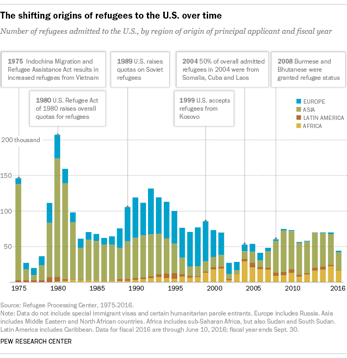
Over the past decades, natural disasters and conflicts all over the world have forced millions of refugees to seek shelter abroad, especially in Western countries. True to its origins as a haven for the religiously persecuted, the US has been particularly generous to refugees for much of its history. After WW2, the country took in some 500,000 displaced Europeans. After the fall of Saigon in 1975 it welcomed hundreds of thousands of refugees from Vietnam and Cambodia. Modern waves of refugees arriving in the US peaked in 1980 when President Jimmy Carter signed the US Refugee Act, the year of Cuba’s Mariel ‘boat lift’ [1]: the law established the Office of Refugee Resettlement and raised overall refugee quotas. Later on, the George H.W. Bush administration increased levels of protection of Chinese nationals from deportation after the Tiananmen Square protests in 1989, and special efforts were also made for refugees from Europe fleeing political turmoil in the former Soviet Union and war in the Balkan area, those escaping the conflicts in Nicaragua and other Central American, as well as Haiti, in the late 1990s.
Thus, as a whole, the US has received more than 3 million refugees since 1975. Yet, refugee admittance dropped off steeply in the early 2000s. Fewer than 30,000 refugees were let into the US each year in 2002 and 2003, down 60% from pre-9/11 levels. Upticks in the numbers did come in the following years, with a wave of Somali, Burmese and Bhutanese refugees. But in 2015, the US still ranked only 14th worldwide in the number of refugees it hosted, with just 267,174 people (against almost 2 million in Turkey, which has the highest raw numbers), i.e., less than 1% of the nation’s population (against 20% in Lebanon).
One of the explanations for these small numbers is geography. Indeed, countries facing the biggest impacts from refugees today are those closest to political or war-torn instability, especially in North Africa and the Middle East. Since 2011, the civil war in Syria alone has displaced 12.5 million people. Still, the US too has plenty of conflicts in its own Central American ‘backyard,’ and its small numbers are also a matter of political choice. Between 2012 and 2015, the US actually capped the annual number of refugees it accepted at 70,000. In September 2015, Secretary of State John Kerry did announce the US would resettle 85,000 refugees in the coming year and 100,000 in 2017, marking a significant improvement. Among them, the administration pledged to resettle 10,000 Syrian refugees: the final number eventually reached 12, 587, making Syrians the second largest origin group after refugees from the Democratic Republic of the Congo (16,370).
Eventually, California, Texas and New York alone resettled 20,738 refugees, i.e., about a quarter of the 85,000. Then came Michigan, Ohio, Arizona, North Carolina, Washington, Pennsylvania and Illinois, which each received 3,000 or more refugees. At the other end of the spectrum, Arkansas, the District of Columbia and Wyoming resettled fewer than 10 refugees each, while two states – Delaware and Hawaii – took in none at all. In terms of refugees resettled per capita, it was Nebraska (76), North Dakota (71) and Idaho (69) that resettled the most refugees per 100,000 residents.
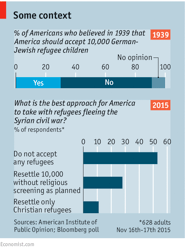
The main factor responsible for the change in policy is that 9/11 has changed the perception of refugees from vulnerable to threatening, especially among Republicans leaders and voters. Typically, days after the terrorist attacks in Paris in November 2015, more than 30 Republican governors (and one Democrat) took the decision of suspending the resettlement of Syrian refugees: the move was unconstitutional, but it revealed the increasing animosity against refugees among American people, especially Muslim refugees from the Middle East and fear about what some conservative commentators have dubbed “refujihadis”… Though as can be seen in the poll presented below, whose results are compared to those concerning Jewish refugees in 1939, this ambivalence is far from being unprecedented in American history. Indeed, fear of refugees is not new: in 1939, the US turned away more than 900 Jews fleeing Nazi Germany because of worries that some might be spies, conspirators or Communists; more than a quarter of those refugees dies in the Holocaust…
Sadly, as was the case then, current suspicions against refugees are disconnected from facts today too. For one thing, these suspicions ignore the rigorous screening process refugees are submitted to. Indeed, refugees must apply for resettlement at American embassies or through the United Nations, and then go through a process that is more thorough than for any other foreign traveller, and that may take as long as three years, sometimes longer, including background checks by the State Department, the Department of Homeland Security and the FBI, as well as defence and intelligence services.
For resettlement in the U.S., the International Organization for Migration and U.S. Office of Refugee Resettlement then work with voluntary agencies like the International Rescue Committee or Church World Service. These voluntary agencies have offices across the country, dispersing refugees across many states. For example, Church World Service has resettlement programs in 21 states, while the International Rescue Committee has resettlement programs in 15 states. Once resettled, local nonprofits such as ethnic associations and church-based groups help refugees to learn English and job skills. After 90 to 180 days, financial assistance from federal agencies stops and refugees are expected to become self-sufficient.
Out of the 800,000 refugees that came to America between 9/11 and late 2015, only two were arrested on terrorism-related grounds (two Iraqis in Kentucky) and none were charged with trying to commit an attack in the country. [2] In fact, not only have no refugees been responsible for any terrorist act on American soil, but almost every terrorist attack since 9/11, as well as most of the attacks that were disrupted in advance, were committed by an American citizen or a green card holder who had been in the country for a decade or more, including Omar Mateen, the gunman claiming allegiance to the Islamic State who killed 49 people in a gay club in June 2016 (he was born in Queens). That means that the attackers were largely radicalized in the US and that there is no evidence that halting the flow of refugees might have any effect.
[1] In April 1980, Fidel Castro announced that Cubans who wanted to leave the island were free to go, provided that they left by the port of Mariel: some 125,000 Cubans – dubbed marielitos – thus took up his offer that year, most of them heading for Miami.
[2] There had been several cases of terrorism or attempted terrorism involving refugees before 9/11, though, such as the case of a Somalian refugee who entered the country in 1999 and participated to the 2004 Ohio shopping mall bombing plot.
 The CONDORCET