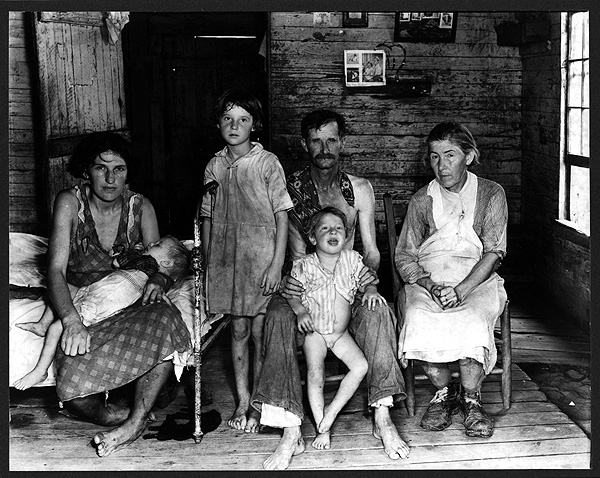
‘Bud Fields and his Family at Home’: photograph by Walker Evans (from: Let Us Now Praise Famous Men, w. James Agee, 1941)
—
The Republican Party’s Strategy to Ignore Poverty
By Eduardo Porter, The New York Times, October 27, 2015
Arizona in July became the first state to cut poor families’ access to welfare assistance to a maximum of 12 months over a lifetime. That’s a fifth of the time allowed under federal law, and means that 5,000 more people will lose their benefits by next June. This is only the latest tightening of the screws in the state. Last year, about 29,000 poor families received benefits under the Temporary Assistance for Needy Families program, 16,000 fewer than in 2005. In 2009, in the middle of the worst economic downturn since the Depression of the 1930s, benefits were cut by 20%. And if Paul Ryan, the Republican lawmaker from Wisconsin who is expected to become Speaker of the House, has his way, poor people in many other states can expect similar treatment in the years ahead.
A bit of history is necessary to understand how we reached this point. Two decades ago, when the Clinton administration agreed with a Republican-controlled Congress to “end welfare as we know it,” Washington replaced the poor’s entitlement to aid from the federal government with a fixed block grant to states. The states were given great flexibility about how to spend the money. And for all the initial enthusiasm for the idea, welfare reform has fallen far short of the claims of its supporters.
Nonetheless, the block grant approach has emerged as the central plank of the Republican strategy to confront America’s intractable poverty. Nearly all of the party’s main presidential candidates are expected to show up in January at the Republican poverty summit meeting in Columbia, South Carolina, organized by Mr. Ryan, who has laid out detailed plans to overhaul what remains of the American social safety net. Last year, he put forth an “opportunity grant,” a block grant to replace just about everything else the federal government provides lower-income people — not just TANF, but also food stamps, housing assistance and energy aid — into one dollop of money. The main exceptions would be Social Security and the earned-income tax credit.
For all the talk about creating opportunity for the poor, it’s hard to view these plans as anything but a bald effort to save money. But don’t just take my word for it. Take it instead from Peter Germanis, one of the White House advisers who helped write President Ronald Reagan’s welfare reform proposal of 1986, called “Up From Dependency.” He has been affiliated with the Heritage Foundation and the American Enterprise Institute, both conservative advocacy and research organizations in Washington. Over the summer, Mr. Germanis published a startling confession. Writing “as a citizen and in my capacity as a conservative welfare expert,” he apologized for whatever role he may have had in the welfare reform enacted in 1996. “To the extent that anything I ever wrote contributed to the creation of TANF or any block grant, I am sorry,” he wrote. “As I hope to demonstrate in this paper, a block grant for a safety net program is bad public policy.”
And he does. Among the easier charges to make against the Needy Families block grant is that it was not meant to adjust for inflation. It was $16.5 billion two decades ago; it is $16.5 billion today. According to the Center on Budget and Policy Priorities, it has lost more than a third of its buying power. What’s more, states were given both incentives and tools to redeploy the money to other priorities.
Arizona is a prime example of what has happened in states where Republicans rule. By now, only about nine out of every 100 poor families benefit from the cash welfare program, down from 55% two decades ago. This has nothing to do with the program’s objective of helping poor adults with children escape the stigma of welfare and get a job, still the best antipoverty tool there is. Arizona simply needed the money for something else. Specifically, as noted in a report by researchers at Arizona State University’s Morrison Institute for Public Policy, the state, facing a huge jump in the number of neglected children put in foster care, needed more money to fund child protection, foster care and adoption services. Rather than ask state taxpayers to help fill the gap, lawmakers took it from the pockets of poor people.
On average, states use only about a half of their funds under the TANF program to fund its core objectives: Provide the poor with cash aid or child care, or help connect them to jobs. Ending the poor’s entitlement to government aid is counted as a success because it has reduced the rolls of people on welfare. But that is not the same as helping the poor get a job, overcome dependency and climb out of poverty. Today only 26% of families with children in poverty receive welfare cash assistance. This is down from 68% two decades ago. And it’s not as though there are no more poor people in America. In 2012, one out of five households receiving food stamps reported no other source of income. Millions more scrape by on modest assistance and low-paying jobs. But by making the poor almost exclusively the responsibility of the states, our national politicians can claim the problem has been solved.
 The CONDORCET