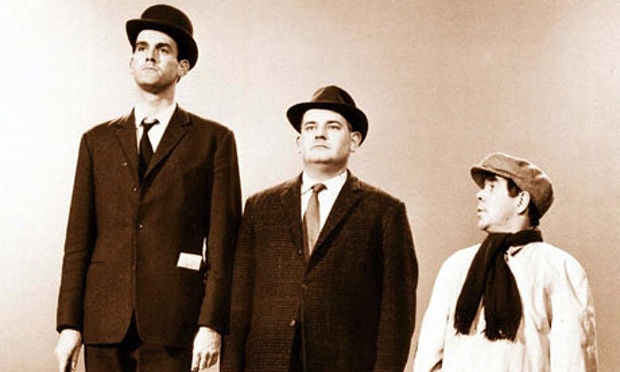
Comedians John Cleese, Ronnie Barker and Ronnie Corbett pictured lampooning Britain’s obsession with social class on the Frost Report, a satirical TV show, in 1966.
—
—
Inequality is ruining Britain – so why aren’t we talking about it more?
By Alex Proud, The Daily Telegraph, 4 May 2015
The Sunday Times Rich List is all that is wrong in Britain. True enough, 15 years ago, I quite liked the list, which combined fairly rigorous methodology with being the financial equivalent of a gossip magazine. “Oh,” you’d say, “look at that Richard Branson, he’s down ten places.” The next day, the Rich List would be fish wrapping and you’d forget all about extremely wealthy people for another year. But that was then. These days, every day is Rich List day. Every day is an uncritical celebration of wealth. In modern Britain being rich is everything. It’s the only thing. And as we’re about to go into a general election, it’s worth picking out a few rich facts from the rather breathless commentary that accompanies the list.
The Rich Listers are over 100% better off than they were 10 years ago, this despite most of the decade being taken up by the worst recession since the 1930s. By contrast, the average Briton is only as well off as they were before the financial crisis. To my mind this is the biggest issue facing the UK today. It’s the corruption of reasonably “fair” market capitalism and our return to the Robber Baron capitalism of the late 19th century. It’s the vast and growing disparity in wealth.
The Financial Times’ Martin Wolf, hardly a man given to socialist hyperbole, wrote last week, “To my mind, the fundamental domestic challenge confronting the UK is that of creating a dynamic and stable market economy whose benefits are also widely shared.” Nowhere is this more true than in London, the epicentre of the great British inequality explosion. A recent report by the charity Shelter revealed that there were 43 suitable properties in London available that were “affordable” for a young family buying their first home. Wow. If I was mayor and this had happened on my watch, I’d probably hang my head in shame and go away to think about how abysmally I had failed the citizens of the city I was elected to represent. Fortunately Boris is made of sterner stuff. In the past he’s told us that rather than resent the super rich, we should describe them as “tax heroes” and give then knighthoods.
Outside the global capital of Richistan, in the forgotten, neglected provinces, all these problems still resonate. Despite all Osborne’s guff about his Northern Powerhouse, the country is run for the City, and the parts of the UK far from London can feel a bit like southern Europe – saddled with an economic policy that ill suits them, like a sort of rainy Portugal.
After the crash of 2007, we might reasonably have expected some sort of rebalancing, some sort of watered down New Deal. Instead, following the Americans’ lead, we bailed out the banks with no real strings attached. And we continue to provide billions in what the IMF describes as implicit subsidies to the big banks despite contempt for the societies they operate in.
One of the things I secretly admire about the Conservatives is their total inability to join the simplest sequence of dots when they conflict with their ideology. Unfortunately, this often inflicts huge costs on the country. A great example of this thinking was saving a few million by cutting spending on youth services… And then watching London riot a year later. Figures for the cost of the riots to the taxpayer run between £100m and £300m.
In a similar vein, many Tories are still wondering where UKIP came from. Being able to connect dots, I can tell them. And it’s not from not being right wing enough. It’s not even really about Europe. UKIP appeared because the Tories stopped being One Nation Tories. When people see their living standards slip continually, that’s where nationalist and xenophobic parties make hay Anyone with a passing acquaintance with history will tell you this. The real solution to UKIP, of course, is make these people feel that they matter. And you do that by making sure the benefits of the market are more widely shared.
I’m going to end on a very small positive note, though. There are a few things that give me hope that our tolerance of ultra wealthy parasites may be ebbing. The first is that people still hate the bankers. This is as it should be because the City has never apologised or even thanked us. Secondly, there’s Starbucks and the rise of tax shaming. We need more of it. We need to rediscover our disdain for ill-gotten gains – and those who’ve gotten them. Instead of just saying that being rich is brilliant, we should celebrate what people have done, rather than the money they’ve made. If you’ve built up a big company or invented something, fantastic, being rich is a nice by-product. If you were in the right place to loot the Russian treasury, inherited millions in property or played around with financial instruments, not so much.
Alex Proud is a gallerist and club owner and regular columnist for The Daily Telegraph.
***
 The CONDORCET