—
—
Bagehot: Physician, heal thyself
The Economist, October 24, 2015
Jeremy Hunt’s battle with junior doctors exposes an awkward truth: Britons do not love the NHS
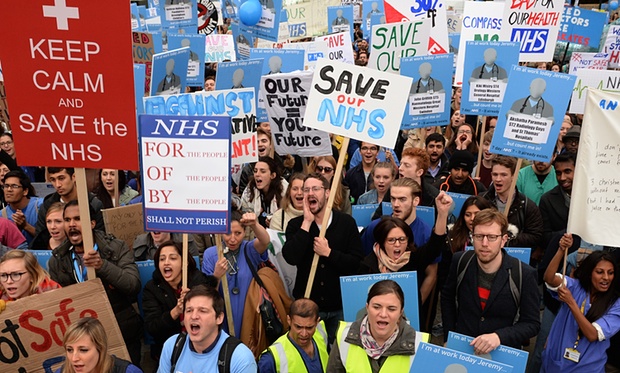
Medics are not in the habit of applauding lawyers. But cheer they did in their thousands at a demonstration in London on October 17 as Peter Stefanovic, a medical-negligence lawyer, rasped his disapproval of the health secretary’s plans to reform junior doctors’ contracts: “Mr Hunt seems to believe that if he says the same thing over again, even if it’s bollocks, we’ll all believe it.” Many of these practical, mustn’t-grumble types (scrubs on, stethoscopes around their necks and children on their arm) had never demonstrated before. “The change in attitude has been astounding,” one obstetrician told Bagehot: “people who would never have discussed politics before are fired up.”
Something has snapped in the medical profession. Junior doctors work punishing hours in Britain’s strained National Health Service and fret about making bleary-eyed mistakes. Burnout is common. Unlike their counterparts elsewhere, they must pay for their own training, indemnity insurance, car parking and even hot drinks at work. Many are leaving for Australia and New Zealand, where conditions are better. For others, Jeremy Hunt’s proposals – under which “normal” working time will include evenings and Saturdays, reducing the top-up pay for extra hours – are the final straw. The British Medical Association (BMA), the doctors’ trade union, is balloting for a strike.
Calling for the health secretary to resign, as the BMA members do, is not constructive. On the central points, however, the junior doctors are right. Mr Hunt has scaremongered about the higher death rate in the NHS at weekends and his talk of a “seven-day NHS” has needlessly insulted doctors who already work seven-day weeks. Though the government is vague about the precise effect of the revised contracts, independent analysis suggests that pay cuts could hit most junior doctors and will almost certainly affect those in high-pressure fields with abnormal hours, such as accident and emergency, obstetrics and anaesthetics. Yet the doctors should not just blame the health secretary. On a deeper level, their beef is with the British public.
Though the health budget has been spared the cuts of the past years, it has remained flat at a time of rising pressures: the population is becoming older and fatter. Waiting lists have hit seven-year highs. A year ago Simon Stevens, the chief executive of NHS England, published an ambitious plan of reforms to do more with less, most of which involve stopping people from getting ill in the first place and diagnosing their problems faster. Another solution, propounded by Sir Bruce Keogh, the NHS medical director, is to expand evening and weekend services in order to cut waiting lists and make better use of operating theatres.
But as both Sir Bruce and the board advising the government on NHS pay have argued, it will also cost more money. Of that there is little. In England, the service faces a £30 billion shortfall by 2020. The government is increasing spending by £8 billion but that still leaves £22bn of savings to be made. So the health secretary has to negotiate seven-day working with no extra money to oil the wheels.
The question is: is Britain willing to pony up? It is a cliché to talk of the NHS as the country’s secular religion, a service still adored in the context of the post-war era in which it was born. But as the collectivist afterglow of that age fades, each generation is less misty-eyed than the last. Britons’ purported love affair with the NHS has become transactional. They are horrified by America’s private insurance system and like the services that they use, but less out of “love” than out of a baser enthusiasm: for good stuff at low cost. Typically, 72% of Britons think the NHS should provide all drugs and treatment at any cost, but only 38% are willing to pay more tax for it. The junior doctors are caught between those figures.
A reality check is thus long overdue. The new Conservative government has a majority and faces a Labour opposition ineffectual in most respects and especially on health. So let Mr Hunt, along with the Prime Minister and Chancellor of the Exchequer, confront voters with the truth: if Britons love their tax-funded health system so much and want it to work, they will have to pay more for it. And if not, they should start considering the alternatives: probably a social insurance system akin to that used elsewhere in Europe. It may be that a more individualistic, consumerist country simply needs a more individualistic, consumerist health service; one of personal accounts, more choice and clearer rights and responsibilities. Perhaps it is time for that divorce.
***
 The CONDORCET